
Courtesy | Unsplash
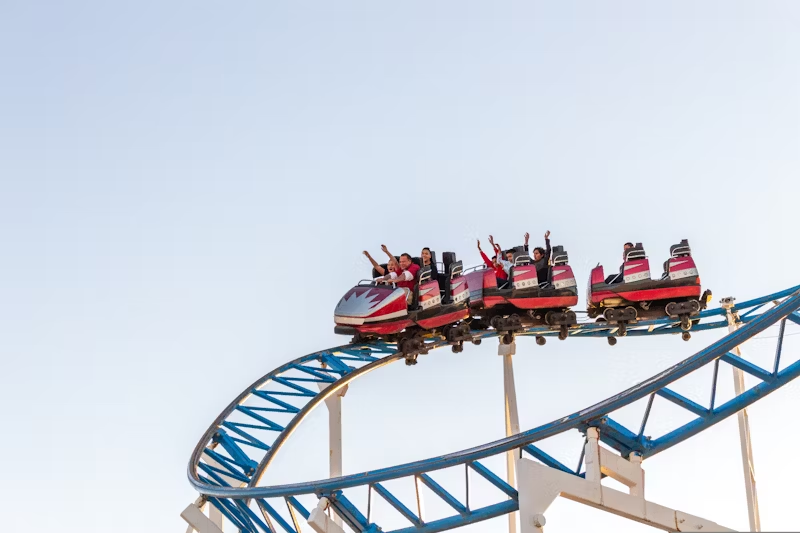
Legoland, California — home to Project X, the world’s scariest roller coaster, with a drop the height of a skyscraper and turns sharper than my #2 pencil on exam days.
At least, that’s what I thought when I was 7.
Little Brennan watched the car zoom down the drop over the queue entrance, his heart straining to escape his throat each time he felt the roar of the coaster reverberate in his chest.
“Mom, I don’t wanna ride it,” he said. She looked at him with steely eyes and pointed to the line with a draconian finger.
“We’re going,” she ordered.
Further protests fell on deaf ears, and Little Brennan resigned himself to his premature end. In line, his visible dismay was a counterpoint to the eager smiles and impatient bouncing of other kids. Yet his parents held firm, knowing that this was an experience he needed. Too soon, he found himself harnessed into the death contraption, and the clicks of the chain lift yanked his car up the hill. Were those clouds below him? The drop loomed. He closed his eyes.
In no time, the car careened down the hill and completed its race around the whiplash-inducing turns. When the ride came to a stop, Little Brennan had a massive smile on his face. He had conquered Goliath.
Now I know that Project X (which was lamely renamed the “Lego Technic Coaster”) is a bog-standard wild mouse ride with a measly 50-foot drop. I’ve gone on to ride coasters with mind-bending inversions and drops measuring well over 200 feet. But when I was a kid, riding Project X allowed me to overcome my fear. It never would have been possible if my parents hadn’t made me ride.
Many parents cringe at the thought of forcing their kids to do anything, much less something “fun.” With the advent of techniques like “gentle parenting,” the idea of telling a child to do something they don’t like is repugnant to the cultural zeitgeist. This hesitancy does kids a disservice. They need to be challenged. Just because they won’t enjoy everything their parents make them do doesn’t mean they shouldn’t be made to do it. Nobody calls Child Protective Services when a mom forces her toddler to eat his vegetables. That’s because the screaming 2-year-old doesn’t know what’s good for him.
The same logic applies to that daunting roller coaster the kid is scared to try. While he can’t see past his fear, mom and dad know that on the other side of the terrifying wait, there’s an exhilarating ride their boy might love. Even if he doesn’t, at least he won’t have given in to that giant of doubt. If my parents hadn’t made me ride Project X, 7-year-old me would have left Legoland feeling like a failure because he hadn’t been able to conquer the “big ride.” It would have reinforced fear’s mastery over me, like a splinter driven deeper and deeper into my foot with every step.
This argument doesn’t come from a born thrill junkie either. I was a nervous child. Crying-on-the-bunny-hill-my-first-time-skiing-at-age-11 type nervous. Every successive leap into the unknown, whether it was at the amusement park, on the ski slopes, or even in the sports arena, required careful prodding from my parents, but I’m so grateful they pushed me further than I wanted to go. I owe my development in character and confidence to those experiences.
It’s not like you’re strapping a parachute onto your kid, saying “Good luck!” and chucking him out of a plane. Roller coasters are one of the safest ways to challenge your child. According to the International Association of Amusement Parks and Attractions, the chance of sustaining a serious injury on a fixed site ride is 1 in 15.5 million. The chance of being struck by lightning is 1 in 1.2 million. Statistics from the National Sporting Goods Association show that you’re more likely to get hurt fishing or playing golf than riding a roller coaster. If you want to be worried about something, worry about the drive to and from the amusement park, because there’s a much higher chance something will go wrong there than on a ride.
Two summers ago, my mom made my younger sister ride her first roller coaster with a loop, despite my sister’s tears of fear and protest. After the ride, she was laughing and giddily recounting every second of the experience. She isn’t nearly the roller coaster fan that I have become, but that was a core memory for her. Making your kid ride a roller coaster isn’t “forcing them to have fun” — it’s giving them a safe avenue to stare fear in the eyes and refuse to back down.
So stuff your kid’s hands, feet, arms, and legs inside the vehicle, because like it or not, they’re going to ride the roller coaster.
Brennan Berryhill is a junior studying English.
