
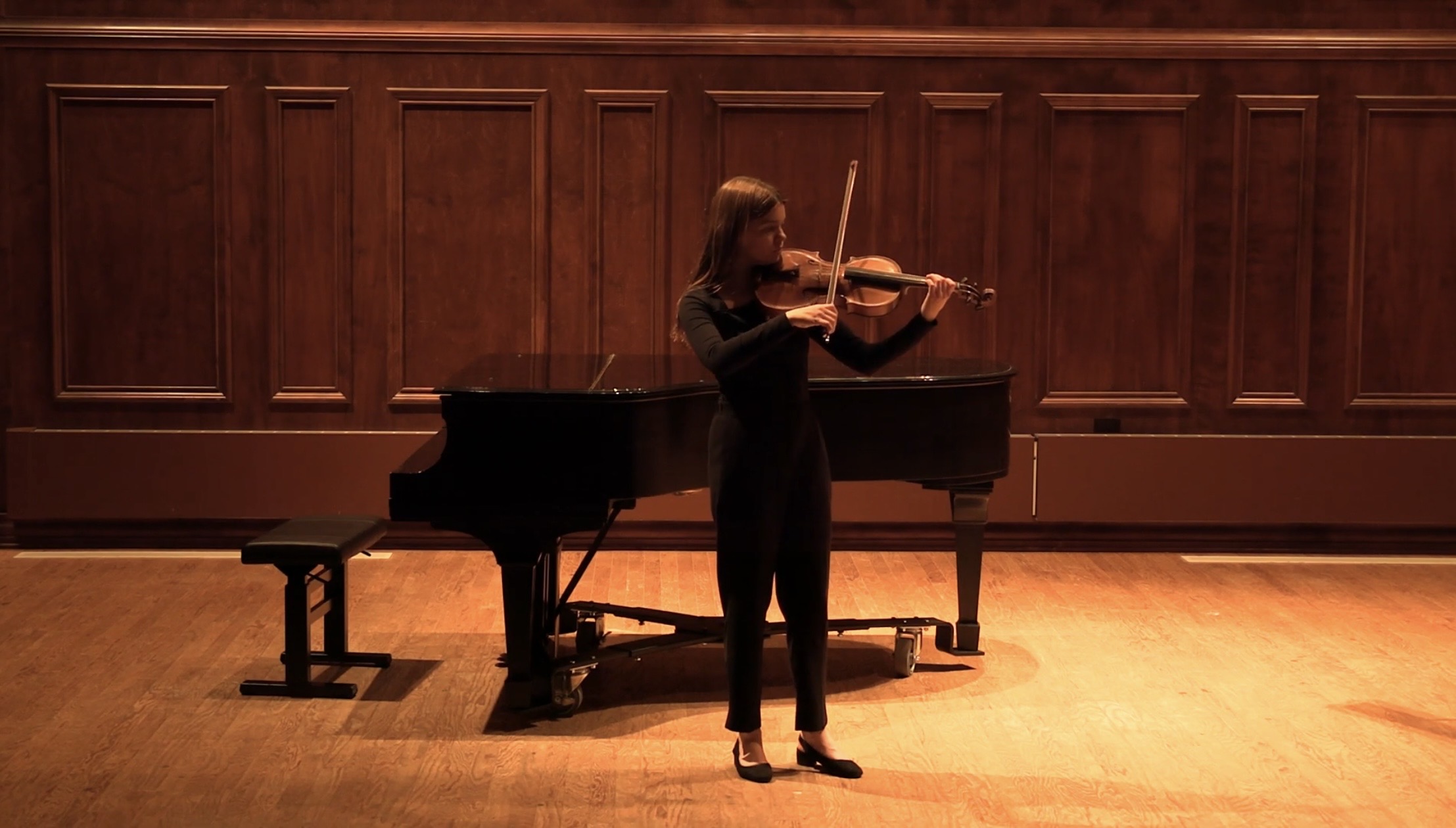
Peyrebrune began playing the violin at age 5 and switched to viola at 14.
Courtesy | Julia Peyrebrune
Sophomore Julia Peyrebrune is the first woman to get into Hillsdale’s Joy String Quartet, a scholarship-based ensemble founded in 2022 in Hillsdale’s music department.
Peyrebrune is joining a long line of professional musicians in her family, including her grandparents, parents, and some of her siblings. She plays viola in the Joy String Quartet and is pursuing majors in music and classics.
“She doesn’t have to have this manner of being aggressive, or anything like that, to overtake three guys with big personalities, because they all have big personalities, but it’s just great to see her quiet influence on that,” said Melissa Knecht, chairman and professor of music.
Peyrebrune’s parents are both classical musicians. Her dad is a double bassist in the Cleveland Orchestra and interim managing director of a smaller chamber orchestra in Cleveland called CityMusic. Peyrebrune’s mom is also a double bassist and teaches at both Oberlin Conservatory and the Cleveland Institute of Music.
“Her parents are important musicians. They’re not just musicians. They’re nationally recognized musicians. But Julia is a remarkable person of her own,” Knecht said. “She seems quiet, yet she holds her own, and she has a lot of strength.”
Peyrebrune’s maternal grandparents are also musicians; her grandfather played clarinet in the Houston Symphony, and her grandmother was a classical violinist. Her oldest sister is a professional cellist, and another sister and her husband just finished graduate school for music and are now taking orchestral auditions.
“I started when I was 5, and I started on the violin,” Peyrebrune said. “My parents have always had a rule that you have to play an instrument until you move out of the house or graduate.”
Peyrebrune picked the violin because she saw her older sister playing it. But when she turned 14, she added the viola after watching another sister perform on it many times.
“Everybody chose which instrument they wanted to play, which is nice, but I don’t know why we were allowed to choose as 4- and 5-year-olds,” Peyrebrune said.
Eventually, Peyrebrune stopped playing the violin and focused on the viola.
“The viola has a different role than the violin. A lot of the time it’s an inner voice, and it plays a more supporting role, but gets to hop around and do different jobs,” Peyrebrune said. “A lot of the time the violin has a more leading role or just plays melodic material the whole time, but there are exceptions.”
Peyrebrune plays almost entirely classical music, following the example of her family members who played before her.
“There’s centuries of classical music that have been written, and centuries of traditions of how people play. Also, the music is so precisely crafted in lots of ways that it’s inspiring to try and bring it to life,” Peyrebrune said. “A lot of times it’s dead white guys’ music, which I love, but since they put all this effort into crafting it, it’s fun to bring it to life and make it present in the world again.”
Growing up, the Peyrebrune siblings all took weekly music lessons, but in high school, Julia also got involved in a preparatory program at the Cleveland Institute of Music.
“I tried to quit for the first 10 years. I didn’t like it until I was a freshman or sophomore in high school,” Peyrebrune said. “I think it’s more fun the better you are at it. I got better, and so I got to be creative instead of just slaving away.”
At 15, Peyrebrune joined the Cleveland Orchestra Youth Orchestra.
“I did it for three years before I graduated, and that was my favorite part of those years, really,” Peyrebrune said. “I was really drawn to the combination of the community of people that were all really invested in this thing that we were doing together, and just the beauty of the things we got to do. We got to play some of the most amazing repertoire and classical music.”
Although balancing music and other aspects of her life can be difficult, Peyrebrune has made friends in the ensembles she did growing up and in those she has done at Hillsdale.
“There’s nothing more bonding than playing music with your friends,” Peyrebrune said.
In high school, Peyrebrune said she felt motivated to improve due to anxiety about how she ranked as a musician. In college, she said, her motivation has changed.
“I’m often in situations where I’m really inspired by the people that I’m playing with, and so I want to inspire them also and for it to be a collaboration, and not just me along for the ride, kind of doing my best,” Peyrebrune said. “Obviously, it’s not healthy to get a sense of worth from how well you play a little box. But also, it’s hard to let yourself relax in that way but still improve.”
In some ways, Julia has developed in her musical talent sooner than her father did when he was her age, according to Henry Peyrebrune.
“It’s a crucial step in anybody’s artistic development to go from playing for the approval of your parents, teachers, and peers, to go to playing for the music itself. That’s a really important milestone and transition to do that,” Henry Peyrebrune said. “It took me a long time to make that transition.”
Peyrebrune has a different perspective on music because of her familial ties to it.
“I think classical music is a world that’s hard to understand unless you’re in it. I’ve sort of got a behind-the-scenes look at different aspects of it too. Because I have an orchestral musician who’s a parent and a teacher, and she sees what all of her students deal with, and I know what it’s like for my siblings nowadays, trying to find a job or going through music school. And I’ve seen really great musicians,” Peyrebrune said. “I’ve just had a wide range of experience, and been able to see lots of different aspects of it.”
Music is a fundamental part of Peyrebrune’s education, but she knows that eventually it will not be a part of it, and her parents’ attitude toward their musical abilities inspires Peyrebrune to continue working hard.
“My mom is always practicing, always trying to improve. To see my parents constantly pursuing something better, and trying to get better at their craft is really inspiring to me right now,” Peyrebrune said.
Peyrebrune has six siblings who range from age 30 to age 10, so they did not often all play together since they are at such different stages of musicianship.
“We would play together for Christmas. We didn’t play a lot together, and when we did, tempers flared,” Peyrebrune said. “I was like, ‘I know you guys are all very professional and good colleagues, but all of us playing together right now is toxic.’”
Even though her family is made up of classical musicians, classical music is not their go-to music to listen to, according to Peyrebrune.
“My dad likes everything. He drove me to school a couple breaks ago, and it was silent in the car. He goes, ‘Hey, Siri, play Hannah Montana, the movie soundtrack.’ So we listened to that. It was great,” Peyrebrune said.
Peyrebrune said her approach to music has changed since she began college.
“I think there’s a culture in classical music, and also in my family, of saying yes to any opportunity to play that you get, which I think was probably good for me,” Peyrebrune said. “It helped me improve as a musician a lot. But it’s not a sustainable way to be a musician. So what has changed since college is choosing for myself the opportunities that I want to pursue, and also realizing that I have to be the reason I get better, and not some external force.”
