
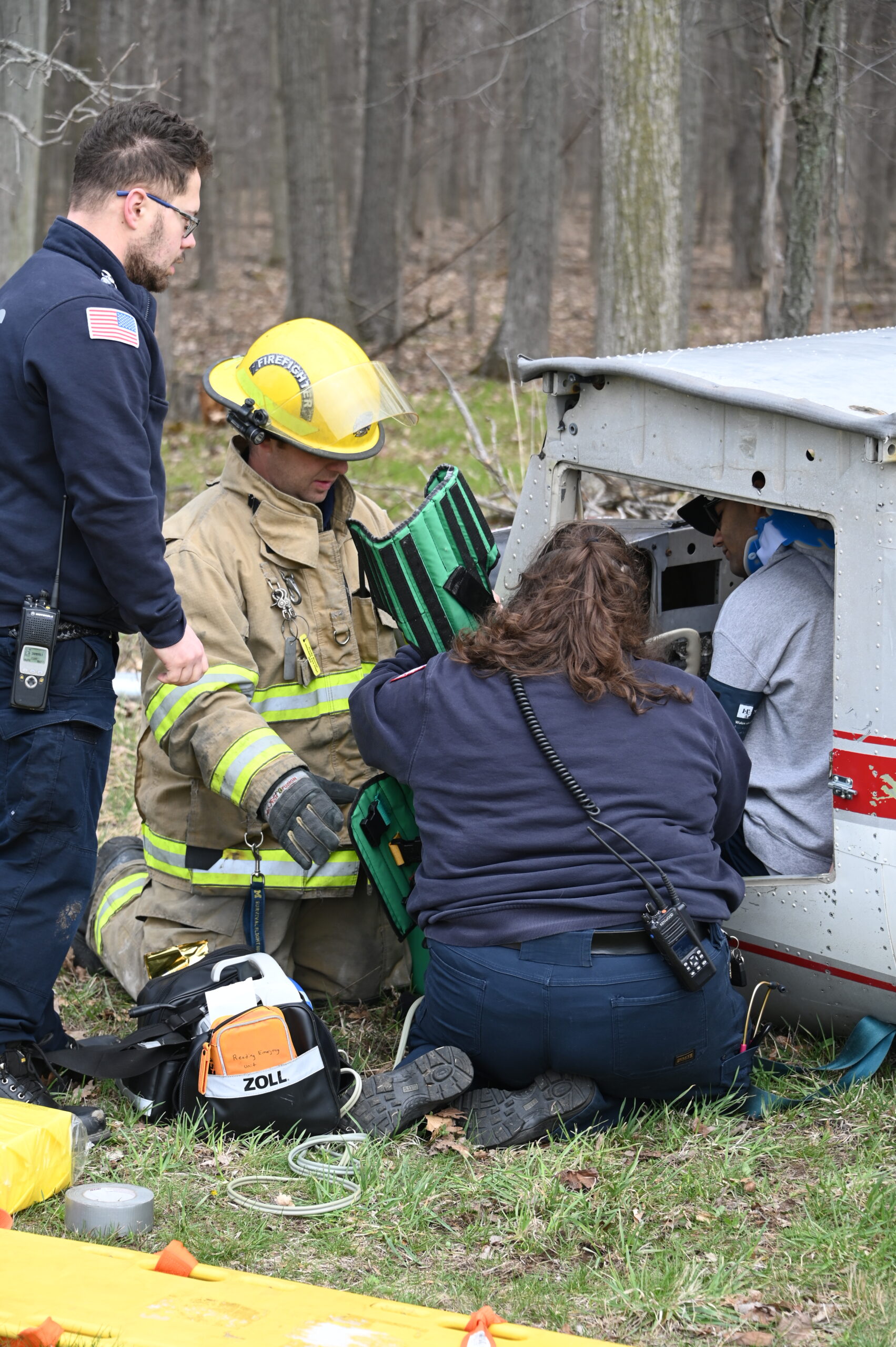
First responders practice helping a victim. Courtesy | Cassie Hambleton
The cockpit of an airplane lies at the edge of the woods. K-9 bloodhounds sniff the wreckage in search of survivors. A victim arrives on a stretcher, carried by EMS and firefighters into the back of an ambulance. Other firefighters stand close at hand, ready for action while the K-9 unit enters the woods in search of any other survivors.
This wasn’t a real plane crash — it was the first responder training at Hillsdale Municipal Airport April 12. The event, called Operation Classical, was hosted by the Hillsdale Composite Squadron of the Civil Air Patrol Michigan Wing and instructed different branches of first responders on how to work together to find the victims of a simulated plane crash.
Lt. Col. Richard King, the Michigan wing director of Homeland Security who coordinates with local emergency services, agencies, and emergency management in Hillsdale county, oversaw the training. King said he was looking for smoothness and continuity throughout the exercise.
“We train quite often throughout the state in different locations,” King said. “We like to say we train how we fight. So, we look for airplanes that are lost and missing persons, and the scenario that they have here involves a plane crash.”
Operation Classical revealed areas of weakness among the branches of first responders in coordinated emergency situations, according to Jason Lautermilch, the director of emergency management for Hillsdale County.
Lautermilch said this is the first exercise conducted by the Civil Air Patrol in this county. The fire and EMS agencies have not done a plane crash exercise like this before, he said.
“This is a good training opportunity for both sides, especially when it comes to working together to unify as one large group to address the situation,” Lautermilch said.
The difference between life and death in emergency situations can depend on how efficiently the team can coordinate. Efficiency requires preparation and repetition, according to Lautermilch.
“If you want people to be able to operate together on the day of the emergency, that means that they need to train together before that day arrives,” Lautermilch said.
Small details and issues present themselves through the exercise, according to Lautermilch.
“So the agencies that are practicing are addressing some of those details,” Lautermilch said. “They are making adjustments as far as what departments or agencies are dispatched, how they are dispatched, and going over the roles and responsibilities that the different personnel or agencies have.”
Lautermilch said this event makes first responders more efficient in an actual emergency and teaches them who has what resources and who takes on which responsibilities.
The training on April 12 focused on the responders finding the plane crash survivors.
Mark Hawkins, the deputy fire chief of the Hillsdale City Fire Department, said the exercise is a great way to work with other emergency departments. The emergency scenario is also very applicable to real life scenarios, Hawkins said.
“It is actually a pretty good one, because we have a fuselage that we got to extricate somebody out of,” Hawkins said.
Russell Bicek, the assistant chief of the Hillsdale City Fire Department, said this training, like any training, always helps.
“This is the one where we learn and we ask questions,” Bicek said
Bicek described the steps in this emergency process, revealing a complex system that would be difficult to execute without preparation.
“We did have people go into the woods a little bit deeper, and then we had to provide manpower to get that victim that was ejected from the simulated crash onto a backboard and carried out through the woods,” Bicek said.
Noah Wollet, the field supervisor and training officer of the Reading Emergency of Hillsdale County Michigian, said the training went well but showed him that more exercises like this need to take place.
“I think it was a very good learning experience of getting everybody together and working together,” Wollet said. “We don’t do it very often, so it is always fun and a good learning experience.”
Dallas Russell, the fire chief at North Adams Fire and Rescue, also sees the necessity of these training sessions.
“It is great to get the departments together and to train together,” Russell said. “That is something that does not happen as much as it should.”
