
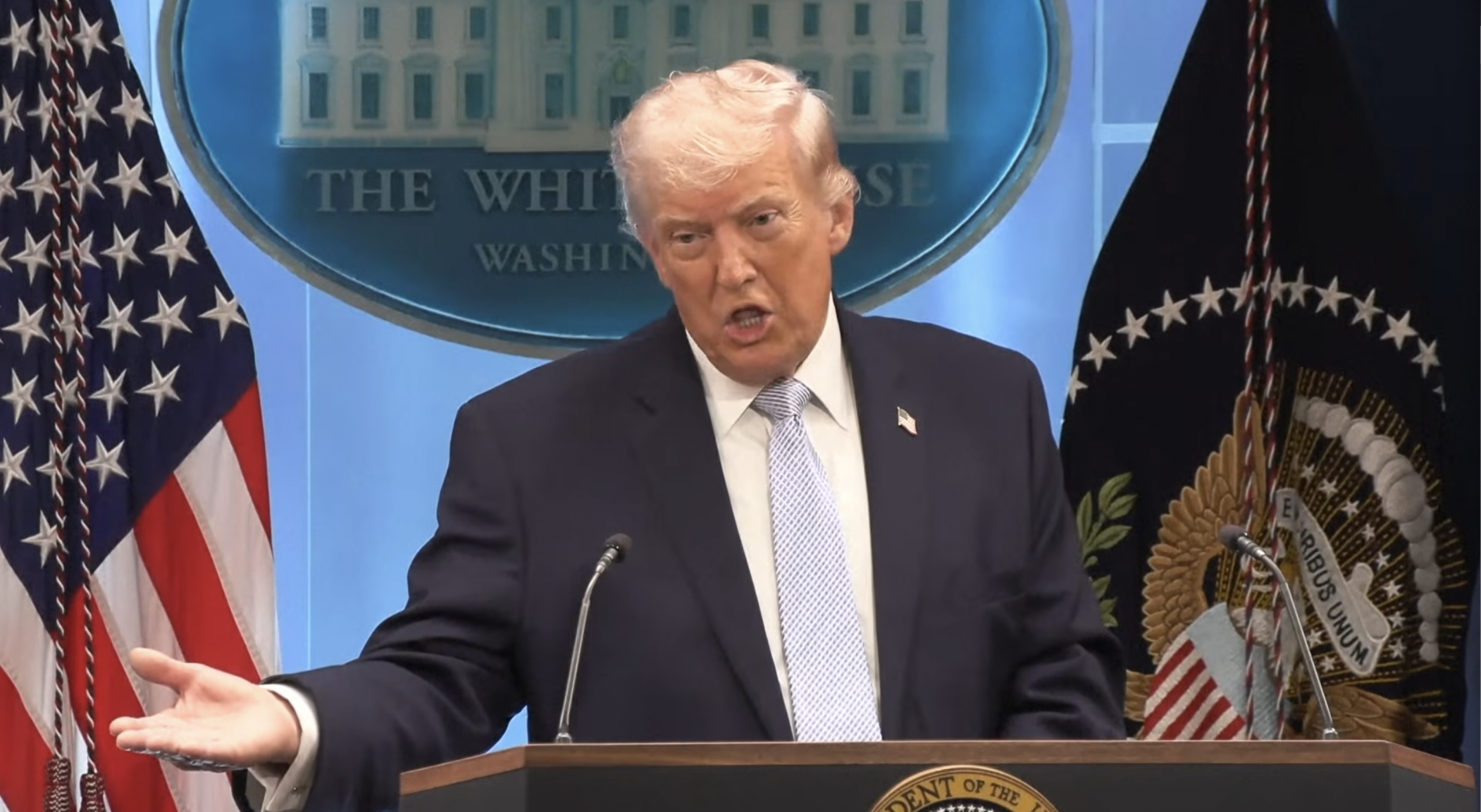
President Donald Trump holding a press conference on the Iran war, Apr. 6, 2026. Courtesy | YouTube
President Donald Trump made one of the most alarming threats of his presidency in a Truth Social post this week.
“A whole civilization will die tonight, never to be brought back again,” Trump wrote Tuesday morning. “I don’t want that to happen, but it probably will.”
The post referred to Trump’s deadline of Tuesday at 8 p.m. Eastern for Iran to re-open the Strait of Hormuz — the crucial waterway for oil and natural gas that Iran has controlled since the war began Feb. 28. But, especially coming from the president who campaigned on peace and avoidance of foreign entanglements, Trump’s threat to wipe out an entire people was nothing short of repugnant.
Immediately, global figures reeled back in shock, with people from Pope Leo XIV to members of Trump’s own party condemning his words.
“Today, as we all know, there was this threat against the entire people of Iran, and this is truly unacceptable,” Pope Leo said. “There are certainly issues here of international law, but even more than that, it is a moral question for the good of the world’s people.”
Within two hours of his 8 p.m. deadline, the president backed down from the colossal threat of civilizational demise, agreeing to a tentative two-week ceasefire while reviewing a 10-point plan by Iran.
Trump has been known to make use of hyperbolic and so-called “maximalist” claims to gain the upper hand in negotiations, even if he doesn’t intend to follow through with them. The strategy is a topic of his own book, “The Art of the Deal,” in which he explains that starting with extreme positions — such as offering an unrealistically low price for a plane — helps press negotiators to settle on prices that may have been harder to reach otherwise. Trump has used this strategy before in politics.
But even as a scare tactic to gain leverage in negotiations, there is no situation in which the world’s most powerful man should threaten to destroy a “civilization” of 93 million people.
Iran is not just the bad actors in government, military leaders, or hostile religious rulers. It includes an entire people, both those innocent and guilty of unprovoked violence, civilian and military alike. Iran’s civilization also includes its people’s heritage: the geographic boundaries of a nation as well as a cultural identity and millennia-long history that spans from ancient Persia to now.
Make no mistake: Even if Trump only intended his ultimatum for the clerical leadership or heads of military who hold the power to make national decisions, his actual wording put millions of innocent civilian lives in the crosshairs of the war.
We should be glad that the U.S. and Iran reached a ceasefire after six weeks of bombing and thousands of casualties in the region. But even though they have agreed to review a peace deal under fragile circumstances, Trump’s blatant disregard for the Iranian people shatters trust in any purported efforts toward peace.
The world has seen the dangerous, irresponsible, and inhumane lengths Trump will reach to make a point to world leaders. Even if the war ends somewhat in the U.S.’s favor, it will be difficult for the U.S. to regain any sort of moral high ground in the war — if it even held that ground in the first place.
Elijah Guevara is a sophomore studying history.
