
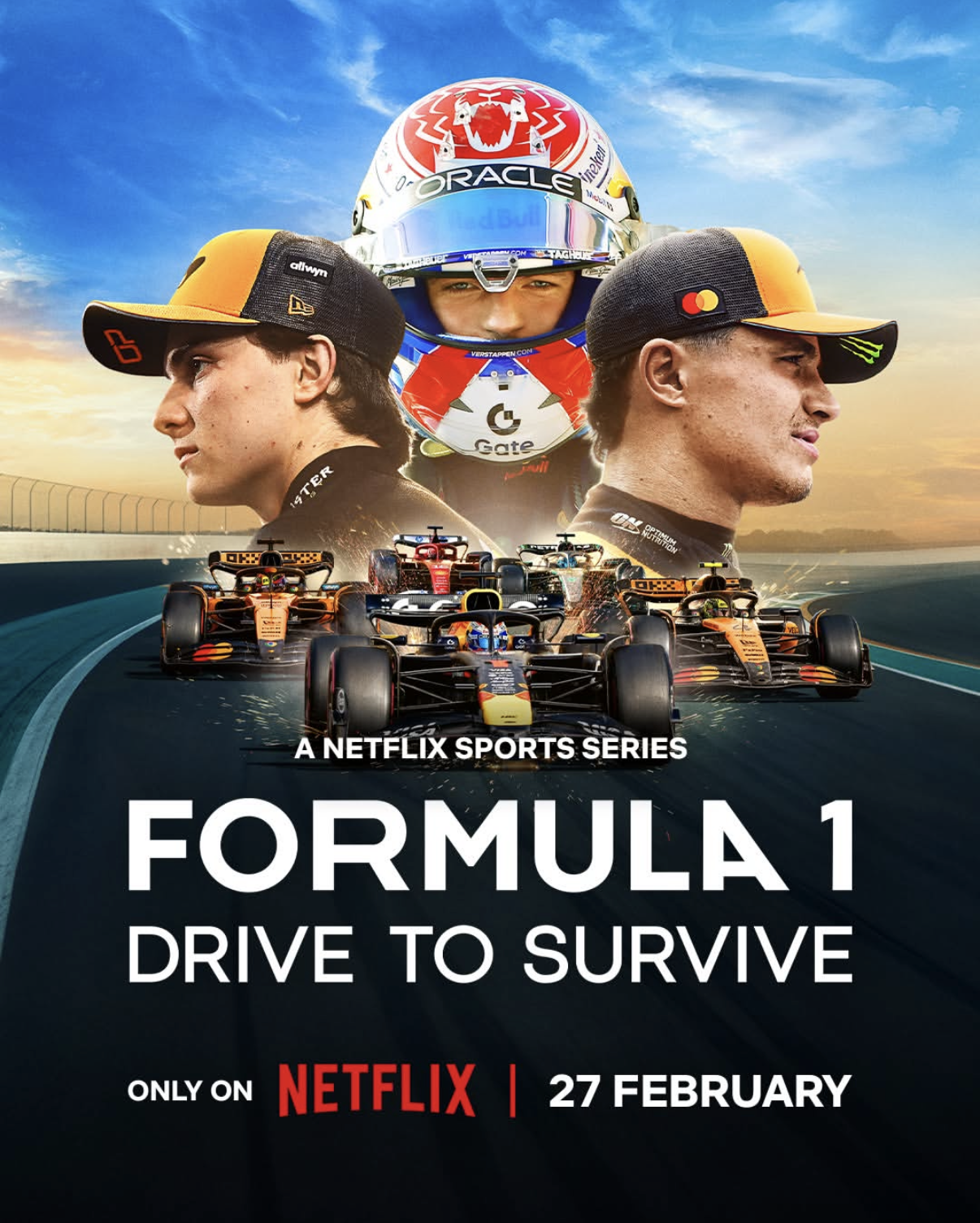
The battle for last place and manufactured rivalries dominated the latest season of Netflix’s docuseries “Drive to Survive.”
Formula 1 is a single-seater racing sport in which 11 teams and 22 drivers compete in 24 races across 21 countries over the course of the year. The teams compete to win the Constructors’ Championship, glory, and prize money, while every driver battles to be the world Drivers’ Champion.
“Drive to Survive,” now in its eighth season, reviews the 2025 F1 season in a form that feels more like reality TV than a sports documentary.
Season eight focuses heavily on the first half of the 2025 season, making it feel as if Netflix produced more than half the show before the race season was over, and then rushing the all-important championship battle.
Despite the show’s shortcomings, “Drive to Survive” did manage to vividly capture Ferrari’s disastrous 2025 season.
Ferrari, though it has a long history of champions, didn’t manage to win a single race last year, with the exception of the Lego car race featured in the drivers’ parade of the Miami Grand Prix. In the season’s fifth episode, Netflix highlights a short race that kicked off the weekend, in which the drivers raced each other in drivable Lego versions of F1 cars.
“It was chaos, but probably the best race of the season for us,” Ferrari driver Charles Leclerc told Netflix.
Its struggles were the latest in a roughly 18-year drought for the team. Leclerc finished on the podium seven times but won no races. Lewis Hamilton, the seven-time world champion who joined Ferrrari for the 2025 season, won one sprint-format race. As the season continued, Ferrari slid lower down in the team rankings and placed fourth in the end.
“Drive to Survive” also showed viewers the massive amount of pressure placed on rookie drivers. Six rookies joined the competition in 2025, making it one of the largest rookie classes in F1 history.
The show especially focused on Kimi Antonelli, who replaced Hamilton at Mercedes. Antonelli had to prove he was worth the risk and had the skills and maturity to handle driving for one of the top four teams.
Oliver Bearman, a driver for Haas, receives almost no screen time, despite finishing fourth in the Mexico Grand Prix and scoring more points than his experienced teammate, Esteban Ocon. Other rookies, such as Alpine’s Jack Doohan and Red Bull’s Liam Lawson weren’t so lucky and were fired or demoted after only a few races.
Netflix slimmed down “Drive to Survive” from 10 to eight episodes this year, forcing the show to leave out many of the F1 season’s key moments. The limited amount of coverage ultimately hurt the show. Each episode failed to provide satisfying conclusions to the stories they did choose to portray.
Netflix spent an entire episode on the battle between Alpine and Kick Sauber for last place. While the show likely hoped to cover a story most fans weren’t following, highlighting the Alpine-Sauber battle came at the expense of the story that is the point of every season: the battle for the constructors’ and drivers’ championships.
The battle for first — that went to the final race for the first time since 2021 — lost out to the battle for last.
The final episode of “Drive to Survive” centered on Max Verstappen, a four-time world champion for Red Bull, and his comeback from a 100-plus point deficit to second in the drivers championship behind McLaren driver Lando Norris. Netflix left out the fact that the other McLaren driver, Oscar Piastri, had been leading the championship for the entire first half of the season.
The show did touch on the competition between Norris and Piastri and McLaren’s problem of having two drivers competing for the championship. The team had to prevent tensions between the two from boiling over and potentially handing the championship to Verstappen.
The coverage of the McLaren drivers by Netflix felt one sided, with Norris, who won the championship in the end, receiving more on-screen time than Piastri. The show also skipped Piastri’s wins in the first half of the season as Netflix focused on his major crashes instead, including a crash in Brazil, when Piastri caused a chain reaction that took Leclerc out of the race.
Overall, “Drive to Survive” does not portray the stories of the drivers or the races in a coherent and easy-to-follow fashion. The show is too basic and overdramatized for die-hard F1 fans to learn anything and too complicated for viewers who don’t follow the sport.
The episodes end without satisfying conclusions, and the final episode also fails to tie up the loose ends left from the previous episodes. “Drive to Survive” uses the most dramatic clips from the races and mentions who won, but it does not address the results of the other drivers the show heavily focuses on. In the end, “Drive to Survive” leaves viewers disoriented.
