
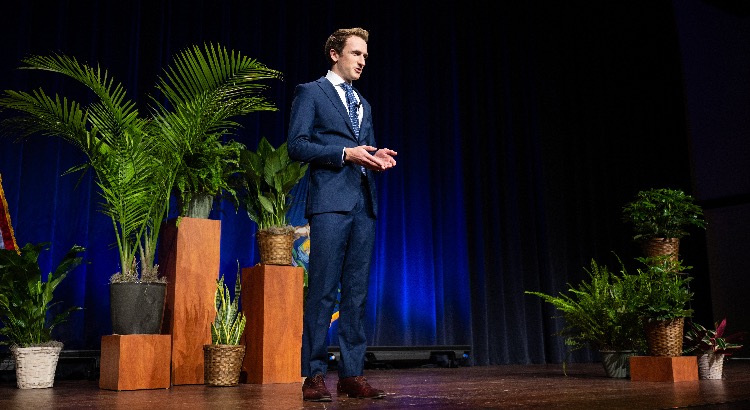
Senior Patrick McDonald won first place in the 26th annual Edward Everett Oratory Competition, the theme of which was “Artificial Intelligence — Paradise and Paradise Lost.”
McDonald was one of five finalists to deliver a 10-minute speech before an audience and panel of judges in Plaster Auditorium March 3. He argued for the wise use of AI as a tool that amplifies one’s judgment, instead of a crutch that replaces human thinking.
“It is becoming so efficient and effective at doing our work for us that it’s making us worse at being ourselves,” he said. “We now must worry about outsourcing our judgement.”
Philanthropist Don Tocco, former Ronald Reagan speechwriter Clark Judge, and College President Larry Arnn awarded McDonald the first-place prize of $3,000. Junior Jon Hovance, last year’s winner, won second, and junior Ariel McDowell placed third. Junior Alex Mooney and sophomore Gabriel Zylstra also were finalists.
McDonald said he found the topic timely and important.
“Dr. Arnn even said he thought he learned a lot from all the speeches because he got to see how kids were thinking about AI in their presentations,” McDonald said. “It met two things that you’re looking for in a topic. One, that people are interested in it enough to want to do it, and two, that they will benefit from thinking about it more.”
McDonald said his speech was inspired by hearing others share positive yet unthinking opinions about AI.
“You just think, this is so much more efficient that you don’t stop to think about some of the downsides with it,” McDonald said. “I thought I’d make the best argument I can against it for limiting how much you use it, while still being realistic that people simply will use it going forward.”
Hovance said his speech considered unique examples where AI might be going wrong. His speech argued that AI outsources one’s humanity.
“The one point in my speech I really liked was bringing in an example where Jim Acosta, an ex-CNN anchor, interviewed an AI avatar of a Parkland School shooting victim,” Hovance said. “This AI Avatar was a dead person. CNN decided to make an AI model of a dead boy and then ask for his opinions on gun control. With craziness like this in the news, it’s no surprise that people are starting to express concerns about AI.”
For McDowell, the topic presented an opportunity to argue that AI is replacing human interaction and increasing isolation.
“We must treat it like the mindless machine that it is,” McDowell said. “The moment anyone treats AI like a peer, a friend, a mentor, or even an intellectual, they give it pieces of their mind and pieces of their hearts that only other people were meant to have, and an algorithmic entity never deserves that privilege. But you and I are not mindless machines.”
Mooney argued AI forces people to understand what makes them human.
“If paradise is to be preserved rather than lost, we must first understand our own final cause as humans and guard what is uniquely human at a time when the meaning of humanity itself is contested,” Mooney said.
In his speech, Zylstra described AI as a powerful tool with one key limitation: It can’t progress beyond its training data.
“Our role as rational creatures is to bring that order into the world, to bring design, purpose, and function that no other creature and no AI system can bring so that we can participate in God’s very creative act,” Zylstra said. “I want you to take a moment to think about how beautiful that is, if our labor is that dignified.”
McDonald said he was impressed by the other contestants’ speeches.
“I would not have liked to be the judge of the final round. They were such different speeches where people are making very good, unique points,” McDonald said. “It was an honor to watch everyone. I really can’t say enough how good all the other speeches were.”
