
Courtesy | Unsplash
The Civil War soldier stands as the most prominent statue on the Liberty Walk. Erected in 1895, the Civil War Monument is now joined by Founding Fathers and other statesmen on a walkway dedicated to “honor the great leaders who have come before us and paved the way for freedom.” But the Liberty Walk is incomplete without the presence of another soldier who also fought for American liberty and deserves a place on that same walkway: the World War II soldier.
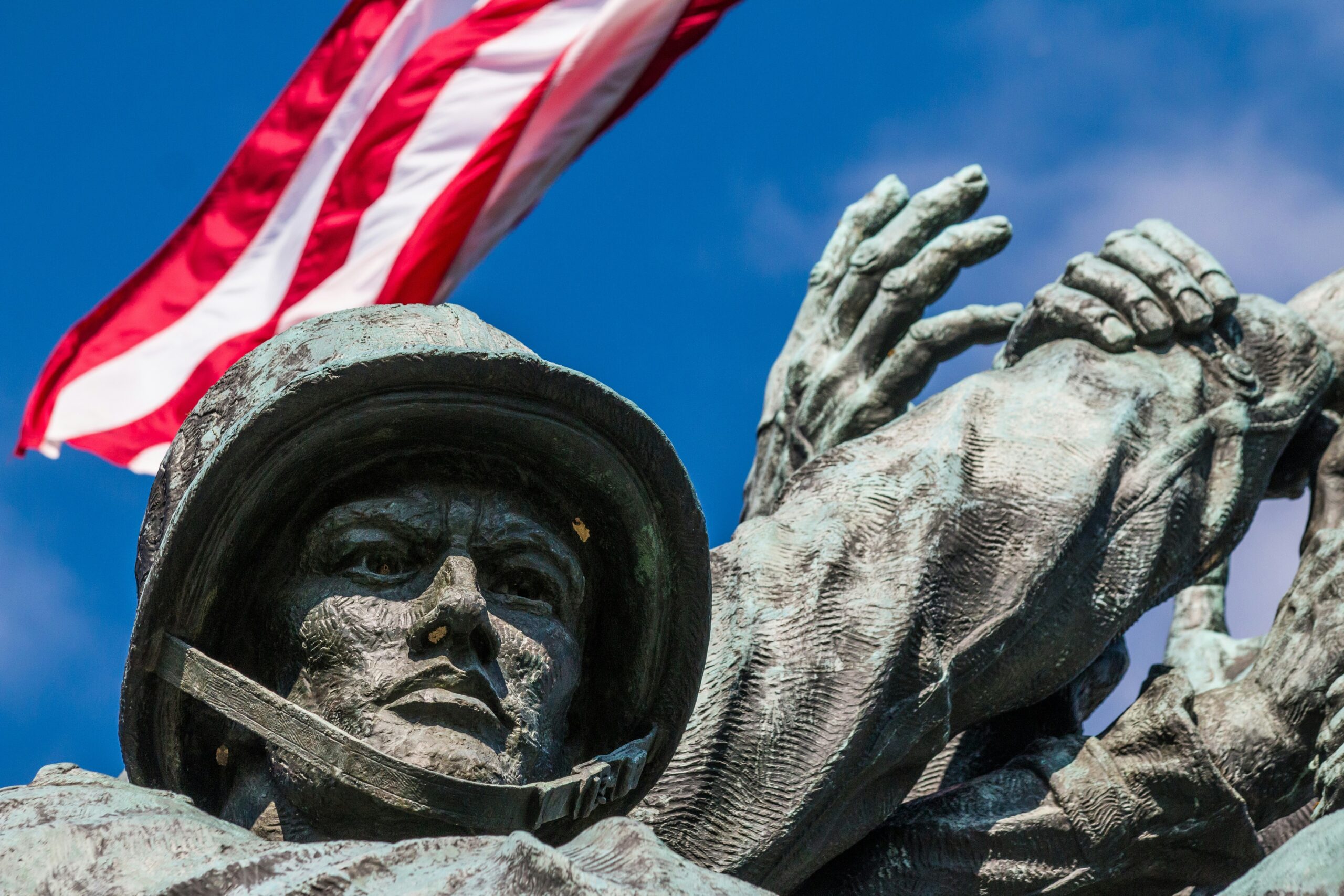
Like the Civil War student soldier, built in honor of the Hillsdale students who fought for the Union, a statue dedicated to the World War II soldier would not depict any specific person who fought in the war. Rather, the identity would remain anonymous and represent the millions of young American men and women — among them Hillsdale students — who enlisted in the armed services. An anonymous World War II statue could complement the Civil War Monument, perhaps placed between the statues of the Civil War soldier and George Washington, the Army’s first commander-in-chief.
We do not know the exact number of Hillsdale students or alumni who served in World War II, as we do for the number of students who served in the Union forces during the Civil War (530) or in World War I (more than 300). More than 500 Hillsdale men and women served in World War II, according to records from the Hillsdale Community Library. The numbers, however, do not distinguish between servicemembers from Hillsdale College and those from the city of Hillsdale.
Still, more than 16 million men and women wore the uniform of the United States Armed Forces during World War II, the highest enlistment number of any war in American history. They fought in and won one of the most consequential wars in history, not only for American sovereignty and liberty, but also for nations and peoples worldwide.
Countless stories and anecdotes passed down for generations recount the heroism of famous World War II soldiers. The nation celebrated the boldness of Audie Murphy, who, in defense of his company, single-handedly fought off six German tanks and hundreds of soldiers with an exposed machine gun and a wounded leg. The country even hailed the bravery of non-combatants, such as the incredible story of Desmond Doss in the Battle of Okinawa, who, as a combat medic and conscientious objector, saved the lives of 75 soldiers — American and Japanese — without firing a single shot.
The sacrifices of American soldiers reached my own family, who owe their survival to the United States Army that defeated the Imperial Japanese Army. Both of my maternal grandparents lived under the rule of the Japanese, who had seized control of the Philippines in 1941. They told us grandchildren stories of evacuating homes in the late night, escaping into the hills, and even hiding under a porch as Japanese forces raided their small village. They also remembered meeting the young American soldiers who helped them resist the Japanese and who eventually liberated the Philippines in 1945. Without the arrival of the Americans, my family would likely not have been able to come to the United States after the war.
My family and I owe our lives to the bravery of the unnamed American soldiers who crossed an ocean to fight tyranny. Most of the soldiers who served and gave their lives for the liberation of others are now unnamed and unknown, like the countless American soldiers whose faces my grandparents could recall, yet could never name. Whether he was a celebrated hero, a combat medic, or an unknown Philippine liberator, the memory of every American World War II soldier deserves to be enshrined on Hillsdale’s Liberty Walk.
Elijah Guevara is a sophomore studying history.
