
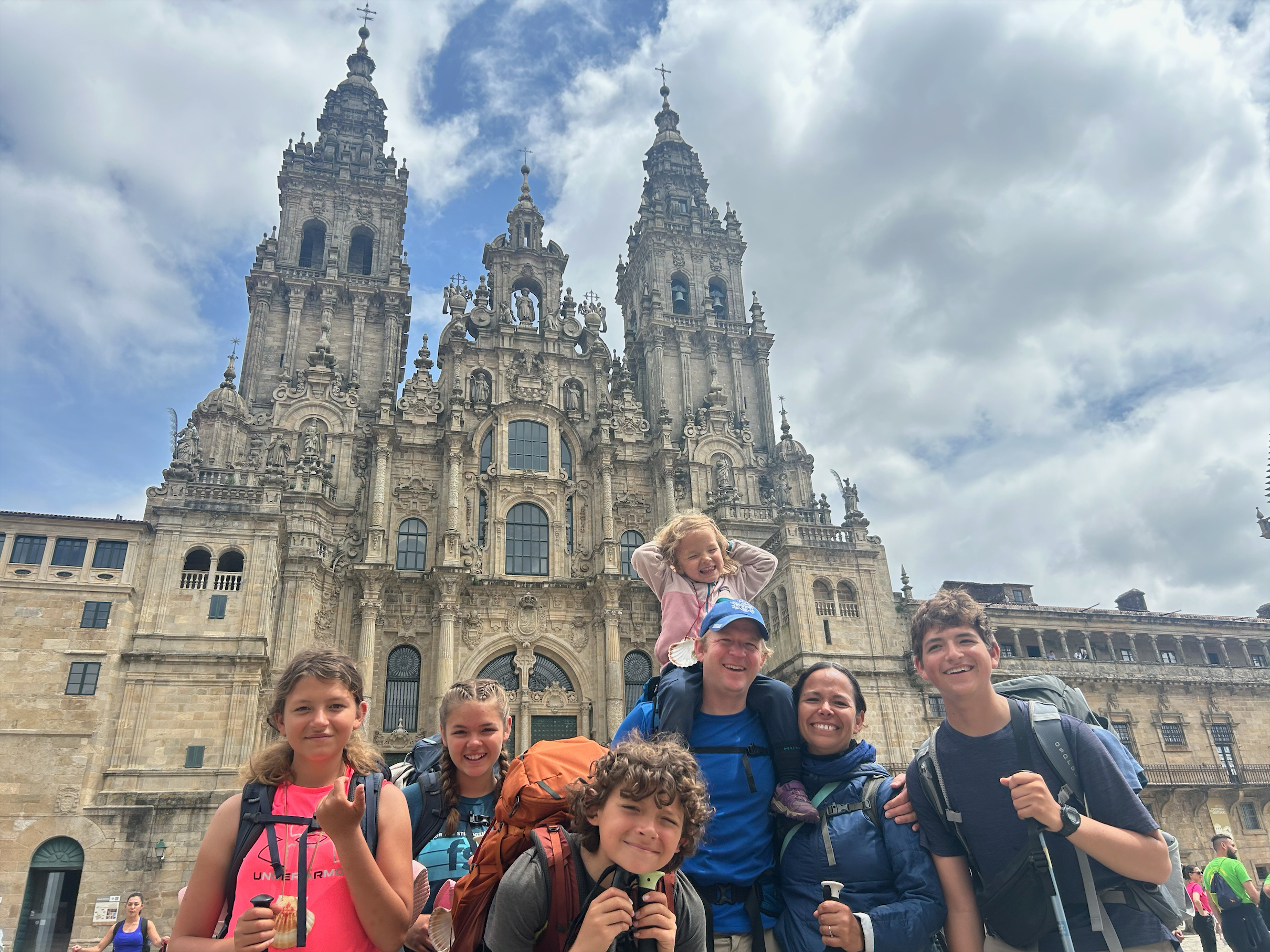
The Mack family in front of the Cathedral de Santiago de Compostela.
Courtesy | Todd Mack
When Spanish professor Todd Mack told his wife he wanted to spend his sabbatical hiking the Camino de Santiago with her and their five children, she thought he was out of his mind.
“I told him, ‘You are crazy! What, walk 500 miles and have kids with you?’” Betty Mack said. “But he had a strong feeling that he needed to take the family, and he told me more than once, ‘Betty, I feel in my heart that we need to do this, that this is the right thing for our family.’ When he told me that, I felt deep in my soul, and prayed about it, and asked for answers.”
In the winter of 2023, department chair and Associate Professor of Spanish Todd Mack and his family embarked on a six-month, 25,000-mile sabbatical journey from the United States to Europe, culminating in the 500-mile hike of the Camino de Santiago. Mack gave a talk on his travels and learnings in a lecture Feb. 19 titled “Presence, Pilgrimage, and the Humanities on the Camino de Santiago.”
The Camino de Santiago, also called the “Way of Saint James,” is an ancient system of pilgrimage routes ending at the Cathedral de Santiago de Compostela in Santiago, Spain, where Saint James is believed to be buried. The routes span several European countries, including France, Spain, and Portugal, and typically takes a month to complete.
“I can explain what a pilgrimage is,” Mack said. “I can tell you any number of facts about the Camino. I can even describe the sacred experiences of others, but none of that is similar in kind to the vital, embodied understanding I get through presence.”
Mack said he set out on his journey to study pilgrimage and sacred travel, but he said he’s still uncertain why he felt such a call to journey with his wife and five children. Mack said he knew the trip would be physically demanding, but it was more exhausting than he anticipated.
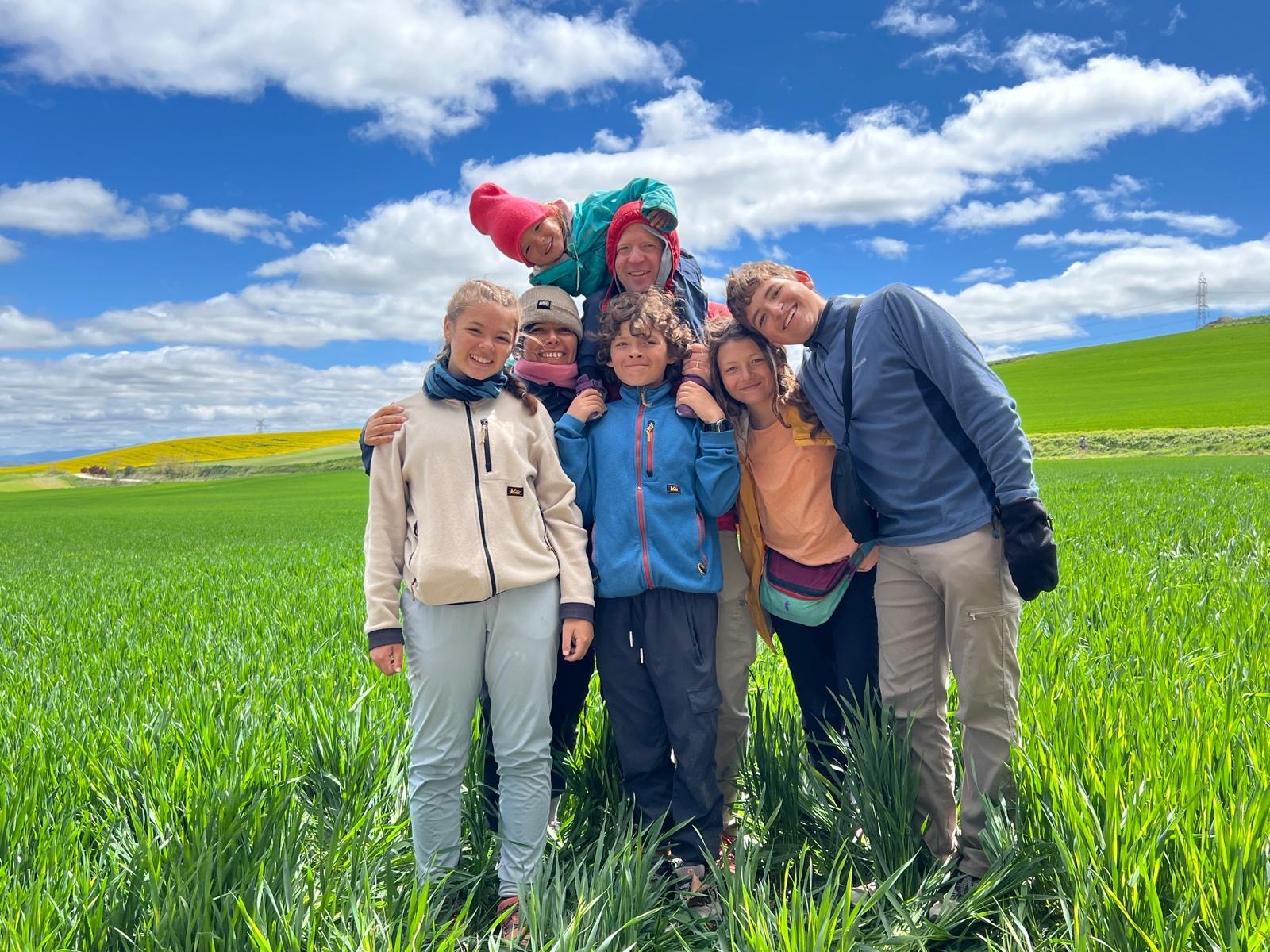
When Todd Mack’s then four-year-old daughter, River, refused to continue walking on the first day of traveling the Camino, Todd Mack said he was not daunted. From that point on, he kept River on his shoulders, and she remained there chattering in his ear or sleeping for the remainder of the 500-mile hike.
Courtesy | Todd Mack
Betty Mack said she began to understand that the journey would not be a tourist trip, but a sacred journey. She said they met an old man who walked alongside their family, struggling slowly on the journey together.
“He was on the Camino because he was waiting for a miracle to happen. And when I saw him, I knew the pain he was having,” Betty Mack said. “He touched my heart and helped me. He showed me compassion and the faith he had in why he was doing the Camino.”
She said on the hardest days of the pilgrimage, she kept going because the people she met motivated her, even those who did simple things to make the trip easier.
“I would see ladies who were older than me when I came into the hostels. They would not ask me, ‘Are you tired?’ They knew that I was tired,” Betty Mack said. “Once, I was so tired that I could hardly walk, and I was carrying my backpack, my walking sticks and my sheets, but I couldn’t even hold them, and this lady who was around 70 just came and saw me, and she said, ‘Let me help you.’ She took my backpack and my sheets. She made the bed for me.”
Betty Mack said the compassion of other pilgrims helped her and her family journey peacefully.
“One of the biggest lessons that we learned was to be resilient,” she said.
Both Todd and Betty Mack said they learned from the ruggedness of their journey.
“Sometimes we forget we can have joy and simplicity, even if we do not have everything,” Betty Mack said.
Freshman Anna Coyle said Mack’s story reminded her to be present in the physicality of what is happening around her.
“We forget what’s really important,” Coyle said. “You can feel the importance of those physical things when they’re lacking in your life, like how they didn’t know where their next meal or place of sleep was going to be. It is there that you really learn to appreciate the physical world in an even greater way and to connect with God through those things.”
Mack said he was surprised to find how much the pilgrimage forced his focus outside of his mind and on his body and his experiences of the real world.
Following the philosophy of Hans Ulrich Gumbrecht, from his book, “The Productions of Presence: What Meaning Cannot Convey,” Mack described how he saw “meaning” and “presence” cultures throughout his journey. Mack said “meaning cultures” aim at understanding and dissecting a phenomenon until it is no longer part of the observer’s experience, whereas “presence cultures” focus on being present in the experience of what truly is happening. He said walking the Camino helped him be more present.
Throughout the journey, Mack, a member of the Church of Jesus Christ of Latter-Day Saints, said he began to understand his faith in a deeper sense through experiences and felt that he was part of a Eucharist-like communion. Mack said love was at the center of the whole sabbatical, in the sacrifices made to draw himself and his family to sacred places.
“I talked a lot with my kids about what it means for something to be sacred,” Mack said. “It was one of the most important topics of conversation that we would have. We talk a lot about important things and deep things. We did a lot of talking about sacred space, and what it means for something to be sacred.”
He argued it is important to incorporate both meaning and presence cultures in our lives, but that in the world of academia, presence cultures are lacking more than ever.
“I invite you all, at least for a moment, to set aside analysis and allow a painting, a passage, or a line to caress you with a letter’s touch or hit you like an impossible sunrise,” Mack said in his presentation. “If you do, you may, if you are lucky or blessed, someday, find a moment of presence and love a little bit like this.”
Mack said the experience did not give his family merely a tangible idea or lesson to understand, but an experience that would continue to shape them.
“To reduce it to a sentence is impossible,” he said.
