
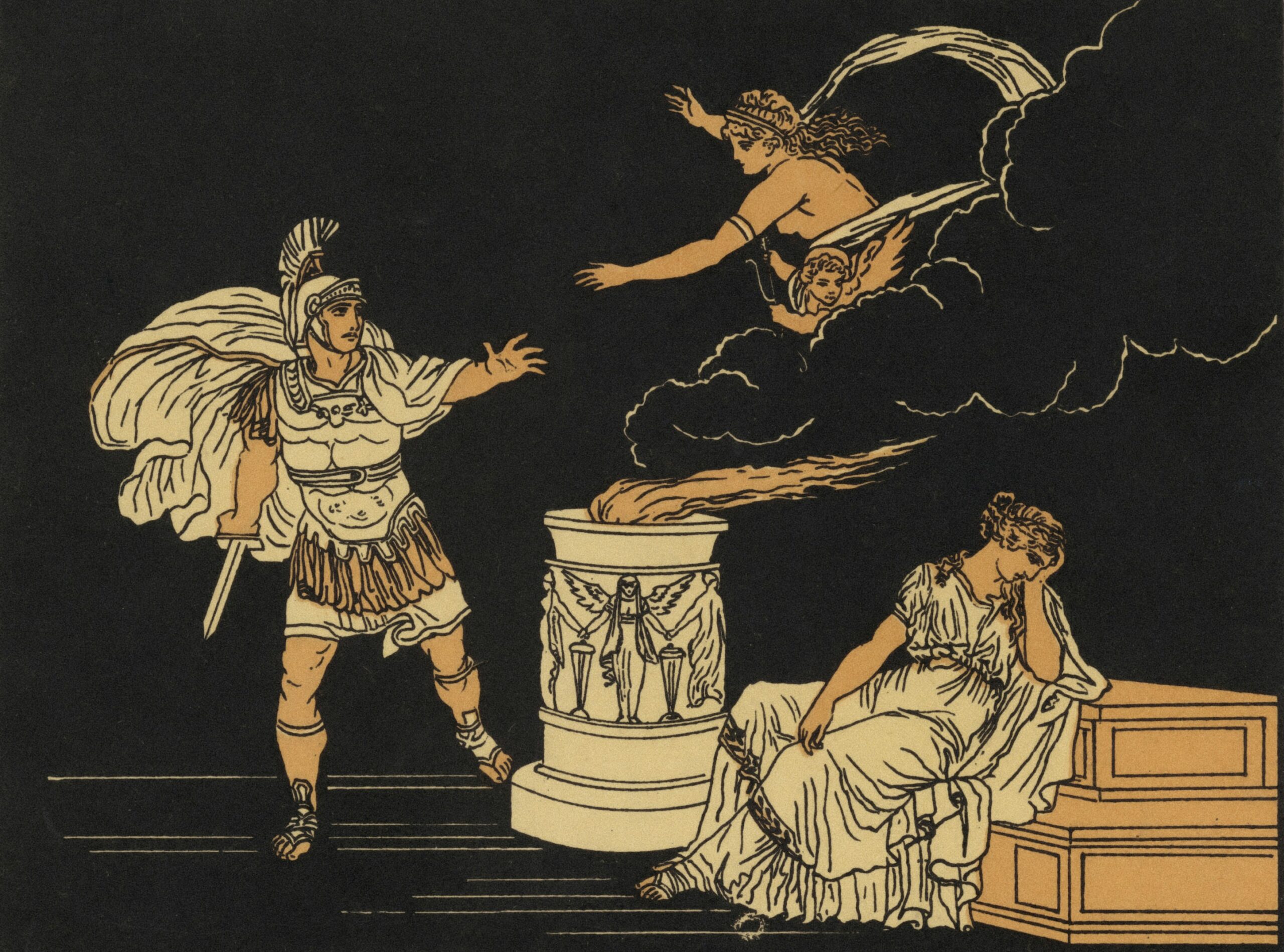
“Aeneas and Helen,” by Bartolomeo Pinelli, 1878. Courtesy | Unsplash
As of now, the Liberty Walk features only political and historical giants. But in the spirit of the liberal arts tradition, we should embrace the myth. Aeneas should be the next statue on the Liberty Walk.
Sent by the gods to conquer the Italian peninsula, the Trojan warrior Aeneas became the father of Rome. As the main character of Virgil’s “Aeneid,” a staple text in the Hillsdale curriculum, Aeneas and his feats are familiar to many at the college.
Tradition and devotion drive Aeneas. A famous image from Book II has spurred on many a late-night essayist or ambitious graduate, himself on the cusp of something great. The altar is cracked, the city fallen. In the middle of it all, Aeneas, tired from battle but driven on by fate, hoists his aging father onto his shoulders and follows his young son through the flames. Like Aeneas, Americans, and Hillsdale students in particular, are bound by duty to shoulder the past and save what they can with an eye fixed on the future.
Aeneas embodies the American spirit. Plucked from his home in Troy, he takes to his mission with zeal for himself and his posterity. From Thrace to Delos to Crete and all around the Mediterranean, Aeneas and his men battle harpies, evil queens, and gods in search of the land they were promised would be theirs. Adventure defines the American identity, too. The minutemen of the colonies defeated a world superpower; humble pioneers pushed further and further into the New World until they reached another ocean; and a boy from Ohio made the first footprints on the moon.
Aeneas undertakes his voyage in service to a nation he would never see. Halfway through the epic, the Sibyl tells Aeneas he will never be king. Still, he celebrates the accomplishment of his descendants. Our Founders did not encounter a Sybil that foretold the nation’s resolve through the Civil War, its military feats, or the American century. But our Founders, like Aeneas, set aside cowardice and risked their lives for a calling they would not see fully realized.
Devotion to the gods defined him as a warrior first, and then as a captain, and then as a founder. Wherever he goes, he prays to his gods, sacrificing with a spirit uncertain but devoted. Aeneas prays in the face of a storm at sea. Aeneas prays for discernment as he enters Hades. And, in the end, he binds himself, on oath, to carry through his sacred mission of founding Rome. The American myth breaks in again: Washington’s prayer at Valley Forge, Franklin’s prayer in Independence Hall, and the oath of the Founders who mutually pledged to one another their lives, their fortunes, and their sacred honor.
A mythical character would make the Liberty Walk itself a more complete example of the liberal arts. We have history and politics. We have military strategy and philosophy. We’re missing literature. A statue of the Roman hero would also be a worthy nod to Virgil, whom the Founders loved.
“‘Aeneid’ is like a well-ordered Garden, where it is impossible to find any Part unadorned or to cast our Eyes upon a single Spot that does not produce some beautiful Plant or Flower,” John Adams said.
Aeneas would sum the worthy characteristics of the other statues into a single image of Western greatness. George Washington, James Madison, and Thomas Jefferson represent the courage of founding a nation against uncertainty. Frederick Douglass and Abraham Lincoln won over a nation with their words; and Winston Churchill, Margaret Thatcher and Ronald Reagan defeated tyranny.
Aeneas would stand alongside them all as a founder and a hero, the bulwark of a people that became a great republic.
Ty Ruddy is a senior studying English.
