
Anna Northcutt | The Collegian
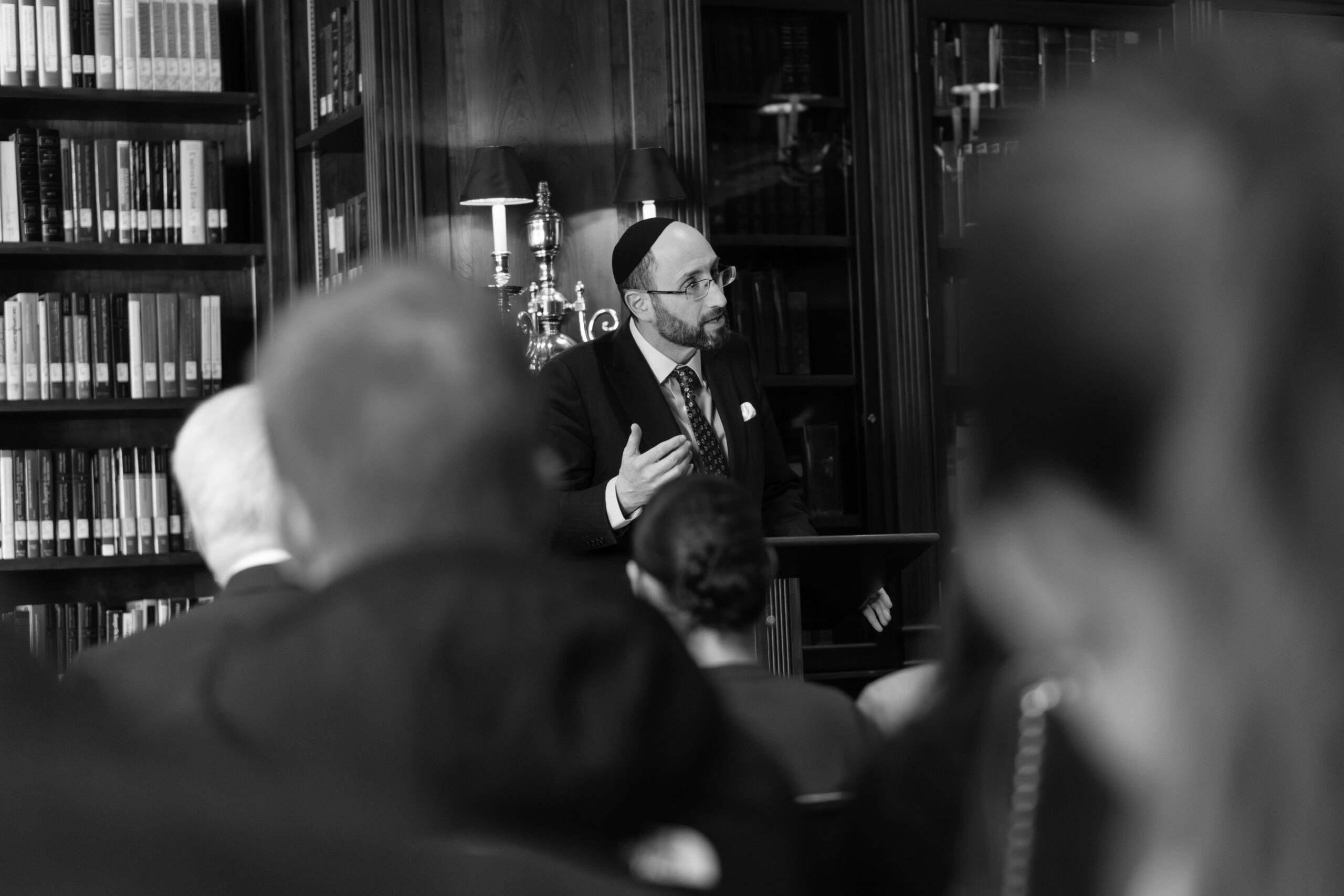
One of the country’s top Jewish leaders said George Washington’s correspondence with an early Jewish congregation demonstrated not only his recognition of the covenantal nature of America’s Founding but also his belief that it could bind together a diverse nation, in a lecture hosted by the President’s Office Feb. 10.
“Washington is saying, ‘For us, toleration is insufficient.’ He’s saying, ‘In Europe, you may be tolerated, but here, everyone is equal. You are not here because we are allowing you. You are here, because you deserve to be as much as us,’” Soloveichik said.
Meir Soloveichik is the rabbi of the oldest Jewish congregation in the United States — a fact which he and others in his congregation are extremely proud of — and Vice Chair of the U.S. Commission on International Religious Freedom.
After Washington’s inauguration in April 1789, leaders of various minority faiths wrote to the president to ensure their group’s equality in the nascent nation. Since the Jews couldn’t agree on who should write their letter, they wrote three, and Washington responded to all of them, according to Soloveichik.
To the first letter, written from the Hebrew congregation in Savannah, Georgia, Soloveichik said Washington not only provided an assurance of religious freedom, but also concluded with an invocation of the Torah, drawing a parallel between God’s deliverance of Israel out of Egypt and God’s deliverance of America in the Revolution.
“No letter in Jewish history from a non-Jewish leader shows his not only embracing the Jews, but comparing his country, his country’s story, with the original, ancient Jewish story,” Soloveichik said.
In his second letter, Washington answered the Hebrew congregation in Rhode Island, Soloveichik said.
In this response, Washington’s quotation of the original letter’s description of America as a country that “gives to bigotry no sanction, to persecution no assistance” is now so famous that it is often misattributed to the president instead of the Hebrew congregation, according to Soloveichik.
Still, Soloveichik said, even after Washington assured them of their right to religious freedom, he went a step further, asserting that not only would the Jews experience religious “toleration” in America, but that they should view living in this country as their right just as much as anyone else’s.
Washington was building on a long history of Anglo-American ideas of religious freedom while also creating a distinctly American concept of religious liberty, according to Soloveichik.
Jonathan Sacks, a British rabbi, observed this difference after noting that American memorials recorded a person’s words and ideas on his memorial statue as well as just his name, Soloveichik said.
This was because American society is a covenantal society modeled after those set up in the Hebrew Bible, where people get together and pledge themselves to each other in the presence of God around a certain set of ideas, according to Soloveichik.
“Covenantal societies represent conscious new beginnings,” Soloveichik said. “They are founded on an idea, dedicated to a proposition. That’s why we have ideas everywhere.”
This kind of covenantal society allows many different sorts of people to bind themselves to the covenant and be considered American, Soloveichik said.
Emanuel Leutze captures this idea in his famous painting “Washington Crossing the Delaware,” according to Soloveichik.
In recent years, Soloveichik said the painting has fallen under heavy criticism due to its historical inaccuracies, such as the time of day, dawn instead of night, and an inaccurate depiction of the American flag — the Betsy Ross flag shown wasn’t actually adopted until after the crossing.
According to Soloveichik, however, Leutze was not trying to be historically accurate so much as send a message about America. The men in the boat include an African American, a Scottish immigrant, and a Native American.
The boat represents all of America, and the time of day represents the dawn of a new idea. Leutze hoped these new ideals of democracy and equality would eventually be adopted in Europe, thus why his depiction of the Delaware river more closely resembles the Rhine river in Germany, according to Soloveichik.
“Leutze is emphasizing that what unites us is the American creed, so that together, without denying our differences, we unify by embracing the American covenant,” Soloveichik said.
Sophomore Yahli Salzman said he appreciated hearing a different perspective on what brings Americans together.
“I’m Jewish, and we obviously hear from the Christian perspective on campus a lot, but hearing a different perspective always gives us a little more hope, a little bit more opportunity to see something new,” Salzman said.
Mickey Mattox, professor of theology, also said he enjoyed the lecture.
“Rabbi Soloveichik’s exhilarating lecture today reminded me of the greatness of America’s first president, George Washington, whose readiness to welcome Jews into the American experiment without prejudice placed their tiny communities on an equal political footing with the many and larger Christian ones,” Mattox said in an email.
According to Soloveichik, Sacks also pointed out that before Moses gave the Ten Commandments in Exodus, he told the children of Israel how to explain Passover to their children.
“One of the central lessons of the Hebrew Bible is you have to make sure that your covenantal beliefs are passed down from generation to generation,” Soloveichik said. “It may be hard to escape from tyranny. It is harder still to build and sustain adults transmitting to the next generation the story of the origin of liberty.”
