

Ronald Reagan gives the 1988 State of the Union Address, which Clark Judge helped write.
Courtesy | National Archives
The day his son was born, Clark Judge wrote a speech for President Ronald Reagan, finishing it just before stepping into the delivery room to be with his wife, Margo.
“I had the table over here, and I’d help with the pushing and all that over there,” Judge said. “I was helping Margo, but I was also updating a draft for the president.”
Judge’s son, Ben, now has a signed copy of the speech with a note: “Look at what your father was doing while you were coming into the world. Good luck. Best wishes. Ronald Reagan.”
“There were two things going through my mind, quite frankly,” Margo Judge said of that day. “One is that there had been some kidnappings in hospitals in D.C., and I was a little paranoid. So I said, ‘Make sure you put a name tag on.’ And then the second one was, I wanted the president to sign the speech, because I did go into labor while Clark was writing the speech.”
These days, Clark and Margo Judge call Hillsdale their home, having made the move from Washington, D.C., in 2023 after 32 years in the district. Ben Judge and his wife Jean both work for the college and have two sons, which is what prompted Clark and Margo Judge to retire in Hillsdale.
“One day, they call up and they say, ‘The house next door to us will be on the market. It isn’t yet, and if you put in a bid now, you can get it,’” Clark Judge said.
Judge got his first job in politics in college, taking a year off Indiana University to begin his career in politics working for the governor of Indiana.
“One of my professors was prominent in state politics, and I had impressed him,” Judge said. “I had been very sick and left school and came back and caught up with everything. I think he decided that I was a standout student. So he became the governor’s aide, the principal policy person and liaison with Washington, and I became the head of the Washington office.”
Judge eventually graduated from Indiana University, afterwards attending Harvard Business school before working as a writer for a publishing group in New York City. The company published biographies of figures living in the immediate post-war period.
While in New York, Judge studied on his own time, reading Aristotle, Plato, and Alexis de Tocqueville. Judge said he taught himself economics, filling himself in on anything that he did not learn in school.
“I couldn’t have moved up the way I did in my career if I hadn’t had that period of self study, as well as a lot of other jobs that involved getting up to speed,” he said. “The result of my work here was, when I got to the White House, we were at the end of the Cold War, and I had a very strong grounding in the origins of the Cold War and of our policies in this Cold War.”
He volunteered for Ronald Reagan’s presidential campaign in 1979, with hopes of becoming part of the administration.
“I was a volunteer, but I was a very enthusiastic volunteer,” Judge said. “I got known in the campaign as someone who was a writer for a living, which was absolutely true.”
Judge spent time working on an urban development campaign before then joining an unpaid commission, which oversaw the management of the government. From there, Judge quickly moved up in the administration and soon took a job with the Department of Housing and Urban Development.
“I was really into politics and government,” Judge said. “It was my passion. It wasn’t just that I wanted to be important and all that. I had very strong views about the economy, where we were in the world, the challenges for the country, and where we had to be.”
Before moving to Washington, D.C., however, Judge met his wife, Margo, on a crowded bus in New York City. They began dating only after they ran into each other in the city on multiple occasions, according to Margo Judge.
“I finally decided to myself, ‘Alright, we’ve run into each other so many times,’ so I say to him, ‘Look, I’m having friends over Friday night,’” she said. “I thought to myself, ‘Alright, I’ll invite him, and if he has a girlfriend, he can bring his girlfriend.’ But he said to me, ‘No girlfriend.’”
Six months after joining the commission, he moved up in rank again as a special assistant to the assistant secretary for international economic policy, where he began editing speeches for his boss and higher positions. But submitted drafts were written by academics who had not been trained in writing these types of speeches, which Clark said was difficult.
Judge said one of the poorly-written speeches submitted would have gotten back too late if he sent it back for edits, so instead of waiting for the author’s response, he rewrote it himself.
“After it was done and delivered, I got a call from the under secretary. He was known for being very candid about what he liked and what he didn’t,” Judge said. “I go into his office, and I don’t really know him, and he goes on for 15 minutes on what a great speech it was.”
While working for the assistant secretary for international economic policy, Judge connected with a former editor who had moved on to be a speechwriter. The speechwriter told him they were looking to hire another member of the speechwriting office. Within six months, Judge was writing speeches for Vice President George H. W. Bush.
But writing for the vice president came with different challenges, Judge said, namely, staying consistent with the president’s messaging given the smaller team in the vice president’s office.
“For a good portion of a year, I was his only speechwriter,” said Judge. “There was only one writer, and the vice president was speaking more often than the president, who had five.”
After two-and-a-half years with the vice president, Judge began writing speeches for President Ronald Reagan.
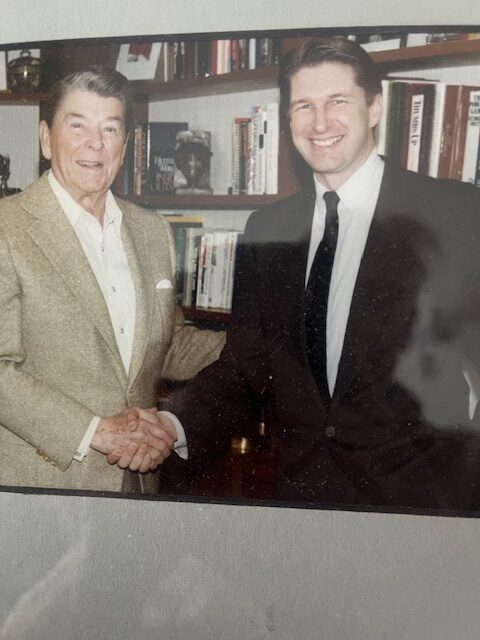
Courtesy | Clark Judge
Although she was not always accepted as a stay-at-home mom in the career-focused Washington culture, Margo remained in the district to be near her husband.
“I wasn’t a career person at that point, so the decision to stay in D.C. meant that I was going to be around all the women who were career women,” Margo Judge said.
While giving friends a tour of the White House one weekend, Ben Judge, only 2 years old at the time, found freedom in the East Room, a room bigger than the Judges’ apartment.
He began to run from one corner to the other and back, grabbing the drapes and running with them, letting go only at the last moment before he pulled the drape down.
“I thought, ‘My life is over, my life is over,’” Judge said. “I’m there, ready to tackle this 2 year old.”
Wilfred McClay, Hillsdale’s Victor Davis Hanson Chair in Classical History and Western Civilization, said he knew about the legacy of Clark Judge before he ever met him.
“Clark really believes the role of a speechwriter is an anonymous one.” McClay said. “He may not be known for specific speeches, but he’s known as a master of the craft.”
Clark Judge is a remarkable man, one who is never spoken of without respectful admiration, according to McClay.
“It’s like having royalty among us,” McClay said. “I think he’s the kind of person that you have to know the nuts and bolts of politics to know how important he is.”
After his time as a White House speechwriter, Judge founded the White House Writers Group, a strategic communications firm, in 1993. White House Writers Group handled many cases, including one on the Florida sugar industry.
“When I got involved, there wasn’t anybody in politics in Florida who wanted to touch the sugar industry,” Clark Judge said.“They’d been libeled, slandered, everything. By the time I was done, there was nobody in politics in Florida who didn’t want to be involved.”
Senior Adriana Azarian, who is interested in going into speech writing, consulted Judge after he spoke in her Advanced Writing journalism course with Director of the Dow Journalism Program John J. Miller.
“He definitely gave me a better sense of the field of speech writing, and what it’s like to work for a president, someone who’s so dynamic like Ronald Reagan,” Azarian said. “To hear him talk about that was a really amazing experience. Even just to be in the presence of someone like that is amazing.”
Judge said he continues to write and sits on the board of the Eisenhower Foundation, a nonprofit with a mission to share the legacy of Dwight D. Eisenhower. He also appears as a guest speaker in journalism classes. Margo Judge is an author and works as a young adult coach. The couple is kept entertained by their dog Yogi, who Clark Judge said is beloved by many students on Hillsdale’s campus.
While the Judges enjoy their slower pace of life in Hillsdale, Judge said he loved his time in politics, particularly working as a White House speechwriter and that he felt he helped move America in the right direction.
“It looks, in retrospect, easy, but there was nothing about it that was easy,” he said. “But there’s no moment in American history that I would prefer to be in than the one I was in.”
