
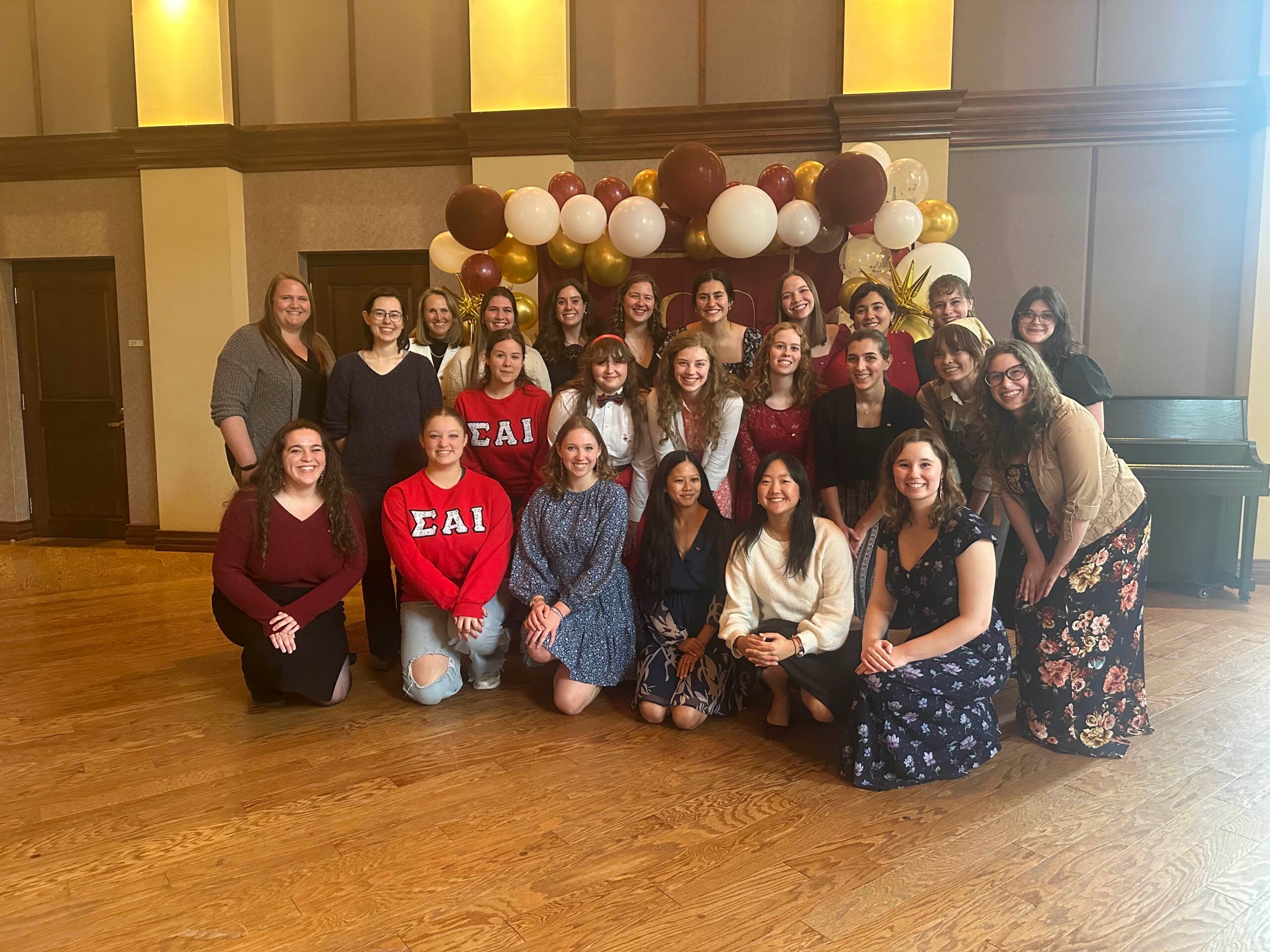
The women of Sigma Alpha Iota celebrate 100 years on campus.
Courtesy | Sophia Carey
Hillsdale College’s chapter of the women’s music honorary, Sigma Alpha Iota, celebrated 100 years of sisterhood and music on campus Nov. 1.
Alumni, musicians from both music fraternities, and faculty joined SAI for its centennial celebration, complete with a jazz piano version of “Happy Birthday” played by junior Nick Heide.
“Music underscores some of the most meaningful moments in life. This is as true today as it was 100 years ago,” Lecturer in theater Tory Matsos said. “We have these things in common across the years: a shared value of community, the cultivation of a welcoming and supportive atmosphere for individual growth, awareness and gratitude for the opportunities music and our musical friends and mentors provide, and an orientation to see music as essential for a good life.”
Several members of SAI from Bowling Green State University attended the Hillsdale chapter’s centennial to support their fellow sisters.
Junior Rachel Franke, chair of the SAI centennial planning committee, said her goal was to create an event that honored SAI’s rich history.
“We wanted it to be a celebration of SAI now and in years past, our heritage and our history, as well as a celebration of the sisterhood we have with other SAI chapters across the country,” Franke said.
The Sigma Mu chapter of SAI began in 1925 and has had a rich history since then, according to junior and Vice President of Ritual and Fraternity Education, Ava Jolley.
“Our chapter grew quickly and held a big influence around campus,” Jolley said. “Christmas chapel services used to be given by SAI, and we were big supporters of the war effort in WWII by holding concerts to raise money to support Hillsdale students who fought.”
SAI currently has 18 members, which is a considerable increase, according to Matsos, who saw the chapter nearly close in 2022. At the time, the chapter had only four members.
Matsos said SAI alumni stepped in to help the chapter after seeing an article in The Collegian about the chapter’s decision to disband.
“It had come as a total surprise to everyone, and to say that the alumni group scattered across the country were quick to respond would be an understatement,” Matsos said. “Messages of, ‘How do we help? What do they need? We’ll do whatever it takes to keep SAI alive’ kept rolling in.”
Mikela St. John ’23 was one of the members who worked to rebuild SAI in her senior year and prevented it from dissolving, according to Matsos. St. John was among the alumni who attended the celebration and was brought to tears during Matsos’ heartfelt thanks. Matsos said St. John wanted SAI to continue because of the community it provides for its members.
Franke said she is grateful for SAI and the community it has given her.
“I made some of my best friends in SAI, or I’ve strengthened pre existing friendships through SAI,” Franke said. “It’s this beautiful place of sisterhood and friendship where we come from all different areas of campus. There are people that I wouldn’t see otherwise.”
Jolley also attributed some of her friendships to SAI.
“To me, SAI is dedication, loyalty, and sisterhood,” Jolley said. “I’ve gotten to know a lot of wonderful and talented young women that I probably would’ve never met if I hadn’t joined.”
According to Matsos, SAI also helped guide her to her true passion of theatre.
“While it ultimately turned out that the theater was my soulmate, music was my wingman making introductions,” Matsos said. “Music was giving me that friendly nudge into the unknown when necessary. Music was connecting me with people who were so supportive while I stood at that crossroads, anxious to sort out what to do next.”
Matsos said SAI is in a unique position to bring the women of campus together because music is one thing that everyone can relate to in some way.
“You find yourself invited into this fascinating, diverse group of women, women that quite possibly would not have landed in a room together in that exact configuration under any other circumstances,” Matsos said. “You find yourself in the room and you’re glad you’re there, singing the chorale with women studying accounting and philosophy and history and art, with women who listen to Beethoven and women who listen to the bangles, with women who are from all over the country, who went to different schools and grew up in different towns, only to have their lives converge here for a year or two or four.”
For a small campus, Matsos said, Hillsdale has a large number of musical opportunities.
“There is a lot of music that happens here,” Matsos said. “It’s extraordinary, and it’s a welcoming place to make music, whether or not music is your major course.”
There is an underlying bond that draws musical women to SAI each year, according to Matsos.
“I think it attracts a certain kind of person to our campus year after year, and so I recognize you all by some essence, by some common rare quality that makes you desire to connect with and care for other people,” Matsos said. “This is the kind of care that builds strong community and keeps organizations like SAI going for 100 years.”
