
Show, not tell, is the basic rule of high school creative writing. Unfortunately for A24’s latest drama, it also applies to cinema.
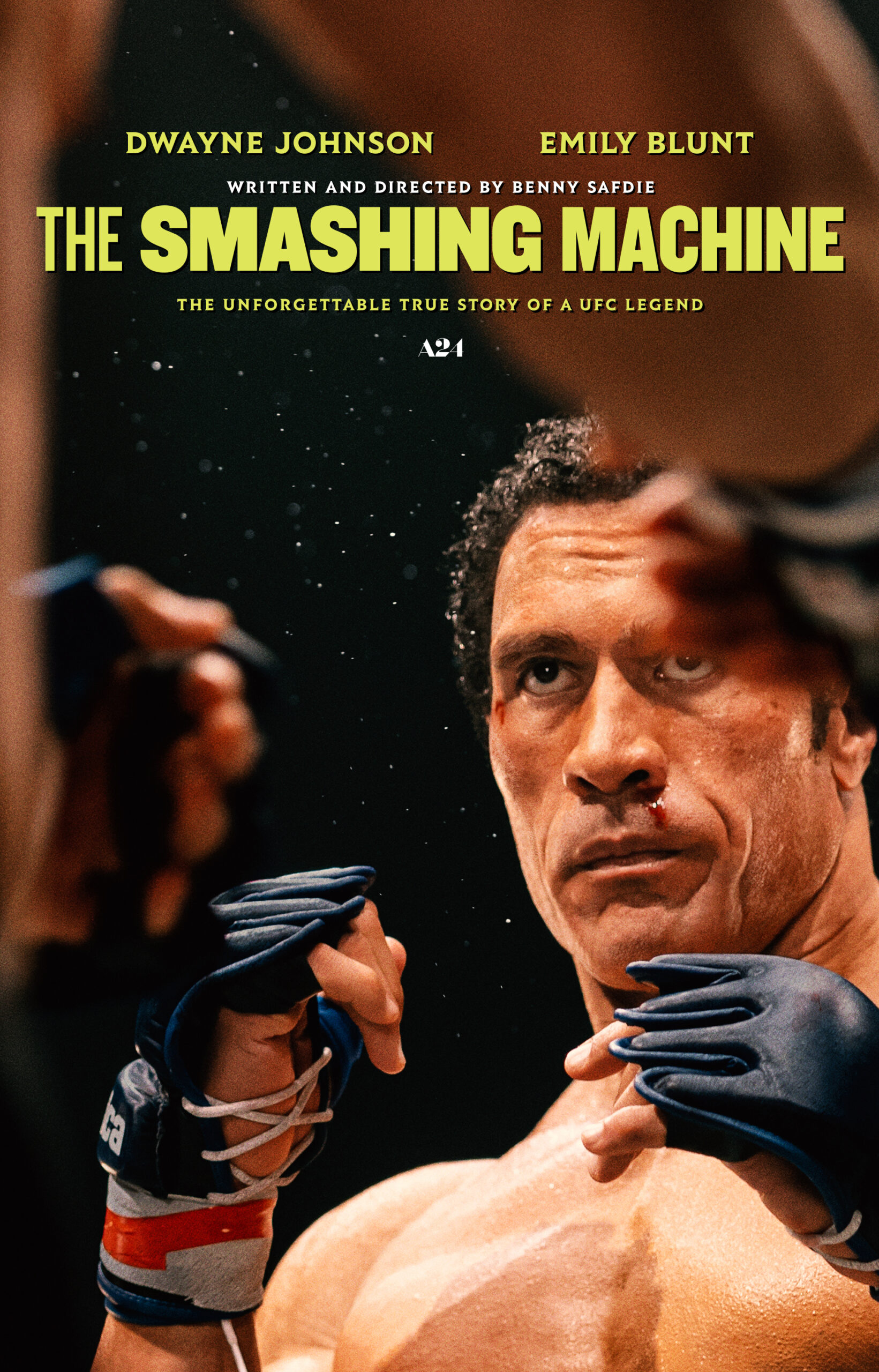
Posters for “The Smashing Machine,” directed by Benny Safdie, sell the movie as an emotionally powerful and unforgettable story. The biopic follows the career of Mark Kerr (Dwayne Johnson), a mixed martial arts fighter who becomes addicted to opioids.
“Winning is the best thing there is,” Kerr proclaims while smashing an opponent’s head into the ground to a peppy soundtrack. He relishes the fact he has never lost a match, so much so that Kerr describes winning as a “high” and draws a blank when a reporter asks him to imagine losing. The setup is promising: the eerie contrast of smiling music and a smiling man with the black havoc which bubbles just out of frame. Yet the execution falls flat, and more’s the pity.
Set in the ’90s and early 2000s, the story alternates between Phoenix, Arizona, where Kerr resides, and moody Tokyo, Japan, where he spars in an early version of UFC tournaments. As one might expect from an A24 film, the cinematography is beautiful: smart angles, masterful color grading, and a sensitivity to time and place. Yet even the best cinematography cannot make up for a bad script and poor acting.
At first, the flat and stilted dialogue feels appropriate to a film about an unmentionable problem in a sport with brain damage. But only five minutes in, it becomes apparent that the constantly choppy lines are less of an intentional artistic choice and more the fault of poor scriptwriters. Characters outside of the wrestling world, like Kerr’s girlfriend Dawn Staples (Emily Blunt) or a grandmother in a waiting room, speak with the same awkwardness as Kerr and his buddies.
Mark Coleman (Ryan Bader) is the worst of all. A longtime friend and trainer of Kerr, Coleman goes on to fight him professionally, while allegedly maintaining their friendship. Though the audience is told numerous times this is the case, we see very little to prove a deep bond remains between the two men. On paper, Coleman gets some of the most touching moments in the film, but his acting and the script leave the audience with furrowed brows rather than teary eyes.
The audience gets just a brief glimpse of a family scene with Coleman, his wife, and his young kids. Had it been better developed, even a minute or two with the Colemans could present an enchanting, alternate vision of life as a fighter akin to “The Cinderella Man,” while the intentionally childless Kerr spirals out of control.
Though Blunt’s acting is notably better than Bader’s, her character, too, is a disappointment. What could be a pivotal, heartbreaking scene in the movie between Kerr and Staples instead feels rushed and cumbersome, simply because the audience hasn’t had time or reason to start to love them. It’s yet another instance of Safdie elevating “tell” at the expense of “show”: it’s hard to empathize with the characters when you can feel the director hovering over your shoulder, whispering that you ought to feel bad for one or the other.
Some of the best-executed moments in the film occur as the couple spirals together. Staples is a master manipulator, her machinations fascinating, if not pleasing, to watch. “Just get over it,” she tells Kerr, dismissing a major loss for him. He punches back — or rather, doesn’t, by instead shutting Staples out of his life, though he is all she has.
The ending sequence raises more questions than it answers, particularly when the plot jumps from a major fracture between Staples and Kerr to their “happy ending” without giving any clue as to the growth and forgiveness they undertook.
The project “The Smashing Machine” embarks upon is a worthy one. Sports dramas become cliche when they give the impression that winning is “all there is,” as Johnson puts it. The film starts where most dramas like it end — with victory — and ends where most start — with a kind of loss. But to successfully subvert this genre, the movie needs an interior drama with enough clarity and depth to be compelling. Here Safdie fails.
The film fails to develop Kerr’s inner transformation. His addiction journey in particular raises the question: What greater motive propels Kerr to make the sacrifices he does? The viewer is forced to draw a blank. Kerr remains, effectively, how he started: his body a shell, his soul a mystery.
We need good films that do what “The Smashing Machine” attempted: remind us that the highest-performing bodies in fact have souls, and to neglect one is to soon ruin the other. A24 is capable of truly powerful sports dramas, as director Sean Durkin proved with “The Iron Claw” in 2023. But “The Smashing Machine,” true to its title, stays at the level of clanky mechanics.
