

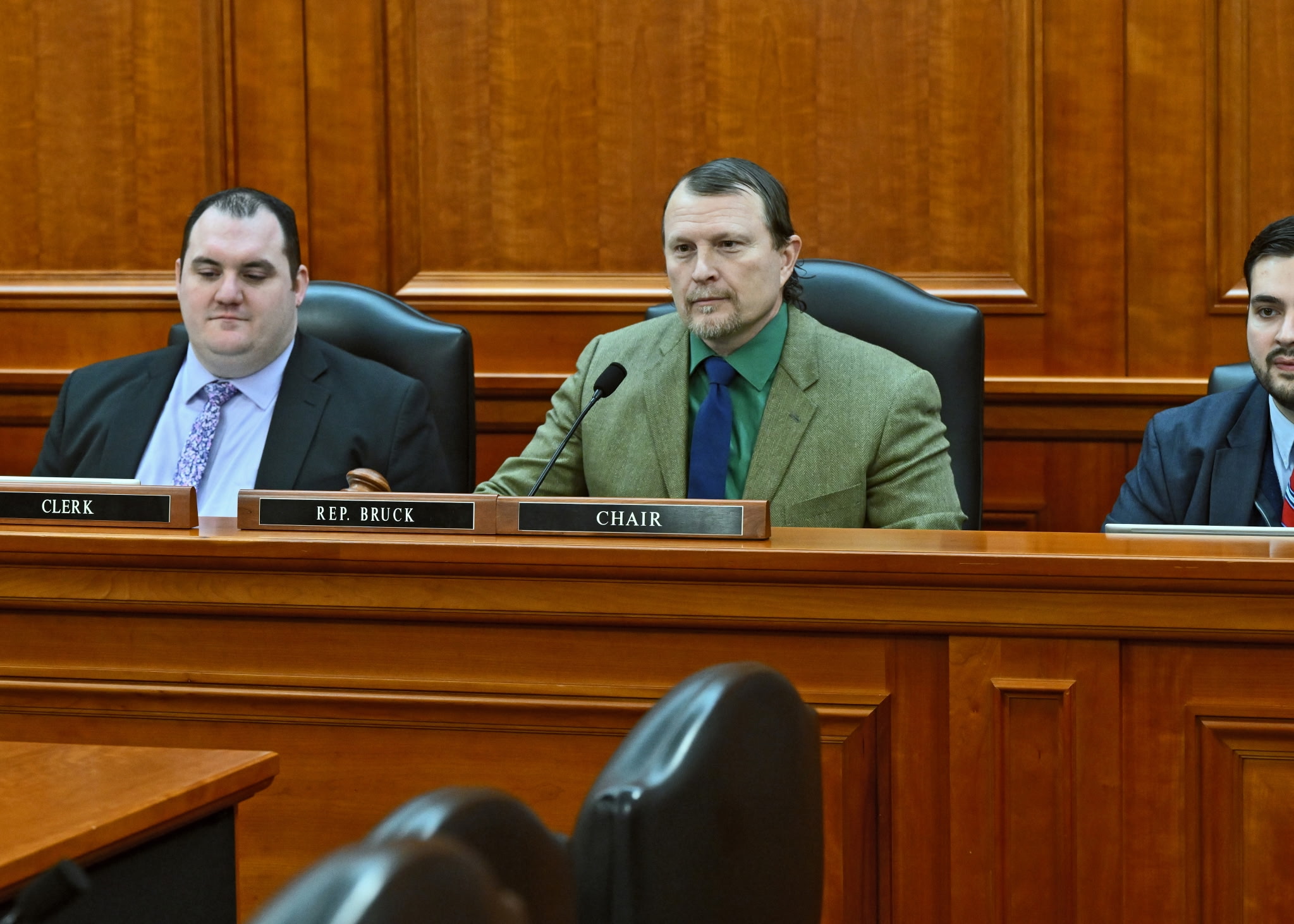
Rep. Bruck speaks at 9/11 Remembrance Ceremony. Courtesy | Will Bruck
As concerns about influence and surveillance by China and other foreign adversaries grow, legislators in Lansing, advised by a Hillsdale graduate, proposed a package of bills last month aimed at protecting Michigan.
Members of the Michigan House Oversight Committee introduced the 10-bill package last month, which included legislation to prevent foreign farmland purchases and factory construction within range of military bases to safeguard against surveillance. As of March 26, six of the 10 bills had moved out of the committee.
Joseph Cella ’91 advises Republican members of the committee on national security matters involving China. Before his time assisting in state government, he served as the ambassador to Fiji under Trump’s first administration. He is also the co-founder of the Michigan China Economic and Security Review Group.
“I’m an informal adviser to some members of the committee, which will provide the necessary framework to investigate, expose, and then counter threats,” Cella said. “This is an important educational moment. This also plays a very important role in educating the private sector citizens in terms of the nature of the threat that is out there.”
Many of those bills follow similar frameworks to legislation that Bill Evanina, a former intelligence official in the first Trump administration, helped propose in Alabama, Arkansas, and Virginia.
“The strategic national threat posed by the Communist Party of China is, at its very core, local,” said Evanina, an informal adviser to some members of the Michigan House.
“Part of my business is to educate and inform governors, legislatures, and chambers of commerce on what China does at the local level,” Evanina said. “I would counter an error that there’s nothing partisan about defending against the Communist Party of China. And if someone tells you that it is, they’re just not educated enough to understand not only the nuances but what it really means for our nation.”
One of the bills would prohibit foreign entities from purchasing Michigan farmland, particularly if within a 20-mile range of military installations. Another would ban certain applications, such as TikTok, from being downloadable on government-issued devices. HB 4236-41 relates to combating foreign influence in economic and educational agreements, which often appear as grants or business contracts. The final bill, HB 4242, would require all state healthcare groups to only use online record software maintained in the United States or Canada.
Evanina said he advocates for a “copy-paste” campaign, where other states use legislation that was already effective in states that passed the policy earlier.
“Other states have put in roadblocks and stop gaps. It’s a risk-based decision,” he said. “You can still decide to do this, but you know all the risks now.”
While it’s been a bipartisan effort at the federal level, Cella said, the Michigan House has had more of a partisan struggle.
“In D.C., you see great bipartisan success and collaboration, where it was almost a super majority, virtually unanimous vote to create the select committee on the Chinese Communist Party, doing cutting edge work,” Cella said. “That is the model for what Michigan legislators are now doing. The new Republican majority of the House was integral for this work to be done.”
Cella said he hopes Michigan House Republicans can gain co-sponsors across the aisle, leading to a victory in the Democrat-majority State Senate and a signature from the governor.
“In the Preamble to the Constitution, there’s the charge to provide for the common defense, and anything involving national security can’t be partisan,” he said.
State Rep. William Bruck, R-Erie, chair of the newly established House Oversight Subcommittee on Homeland Security and Foreign Influence, said the key issue at hand is transparency.
“That’s what these bills are about, bringing to bear that there is an active threat in Michigan, and these bills will bring transparency to the public that we care about these threats,” Bruck said. “We care about our country, and we’re not just being complicit.”
Oftentimes, surveillance takes the form of factories owned and operated by foreign nationals, Evanina said. He said the 2022 CHIPS and Science Act’s goal of bringing semiconductor manufacturing back to the United States is under particular watch by the CCP.
The Ford Motor Company faced backlash over deals made with Chinese-owned battery corporations, most recently over the BlueOval EV plant, a deal made between Ford and Contemporary Amperex Technology, or CATL. State representatives, in a recent report on foreign influence, expressed concern over its close location to the Battle Creek Air National Guard Base. CATL was later blacklisted by the U.S. Department of Defense for its alleged ties to the Chinese military.
A similar deal was made with Gotion, another Chinese-owned battery plant. The Mecosta County facility’s construction has been halted by a lawsuit, citing concerns over its proximity to the Big Rapids National Guard Armory.
“The Chinese came in and manipulated economic development portions of Northwest Michigan, and they got agreements to build battery plants to facilitate the EV programs that were being promulgated by the Biden administration,” Evanina said. “But CATL, the company is a Chinese company. It’s a subsidiary of a state-owned enterprise. So basically, we are bringing the Communist Party of China into Michigan to build batteries and stifle our supply chain. They’re willing to build something that’s 80% of the technical proficiency at 20% of the price.”
As it stands, Evanina estimates that CATL is looking to build 13 factories across the United States.
The issue extends to farmland as well. A 2023 Department of Agriculture report revealed that China owns at least 277, 336 acres of American soil. While that represents less than 1% of foreign-held acreage, a substantial portion of that land is next to military and nuclear installments. Michigan, with 8.5% of foreign-owned land, is the state with the third largest amount of land in international hands.
“You look where they procured U.S. farmland. It’s usually not for farming. No, they’re all located near strategic military bases where they can put cell towers up, listening devices, and signal intelligence,” Evanina said. “And it’s not just farmland. They’re also buying commercial real estate in houses near strategic military locations because they can put people in those that serve as lookouts, as informants, as people who could recruit others who live around there.”
The Michigan House bill package expresses particular concern over “nontraditional collectors,” or citizens who act as proxy spies in everyday jobs. This often takes the form of interns, international students, or government-contracted employees.
This is partially by design — China’s National Intelligence Law mandates its own citizens, not just state-recognized spies, to “support, assist, and cooperate with national intelligence efforts in accordance with law, and shall protect national intelligence work secrets they are aware of,” according to Section 1 Article 7.
China’s influence often leaks into Michigan’s education system. Last year, five Chinese nationals who graduated from the University of Michigan were charged for filming the military training facility Camp Grayling.
The bill package also recognizes surveillance can take place without human presence, be it through drones or digital applications like TikTok. According to a release from the Michigan House Republicans, the Michigan State Police, for example, uses surveillance drones made by Chinese factories. When flying over government buildings, imagery can potentially be sent back to the CCP.
Evanina said foreign influence is far more inconspicuous than people may realize.
“If you own a farm somewhere in rural Michigan, and you are 100 miles from the military base, you probably don’t even know it,” Evanina said. “And then some company comes out, and offers you two or three times the value of your land, right? They’re not coming to you as saying, ‘Hey, we’re the Communist Party of China,’ they’re coming and saying ‘We’re LMNOP LLC.’ That’s where there has to be a better way, federal legislation to advise and inform those landowners and be able to prevent that kind of procurement.”
Send tips to the City News team: collegiancitynews@gmail.com
