

Elijah, Mary Catherine, Margaux, Patrick, Max, Thomas Smith with their eggs. Courtesy | Lauren Smith
As prices rise, more residents raise broods at home but not just for ‘dollars and cents’
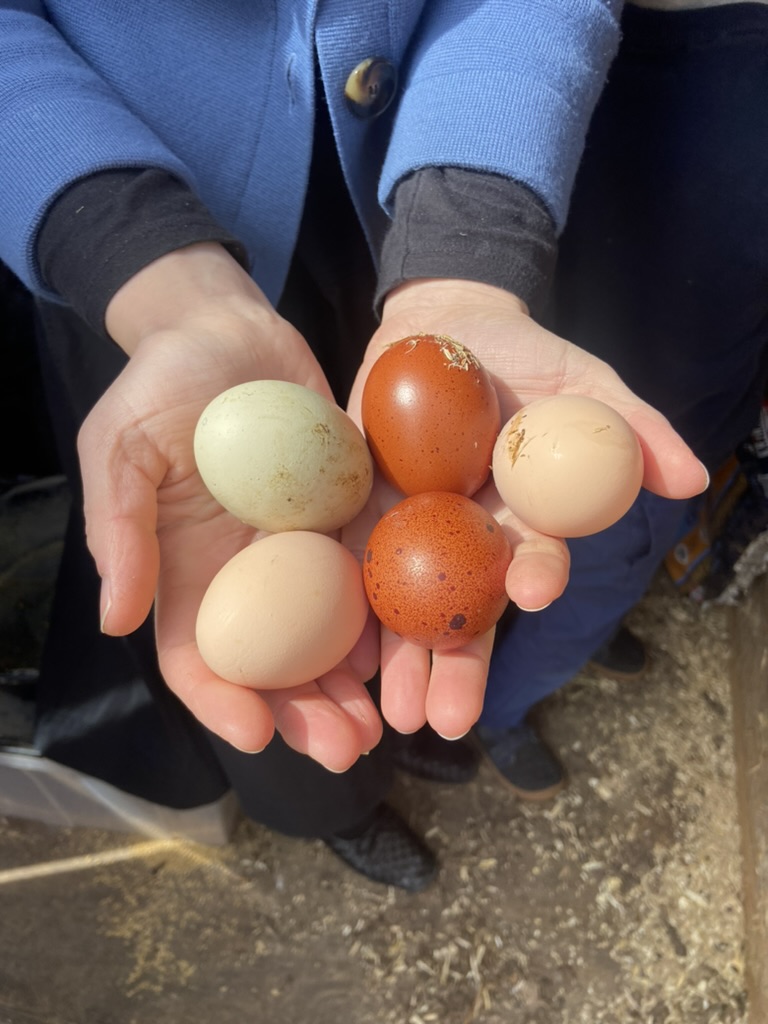
As egg prices soar to a minimum of almost $5 a dozen, raising backyard chickens in Hillsdale has become more popular.
Earlier this month, Secretary of Agriculture Brooke Rollins said she wants to help citizens raise chickens on their own to combat the climbing prices.
“We also want to make it easier for families to raise backyard chickens,” Rollins said in a Fox News interview March 3.
Some Hillsdale families have already started this project and have found the value of raising their own chickens outweighs the ease of simply going to the store. Jonathan Smith, the college’s senior director for continuous improvement, and his family have kept chickens for around a decade and continue to expand their flock each year. Smith and his wife, Lauren, both alumni of Hillsdale College, said they are certain that the investment of raising chickens is worth it.
“A lot of people tend to be pretty mechanical in their calculations about these things where it’s purely an investment — a value proposition of dollars and cents,” Smith said. “But I think the reality is that it’s more than just a dollars and cents function. It’s also the health and intangible values that it brings to the family.”
Mary Catherine Adams ’16, another Hillsdale local who raises chickens, agreed.
“We see so many pros beyond just saving money,” Adams said. “They bring quite a bit of richness to life.”
As well as providing an enriching lifestyle, Adams said the nutritional benefits of chickens contribute to the value of raising them. The chickens eat and digest insects, which creates nutrient-dense eggs to nourish her family.
“We let them fertilize the garden all winter long because their manure is great fertilizer,” Smith said. “Or if you need an area clear, you can just put them in that area for three or four weeks and it becomes dirt.”

The Smith children with some of their chickens. Courtesy | Lauren Smith
In 2019, the Michigan Cage-Free Egg Law required all eggs sold in the state to be from cage-free farms, with a few exceptions for smaller farms. This law took effect in December 2024 and, combined with the recent bird flu outbreaks, has escalated the already rising prices of eggs. In Hillsdale, locals who raise chickens still face their own kind of regulations.
Michael and Lindy Jordan, a retired Hillsdale English professor and his wife, raised chickens in town for 15 years. They said the chicken regulations are not entirely clear in Hillsdale. For those outside city limits, people are free to have as many chickens as they want. Yet, in town, a law limits residents to six chickens, according to Adams.
“There are some people in the local government who want to change that,” Adams said. “They think this is a worthy effort, and we should be able to feed our families.”
Occasionally, chickens in town can also cause trouble by wandering away into other yards or even the road, according to Jordan.
“Mr. Fine Feathers was a beautiful rooster,” Jordan said. “Dark brown, red, green, and purple. He was beautiful. But he chased our daughter Mary on her bicycle, he challenged people on the sidewalk, and he and I had four or five epic battles.”
Despite the potential inconveniences of unruly chickens, the Smiths said they enjoy the natural routines that come from caring for animals daily. They said it teaches their children the value of growing their own food and gives them hands-on lessons about the power of observation.
“The kids feed the chickens every morning and then go collect their eggs every afternoon,” Smith said. “They have a certain sense of pride because they’re like ‘Hey those are the eggs I collected!’”
Adams agreed that the daily routine with chickens is highly valuable for both children and parents.
“There’s a sort of rhythm to it that I think is really beautiful and good,” Adams said. “We’re so out of touch with those things in our culture today and so I think chickens are a little bit of a way that we can enter back into the reality of things.”
The Adams and Smith children are actively involved in caring for the chickens. The Jordans also said their children experience a vibrant childhood growing up with chickens.
“My favorite story about John and the birds was when he put three of them in a pail and climbed to the top of the black maple tree on the corner of our yard,” Jordan said of one of his sons. “I thought he was going to try to teach them how to fly, but he just wanted to take them on an excursion.”
Smith and Jordan said that while raccoons, dogs, and even hawks prey on chickens, the potential death of chickens is not a major inconvenience and can actually serve to teach children valuable life lessons about mortality.
“It teaches the reality of life and death,” Smith said. “You get them as baby chicks and it’s fun to bring them home from Tractor Supply, but we’ve raised meat chickens as well, and you have chicken butchering days and so you’ve got to kill them or they will die from other things.”
Raising chickens could potentially save money, but the real value comes from the lifestyle change that chickens bring, according to the Smiths.
“You can’t put a dollar and cent sign on that,” he said. “There are these intangible values about what makes us human that are much more important than ‘Did I save 20 cents on my dozen eggs?’”
Send tips to the City News team: collegiancitynews@gmail.com
