
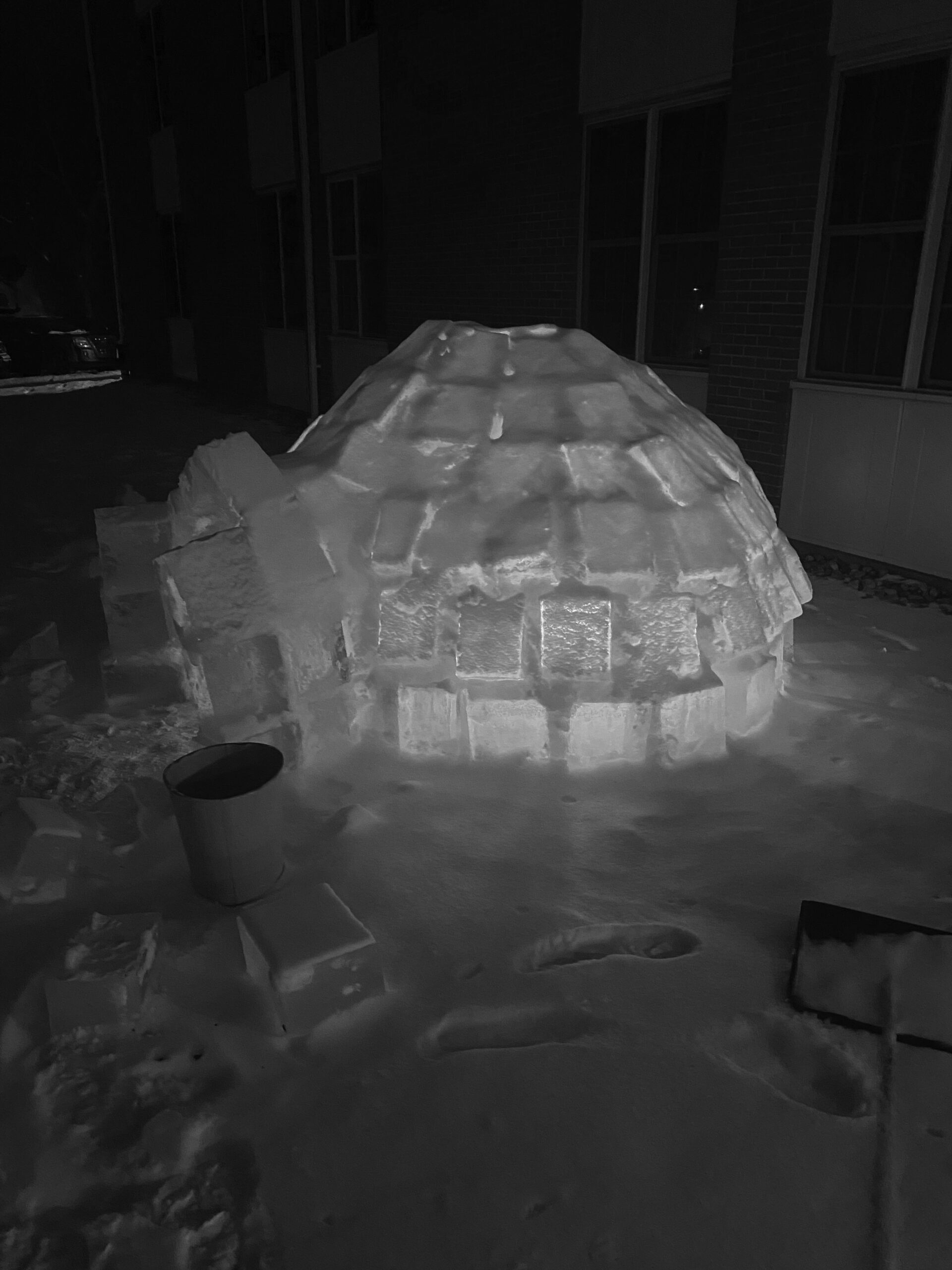
After 40 hours of work and two tons of ice blocks, four men from Simpson Residence constructed an igloo outside the dorm.
“Doing something cool that nobody else would really do, and going to a ridiculous amount of effort to do something that’s going to melt in a week, just for the sake of it, is kind of fun,” sophomore Andrew Hawken said.
Hawken and sophomore Wyatt Peters had extra time on their hands when Hawken decided to build an igloo, according to Peters.
“He wanted to build an igloo all of a sudden,” Peters said.
The full project took four days, according to Peters and Hawken. They first tried snow blocks, but the igloo kept crumbling, Hawken said.
Peters and Hawken said their next idea was to build the igloo with ice. They first went to excavate ice at Winona Lake, across from Slayton Arboretum, but security found them and ordered them off the ice.
“The security guy was very nice, but he said that we couldn’t be out on the ice. There was running water underneath that causes thin spots and people have fallen through before, so it’s a liability for the college,” Hawken said.
Peters said he was surprised the chainsaw wasn’t more of an issue.
“I was mostly just surprised that he didn’t ask us what we were doing with a chainsaw,” Peters said.
Undeterred by the incident with security, Peters and Hawken said they moved the operation to Baw Beese Lake. They worked day and night to cut and move the ice.
Hawken cut strips of ice with a chainsaw before cutting them into blocks. The men then used snow shovels to remove the ice from the water.
“We didn’t reach into the water at all because we tried that once, and our hands got so cold that we would have gotten frostbite if we’d done that for all the blocks,” Hawken said.
From there, Hawken said they slid the blocks across the ice to shore.
Initially, the pair used Hawken’s car to transport the ice blocks back to Simpson. They lined the car with plastic to prevent the melting ice from ruining the seats.
“We only managed to fit 15 blocks in his car, and each block was 30 pounds. So we had 450 pounds of ice in his car,” Peters said. “It was pretty inefficient and it was gonna take a really long time.”
Sophomore Victor Fernandez loaned his truck for hauling ice, Peters said. This way, they could haul up to 50 blocks of ice per trip. With each block weighing around 30 pounds, they transported about 1,500 pounds per trip.
Sophomore Jack Baldwin and freshman Thaddeus Reudelhuber also helped excavate the ice. Baldwin said he was motivated to help because building an igloo is a rare occasion.
“There’s not many opportunities anywhere south to build igloos,” Baldwin said. “It was therapeutic. I would cut ice for a living.”
But Hawken and Peters said the same cold conditions that made the construction possible also made the process arduous and painful. After hours of excavating, Peters said his tendons hurt and his gloves were frozen stiff.
“I definitely damaged those poor gloves. It took two and a half dryer cycles with just my gloves in there to get them dry,” Peters said.
Hawken said his pant legs froze completely solid from the water kicked up by the chainsaw.
“It was 10 degrees outside, so all that water hit my jeans and then froze solid,” Hawken said.
For the construction of the igloo itself, the Simpson men laid a foundational layer to outline the base. They mixed water and snow to create a slush mixture to pack around each layer of ice blocks.
“It was six degrees, so it froze instantaneously, and after a few minutes, you could put your whole weight on the ice blocks and it wouldn’t break,” Peters said.
Hawken and Peters said they each took turns spending a night in the igloo.
“I slept a good seven hours in there, and I was actually too warm,” Peters said.
Hawken said he felt safe sleeping in the igloo because he was confident in its structural integrity.
“It was actually pretty snug; it kept the wind out and everything,” Hawken said.
Six days after the men completed the igloo, warm weather made the slush mixture melt and the structure collapse. Hawken and Peters said they decided to smash it with a sledgehammer.
“We just smashed it to bits, which was fun, but it was also sad,” Hawken said.
Peters said he didn’t want to destroy the igloo, but it was the proper decision.
“We put it out of its misery; it was the right thing to do,” Peters said.
Hawken said the difficulty of building the igloo added to its worth.
“It was pretty hard to do, which adds value to it,” Hawken said.
Despite the cold working conditions, Peters said he hopes it becomes a Simpson tradition.
“It was really awful, but it was a ton of fun. I would definitely do it again next year,” Peters said. “It was worth it for the igloo.”
