
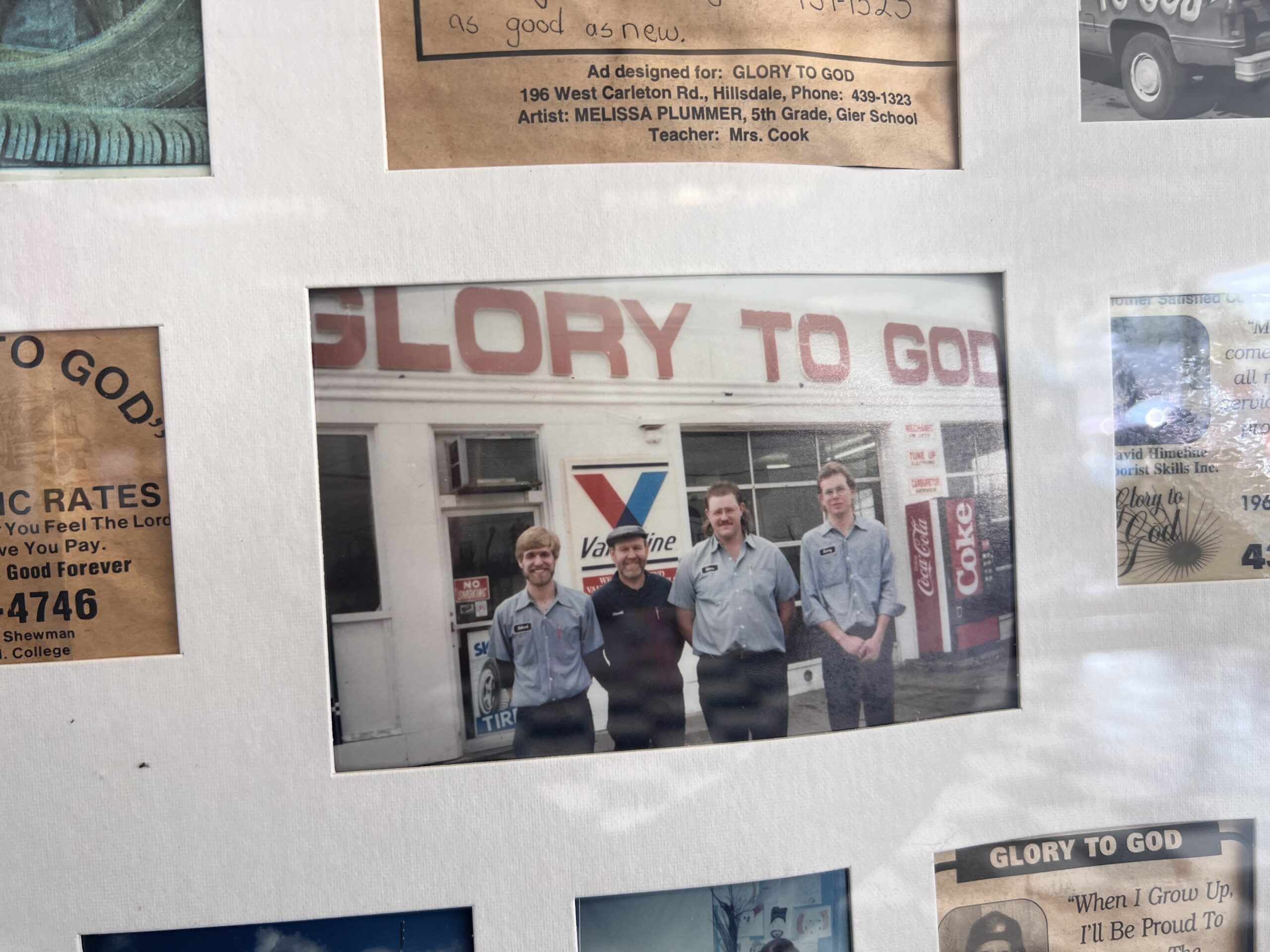
Photos from the past four decades capture the history of the Glory to God auto shop. Sarah Katherine Sisk | Collegian
Students should drive their cars more often to prevent battery failure in the winter, according to Robert Schuman, owner of Glory to God Auto Repair.
With February’s temperatures hitting as low as 2 below zero, Hillsdale auto repair shop employees said they have noticed an uptick in weather-related repairs, often connected with car battery failure. Students who keep vehicles on campus and drive infrequently in the winter are more prone to have car issues.
“Just activating that battery and getting a little bit more charge back into it would definitely help,” Schuman said. “That way when they want to leave for the weekend, or some break coming up, they’re ready to go.”
Other mechanics also said they saw more battery issues in the cold weather.
“With winter time we’re certainly seeing a lot of battery replacements,” said Chelsi Dryer, owner of Parney’s Car Care. “The harsh cold is really tough on those batteries. This is the time of year that you’ll do more battery replacements, a lot of wiper blades, and tires.”
When vehicles don’t start in low temperatures, it’s generally because of a battery issue, according to Mathew McLain, manager at Phat Jaxx Automotive LLC.
“When everything is cold, it takes more juice, more amperage to get it to start,” McLain said. “So if the battery’s subpar to begin with and it gets real cold, then it won’t start.”
Aside from weather-related maintenance, winter also brings in more inconsistent business for auto repair shops.
“The only time business is different is from mid-November to the first of the year just because of the holidays,” McLain said. “And it’s not always real slow or real busy, it’s just kind of up and down for that six weeks or so.”
Schuman said he sees a dip in business post-Christmas, with clients reluctant to bring a car in for repairs unless absolutely necessary.
“People spend all their money on Christmas, so sometimes they don’t want to get their car fixed in January,” Schuman said. “If their car breaks, they don’t really have an option, they have to get it fixed, but if there’s something they can put off for a while, we see that happen a lot.”
Business fluctuates for Parney’s throughout the year, according to Dryer.
“The animal of the auto repair industry is that it truly does ebb and flow,” Dryer said. “It’s really hard to hit any sort of pattern because cars just don’t break certain things based on weather, and maintenance needs come at a mileage interval, not at a season interval.”
Since COVID-19, Schuman said he’s seen a delay in the arrival of car parts that used to be available overnight, but now take an extra day to arrive.
“I’m not exactly sure what the cause is, but my opinion would be just a lack of workforce slows things down,” Schuman said. “It’s better than it was then, obviously, because nobody was working, but it just hasn’t regained the level it was before.”
Slower supply does not affect repair shops much, other than the inconvenience it causes to customers, according to Schuman.
Although electric vehicles are slowly becoming more common, repair shops say they have not seen many come in for repairs. Schuman said he will fix tires and brakes on electric vehicles, but he sends electrical repairs back to the dealer because of the technicality and high voltage involved.
While most car batteries contain roughly 12 volts of power, electric vehicles can carry up to 800 volts.
“You have to take a lot of precautions,” Schuman said. “If they have to go into an electric vehicle, they have to rope off two service bays to keep people out and to keep just one guy working.”
Auto repair shops are also concerned about an issue classified under the Right to Repair Act, involving repair shops’ abilities to access information necessary for completing repairs.
“The auto manufacturers would like for us not to be able to repair their vehicles,” McLain said. “And that wouldn’t just mean me as a locally owned and operated business, but the purchaser who owns this.”
McLain said manufacturers have been increasingly restricting their access to software, requiring a dealership to complete repairs as simple as a brake job.
As spring approaches, so does Michigan pothole season, often increasing suspension and brake work in repair shops, according to Dryer.
“Suspension, brake components, that wear happens mile by mile,” Dryer said. “They cannot be avoided, but they can certainly be postponed by driving your vehicle a little bit more gingerly and not beating the crumb out of it.”
Send tips to the City News team: collegiancitynews@gmail.com
