
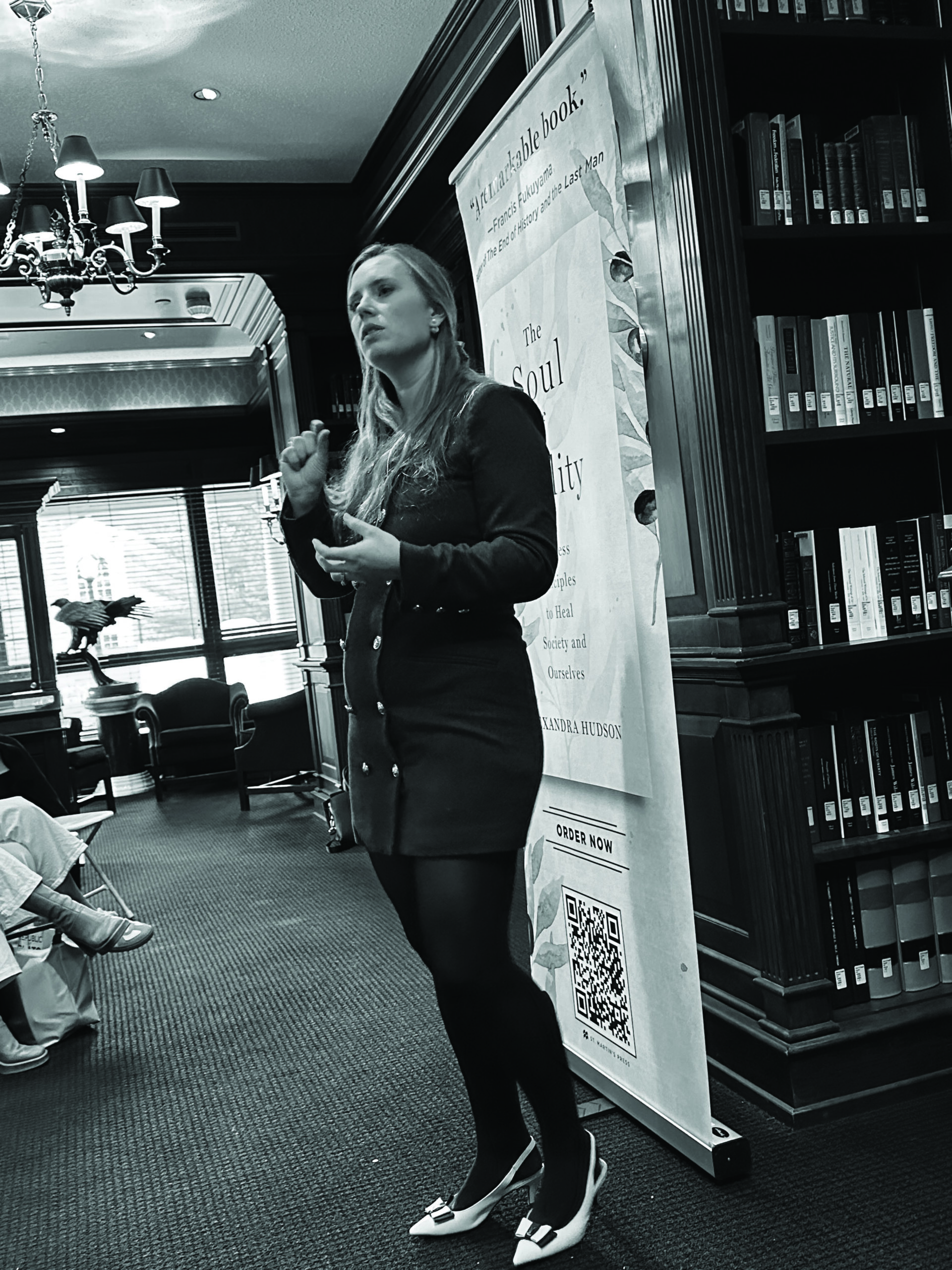
Alexandra Hudson recently published a book on civility. Catherine Maxwell | The Collegian
Adopting civility in daily life could heal our divided society, said Alexandra Hudson in her Feb. 10 lecture “The Soul of Civility,” also the title of her latest book.
Hudson, the founder of the online community Civic Renaissance and 2020 Robert Novak Journalism Fellow, gave the lecture as part of a book tour spanning five countries and more than 60 cities.
Hudson said the world needs less politeness and more civility.
“Politeness is technique. It’s external stuff — what we say, what we do,” Hudson said. “Civility is internal. It’s a disposition of the heart. It’s a way of seeing others as our moral equals, worthy of a bare minimum of respect just by virtue of our shared moral status as members of the human community.”
Hudson said her parents taught her civility and intellectual curiosity, but the “utterly toxic” work environment in the U.S. Department of Education disillusioned her of her belief in natural societal civility. She spent a “soul-crushing” year working at the department before she and her husband moved to Indiana.
“I’ve come to realize that my experience in government was a microcosm of the deep divisions in our world and our country right now,” Hudson said.
Hudson said the experience at the department revealed two extremes in the way people interact and relate with each other.
“On one hand, there was a contingent that was bellicose and hostile. They were willing to step on anyone and steamroll anyone in order to get ahead and get what they wanted,” Hudson said. “The other contingent was polished and poised and polite. I thought these were my people, but they would smile and flatter me one moment and then stab me and others in the back the next.”
Hudson said she realized both extremes dehumanize people: the first by bullying and the second by manipulating. Politeness is not a solution because it “papers over differences” between individuals.
“The goal is not to eradicate difference,” Hudson said. “It’s to peacefully coexist, perhaps even thrive in light of difference, which is why civility is indispensable to a free and flourishing society and democracy.”
Hudson said her book is about navigating life in a society with competing visions of the good.
One of the best ways to practice civility, she said, is through “porching,” a term based on an experience with a woman from church inviting Hudson and others to gather on the woman’s veranda.
“This was her quiet revolution of saying, ‘I can’t control what’s happening in Washington, who’s president, or even what’s happening down the street at city hall, whether my roads get paved or plowed,’” Hudson said. “‘But I can control myself, and I want to choose to make my community better, stronger, and more beautiful.’”
Hudson said “porching” is about turning people from outsiders into insiders.
“People across the country, across the world, are doing the same thing and saying, ‘I can’t change the world, but I can change myself,’” Hudson said. “There’s tremendous subversive power in that.”
Hudson said her journey with civility came in part from her mother, Judi Vankevich, known as “Judi the Manners Lady.”
For more than 30 years, Vankevich has taught children about manners through music, live concerts, and published books. Hudson grew up touring North America with her mother, and now Vankevich is helping Hudson with her book tour.
“We need to win our children, and teaching manners and civility starts with reaching our children with truth,” Vankevich said. “It’s entertainment with a purpose.”
Senior Anna Maisonville said she found Hudson’s lecture encouraging.
“We hear a lot of depressing and abstract conversations about our world today, but I appreciated a very tangible vision for how we as individuals can help heal our society,” Maisonville said.
Hudson said restoring civility would bring back a tradition that stretches back to the ancient Greeks.
“I encourage you to keep that in mind that we can’t change the world, but we can change ourselves,” Husdon said. “If we choose to reclaim the soul of civility, we might be able to heal our broken world, or at least make it a little more gentle, for ourselves and for future generations.”
