
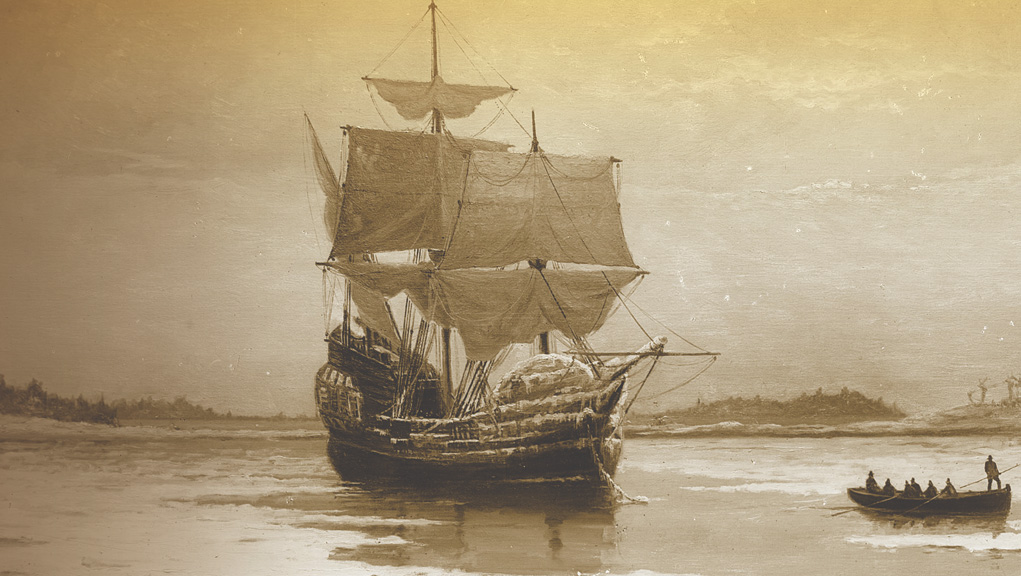
Speakers for CCA I: Christianity in America discuss American history and the country’s roots in religion. Courtesy | Hillsdale Archives
Christianity is necessary for the morality and preservation of the American republic, according to speakers at this week’s Center for Constructive Alternatives seminars.
“A post-Christian America will not just be hostile toward individual Christians, but it will also be hostile to those ideals and principles that are derived from and are dependent on Christianity,” speaker John Daniel Davidson said Tuesday evening.
Hillsdale held its first CCA of the academic year, “Christianity in America,” from Sept. 29 – Oct. 2.
George Marsden, author of “Jonathan Edwards: A Life,” spoke Sunday evening about “Jonathan Edwards and Christianity in Colonial America.” Marsden said Jonathan Edwards has become known as one of Christianity’s most prominent theologians and talked about how Edwards would contemplate God’s creation.
“God is constantly speaking in creation,” Marsden said. “We can all get glimpses of this in nature when we see a gorgeous sunset or wonderful trees in the spring, we get some sense of the beauty of God in creation.”
Marsden said Edwards would go into the fields and contemplate God’s creation and how it pointed to the beauty of Christ.
Marsden also talked about Edwards’ contemporary, George Whitefield.
“Whitefield was the first American celebrity superstar,” Marsden said. “He preached several long tours up and down the colonies. Word that he was coming would spread like wildfire, and it seemed that almost everybody who was able-bodied would come out to hear him speak.”
Daniel L. Dreisbach, professor of justice, law, and criminology at American University, spoke on “Christianity and the American Political Tradition” Monday afternoon.
Dreisbach contested the claims that the United States was founded as a secular nation with total separation between church and state. He said the Founders were inspired by the Bible while drafting the founding documents.
“My first observation is that the Founding Fathers read the Bible,” Dreisbach said. “That shouldn’t surprise us, because after all, the Bible was the most accessible and authoritative text for 18th-century Americans.”
Dreisbach cited a study from the American Political Science Review, noting that the Bible was cited more often than any European writer in early American political writings. He said the Bible gave a representation of human nature and showed the laws that the Hebrew republic put into place, which also aided the Founders in writing the early laws in the United States.
“Although the Founders did not seek to replicate the Hebrew model in all its details, its biblical precedent reassured many that republicanism was a political system that enjoyed divine favor,” Dreisbach said.
In addition, Dreisbach said the Bible also gave the early Americans justification for disobeying the unjust rule of King George III and declaring independence.
“Patriotic Americans emphasized that civil authorities are established for the good of civil society,” Dreisbach said. “Moreover, as the argument goes, civil magistrates have no authority from God to act contrary to the public good. Accordingly, one who bears the title of civil magistrate, but is a terror to good works, deposes himself.”
Davidson ’04, author of “Pagan America: The Decline of Christianity and the Dark Age to Come,” gave the final lecture of the series Tuesday evening on “Christianity in a Post-Liberal World.”
According to Davidson, the United States is in danger of falling back toward paganism if we lose sight of Christianity.
“The pagan ethos will be the dominant view of a post-Christian era,” Davidson said. “It is a worldview that is wholly incompatible with something like American constitutionalism or an American republic.”
Americans must return to Christianity to save the republic, Davidson said.
“We have to reject the fatuous notion that liberalism divorced from Christianity can sustain Western civilization,” Davidson said. “Liberalism’s claims about human rights and dignity are empty without the religion from which they sprang. The idea that we can have the one without the other is a pernicious delusion and the sooner we rid ourselves of it, the better.”
Sophomore Luke Myers said Davidson’s lecture was his favorite of the series.
“The claim that the future of America will be one characterized by paganism rather than secularism is a notion which definitely helps me understand the roots of wickedness in American public life,” Myers said.
The series concluded with a faculty roundtable Wednesday afternoon.
Assistant Professor of English Patrick Timmis encouraged young Christians to stay strong in the faith and to foster strong Christian communities on the local level.
“There is a virtue to staying true to the faith of your fathers, assuming that faith is orthodox trinitarian Christianity” Timmis said. “Keep the faith, and know that you will always be part of this work that we’ve begun here.”