
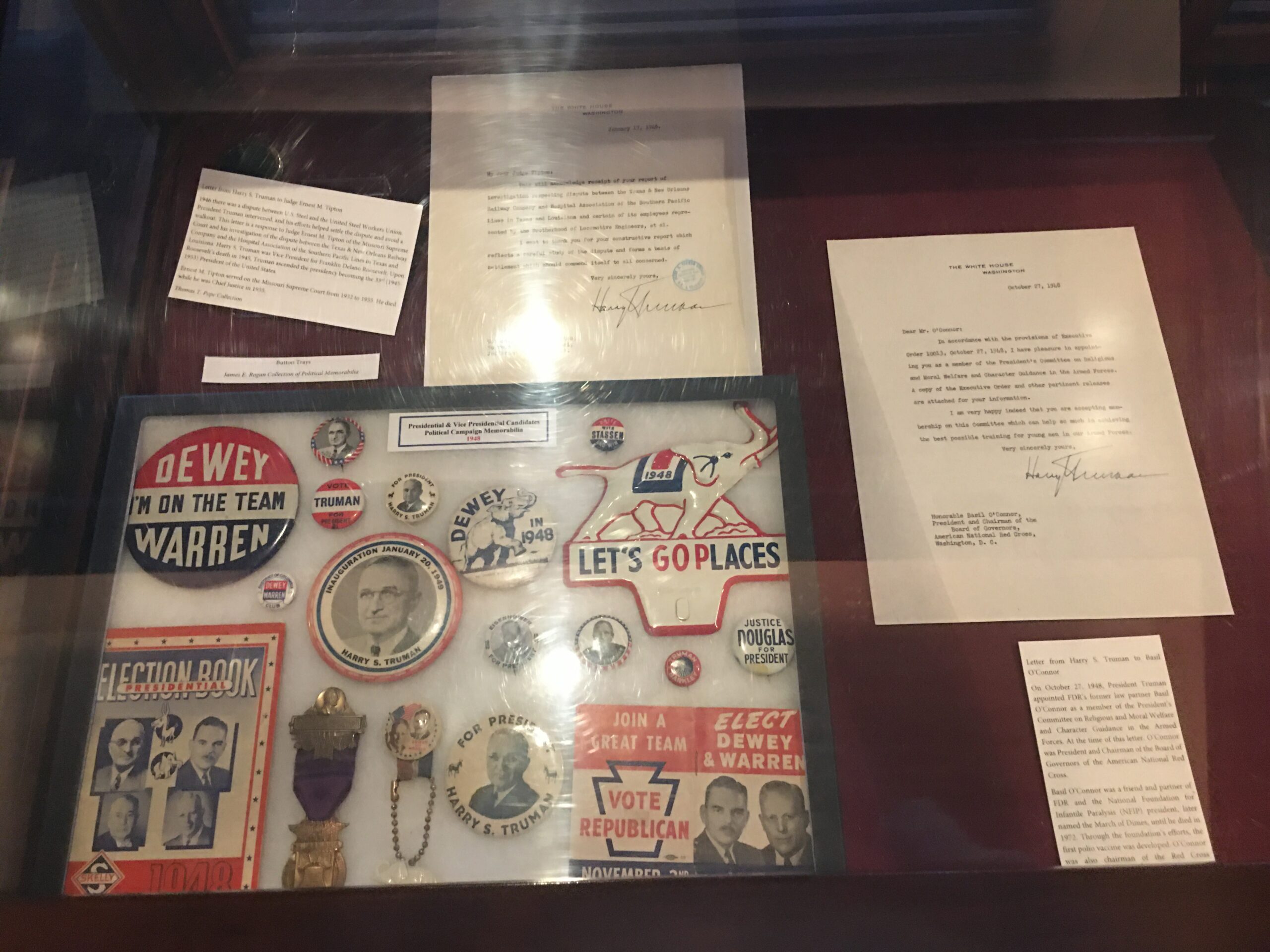
New displays of pesidential letters and trays of political memorabilia can be found in the Heritage Room. Courtesy | Megan Li
Hillsdale’s newest archive features letters from former presidents, artifacts from the college’s history, and political memorabilia — including more than 160 trays of pins and buttons from various election campaigns.
James E. Rogan and Charles G. Schott are the donors contributing to the collection, according to Markie Repp, library technician for Archives and Special Collections.
“A lot of pieces that are relevant to not just the White House’s history, but the nation’s history,” Repp said. “At a time when most places are wanting to erase it or tear it down, we’re here to preserve it, to make sure it lasts.”
Repp said she loves sharing the exhibits with the students and watching them admire the past.
“Just seeing the joy on their faces was really fun,” Repp said. “That’s what we’re here for, and that’s what we want.”
According to Repp, the donors are very generous, and every collection is the result of a donation to the college. Repp said donors usually ship artifacts to the college or bring them themselves.
“We have boxes upon boxes upon boxes, so it’s time consuming to go through and catalog everything,” Repp said. “What we have out is barely scratching the surface.”
Repp said the artifacts in the Heritage Room — from campaign products to presidential letters — date as far back as the time of Franklin Pierce, Grover Cleveland, and Teddy Roosevelt, with memorabilia from John F. Kennedy in the 20th century being the newest addition.
“It was very fun to do the exhibits and to see them and to touch them, and, you know, try not to freak out a little bit because I’m touching these things,” Repp said. “That was just an absolute joy to put together.”
Sophomore Ava Jolley said she was not aware of new exhibits in the Heritage Room, and she was excited by the pin collection, especially as someone who collects pins herself.
“My grandpa started that pin collection and he gave it to me when he moved, but they’re all reproductions,” Jolley said. “But it was really cool to see the legit ones since I’ve seen the reproductions and how they differ — even just materials.”
Jolley said she liked the connection between this year’s election and the new exhibits, emphasizing the importance of American election heritage here at Hillsdale.
“It’s an election year,” Jolley said. “They also had some of the really big presidential names that had a lot of controversy in the running — just like this year.”
Repp said they put out various letters from Thomas Jefferson, James Monroe, and John Quincy Adams for the library’s freshman tours. She said it is a rare collection for a college as small and rural as Hillsdale.
“The looks on their faces when we told them these were not replicas,” Repp said. “Seeing this sort of awestruck and wonder like ‘oh my goodness, we have this here.’”
Repp said she worked with her colleagues to put together the exhibit in the Hoynak Room, featuring pieces from the college’s history in celebration of Hillsdale’s 180th anniversary. The Hoynak Room collection includes a 1916 baseball uniform, fraternity pins, photograph albums from the 1860s to the 1880s, portraits and watercolor paintings as well as a journal from Daniel M. Graham, a former president of Hillsdale College.
“A lot of alumni are very proud of their time here at the college,” Repp said. “Their families have donated these things back to us to preserve the history.”
Archivist and Special Collections librarian Lori Curtis said she was especially struck by the story of Henry Temple McDonald, an 1897 Hillsdale graduate, and his football sweater displayed in Hoynak.
According to Curtis, McDonald was very involved on the college campus and went on to become the president of Storer Collect, a historically black college in Harpers Ferry, West Virginia, where he served for 45 years.
“He was a very interesting individual,” Curtis said. “Seeing the sweater doesn’t tell you any of that.”
Curtis said she evaluates potential exhibits with the library director by seeing what artifacts are available, developing a theme, deciding what perspective to take on the exhibit, and figuring out how to display it, which requires measuring the cases and writing up descriptions.
“Things don’t happen overnight,” Curtis said.
Jolley said she worked at a museum over the summer and that the display mirrored that of a real museum exhibit.
“There’s supposed to be a mathematical way about how you display certain things depending on their size in museum stuff,” Jolley said. “The setup of the individual exhibits was very nice.”
Repp encourages students that spend time in the Heritage Room to look at the artifacts and read their descriptions, especially for the letters.
“Some of them are quite personal, and it’s just a glimpse into either personal lives or the administrative lives of the people that you read about in your history books,” Repp said. “To me, there’s no better feeling than being able to see and touch history.”