
Smoke billowed up into the Mediterranean sky, just as the first stars began to pierce through the gentle dusk. Hushed, we crowded around the Paschal bonfire, candles in hand, eager for the Easter vigil to begin.
Like many Hillsdale students, my Holy Saturday was one of prayer, community, and — at long last — celebration. Unlike others, I was experiencing the Resurrection from the Eternal City: Rome.
Freshman Isabelle Ellis and I awoke that morning — our eighth day in Rome — in a little hostel run by nuns, a 15 minute walk from the walls of the Vatican. We grabbed a quick breakfast of espresso and pastries before power walking to the Valle Aurelia station, catching a train to Termini and then a second one to the Circo Massimo stop.
We emerged from the subway station, meters from the Circus Maximus—once the site of chariot races and gladiator fights to entertain half a million people, now a grassy park with gentle slopes, a favorite of Roman dogs and their owners. We passed one man holding six greyhounds on a leash.
Our first destination that day was the Mouth of Truth, to test some of our most pressing quandaries. The ancient Roman sewer cover in the shape of a man’s face is said to bite off liars’ fingers.
I ducked inside the church behind the Mouth of Truth: the sixth century Santa Maria in Cosmedin. Catholic clerics of the Melkite Greek rite bustled about, already busy setting up for the evening’s vigil Mass. On the right side of the church, a wide doorway led to a side chapel, dedicated to the Virgin Mary.
My ability to read Italian and Latin is limited, but I had little need to decipher the signs: all across Rome, the artwork spoke a language of its own, a universal Christian dialect.
White plaster angels hovered above a large image of Mother and Child, silent in their duties. Peeling paint betrayed the former splendor of the room. A series of interlocking, engraved arches intersected light streaming in from the chapel’s narrow windows.
Upon leaving the church, we headed toward the Aventine hills. A left turn took us up a series of mossy stone staircases. After a couple of dead ends, we found our way to the top. Orange trees swayed in the breeze while tourists snapped photos of the overlook. Flocks of doves swooped over our heads. Beyond the Tiber, the city was a vast, tiered expanse of church domes and orange tile roofs, hazy in the sun.
Emerging from the gardens, we came upon the Basilica of St. Sabina, the mother church of the Dominican order. Two Dominicans sat reading in folding chairs, white habits ruffled by the wind, outside of the convent that St. Thomas Aquinas frequented and where St. Dominic lived.
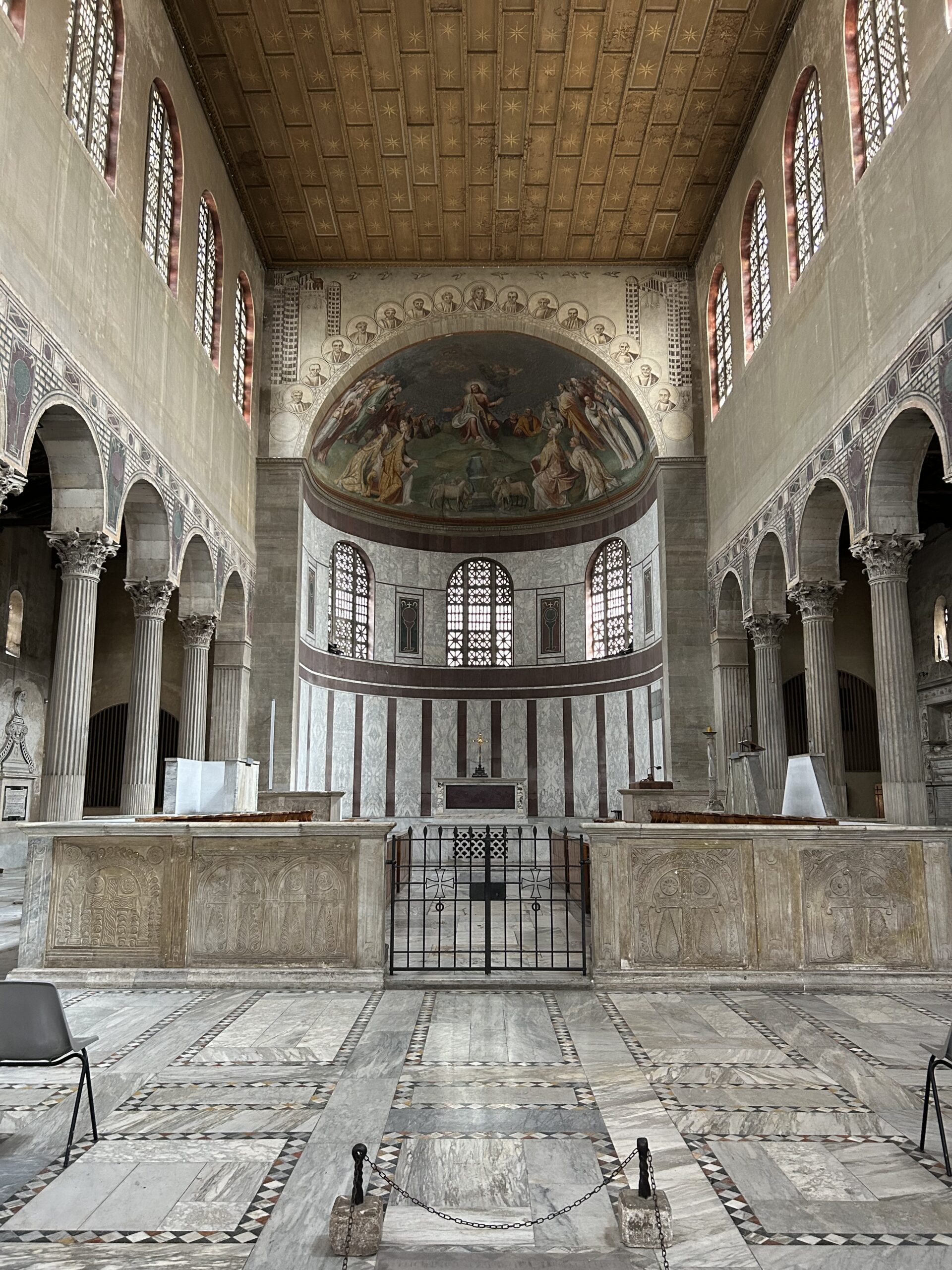
Unlike many Roman churches, St. Sabina’s interior is simple. Built in A.D. 432 on the site of early Imperial houses, the basilica borrows the crisp, high-ceilinged style of the secular Roman covered forum. Its carved wooden doors bear the earliest certain depictions of Christ’s crucifixion.
In a small chapel at St. Sabina’s, I discovered some of my favorite artwork in all of Rome: exquisite Baroque frescoes by Giovanni Odazzi. The four pendentives of the chapel show a blond, blue-robed Jesus giving St. Catherine his wounds, the crown of thorns, his heart, and finally the Eucharist. On the dome, Mary presents Catherine to her son, clouds and cherubim brimming over the frame.
I longed to sit and stare at Odazzi’s milky pastels for hours, but Isabelle and I were off to our next destination: the Aventine Keyhole. The half-inch peephole in the Knights of Malta’s gate presents a perfect view of St. Peter’s Basilica, framed by arching rows of trees. Despite my doubts, the sight was well worth the 30 minute wait in line.
We next headed down the hill to meet up with friends at the Trevi fountain. After a lunch together of fried risotto and spaghetti, Isabelle and I treated ourselves to a necessary gelato and caffè latte.
On a cobblestoned side-street, I bumped into my brother, Jack, also in Rome for Holy Week. While Isabelle shopped around, the two of us perused a little menswear shop. Jack found a the perfect navy polo. I bought a tie for my boyfriend.
Per tradition, both of us had tossed a coin over our right shoulders into the Trevi: a return trip to Rome was certain. Next time I’d buy shoes and a leather jacket, and even see the bones of St. Peter. For now, Jack was off to St. Peter’s Basilica to claim a spot at Mass with the Pope. We parted ways on the steps of St. Ignatius.
Isabelle and I made our way to Villa Balestra, home to the Roman College of Santa Maria, and the beautiful chapel in which we would celebrate the vigil. We sank into our pews, tired from a long uphill walk an hour before the service.
The choir was already practicing in the loft above, their Easter hymns in three-part harmony resounding through the length of the chapel. Eight priests walked down the aisle, practicing for the Mass, their vestments resplendent in the evening light.
The tabernacle stood open and empty: the only time of the year it would be so.
Sixty minutes passed quickly. Before I knew it, the pews around us were full, and it was time to gather in the fresh night air around the Paschal bonfire.
We celebrated Mass in English—most of the liturgies that week had been in Italian. An ocean away from Hillsdale, we sang the same Latin chants sung at St. Anthony’s, its cadence familiar, its message universal to the international congregation.
Isabelle and I joined our friends after Mass to wish one another a “Buona Pasqua.” Our group taxied to a restaurant across from the Vatican for Easter drinks and dessert. The fast was over.
The moon high above us, we walked back to our hostel in high spirits. Nevermind the 10 hours on a plane awaiting us tomorrow — we were under Roman stars, and it was Easter at last.
