
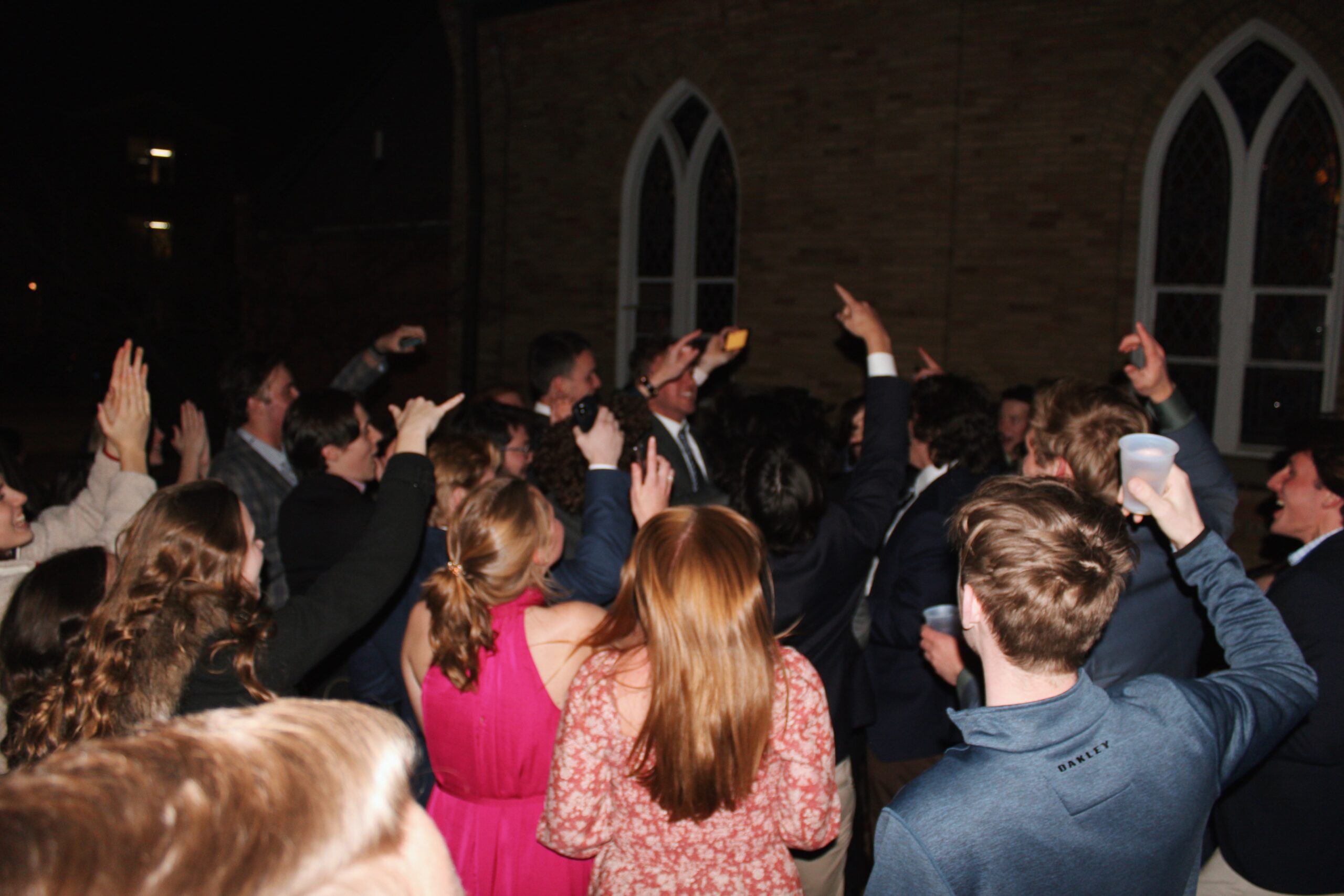
Parishioners gather outside of St. Anthony Catholic Church to sing Irish shanties and ballads. Courtesy|Rosemary Surdyke
Parishioners and visitors alike packed the parish hall of St. Anthony of Padua Catholic Church in the wee hours of Easter morning for the church’s annual Greek Feast. With more than 500 participants, this year’s Greek Feast was the biggest yet.
The feast began at midnight, directly after the Easter vigil Mass. Young and old crowded into the parish hall, first standing in line to load their plates with steaming soup, pita, and pastry.
Giant platters of hummus, pasta, and salad were soon emptied. Flaming cheese elicited cries of “Opa!” from the crowd. In the middle of the room, men carved up piping-hot roasted lamb for eager plates.
Seated amidst classmates, professors, sponsors, and priests, newly confirmed members of the Church enjoyed their first meal as Catholics. With chrism oil still fresh on their foreheads, they jubilantly embraced friends and family.
Junior Michael Hoggatt converted to Catholicism at St. Anthony this Easter. He had previously attended the vigil and Greek Feast his freshman and sophomore years, but was now among those being celebrated.
“Having plenty of friends
and even strangers at the feast congratulating me on my faith journey into the Church felt like the warmest welcome I’ve ever received,” Hoggatt said. “I stayed for somewhere over an hour, even for several of the Irish songs the throng of students sang outside.”
Alexis Zeiler ’18 hosted the parish’s first Greek Feast in 2015 after converting to Catholicism the previous year.
“I was struck by the beauty of the liturgy but saddened how everyone just left without celebrating the new converts. They had cake and punch in the parish hall, but no one stayed,” Zeiler said.
She and her husband spoke with Rev. David Reamsnyder, the pastor of St. Anthony’s, and were inspired by his stories of post-vigil dinners at Greek restaurants when he lived in Baltimore.
Hillsdale didn’t have any restaurants open late enough, but Zeiler was confident she could make something work.
In 2015, Zeiler and her husband, Seth, worked with friends and family members to put together a Greek Feast for the parish.
“The first year we did not have any real help from the parish and a lot of naysayers,” Zeiler said.
Then came 2016. Zeiler was five weeks postpartum and five weeks widowed, having lost her husband to a heart attack just a day before giving birth to her son, Charlie.
“Many people tried to convince me to cancel the Feast that year, but I persisted,” Zeiler said.
Parishioners responded to Zeiler’s tenacity, stepping
in to help her succeed. Her motivation: a devotion to building the faith community at St. Anthony’s.
Zeiler said she chose Greek food because it incorporates lamb,
a traditional symbol of Christ’s suffering and Resurrection.
“The food has become more ‘mediterranean’ as the years have progressed,” Zeiler said, noting the addition of dishes like tabbouleh and baba ganoush.
Zeiler’s culinary background allows Greek Feast to run smoothly. Her family has owned restaurants for several generations, and Zeiler currently runs her own catering company.
Seven years since its inception, Greek Feast has become a beloved St. Anthony’s tradition, involving dozens of parish families and Hillsdale students in the planning, cooking, and cleanup process. A spreadsheet records the weeks-long preparation process, with jobs ranging from baklava training to floor mopping.
Just days after the Greek Feast is over, Zeiler begins planning for the next one. She orders the lambs a year ahead to give the farmer time to plan his flock for the next year.
“I work to live liturgically, so I start my preparation at
the beginning of the liturgical
year during Advent, then work to recruit volunteers during Lent,” Zeiler said.
Maria Schmid, a freshman, joined several other Hillsdale students at the home of Nathan Schlueter, professor of philosophy and religion. The group spent Holy Saturday rolling dolmades, stuffed grape leaves, for the feast.
“I was amazed by the community that was fostered not only during the feast itself but also during the preparation,” Schmid said. “Helping make food for the feast was such a beautiful way to serve and invest in the life-giving community that we have.”
Irish music has become part of the Vigil tradition. After the feast, students gathered in the crisp night air to sing ballads like “Red is the Rose” and a spirited version of “Hail Holy Queen” while smoking cigarettes or sipping wine.
To Hoggatt, this sort of celebration complements the solemn joy of Easter.
“Greek Feast adds the ever-Catholic element of community which is to make merry mirth. We’re celebrating the Resurrection, after all,” he said.
