
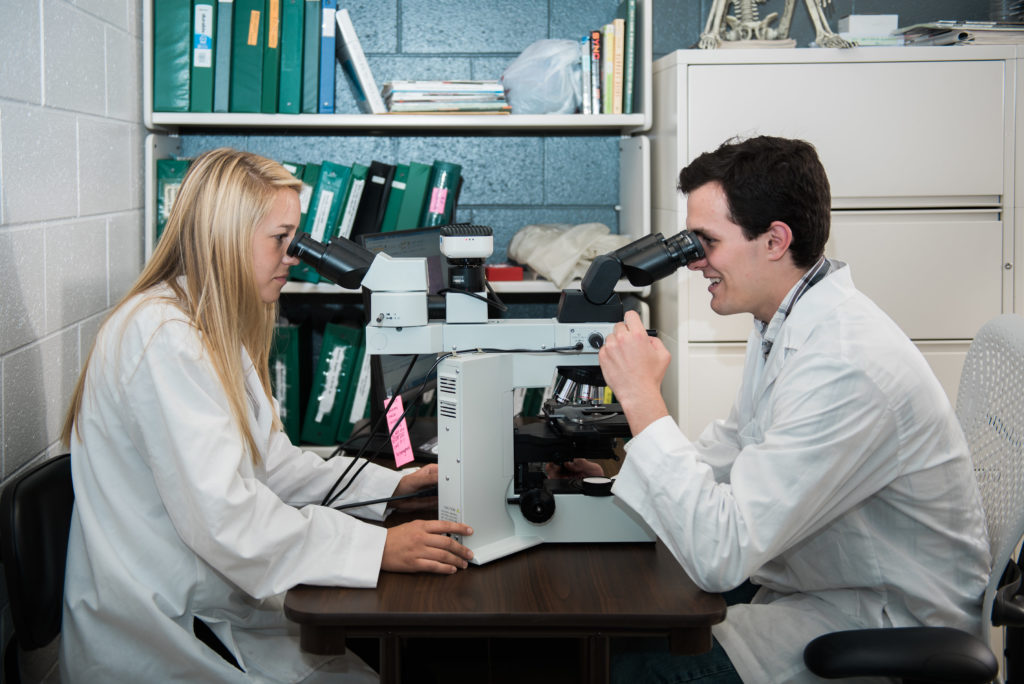
Indecisive decision-making coupled with the incoming class registration is nothing short of a recipe for chaos. Thankfully, for those thinking about STEM, students and professors offer insight into the field to help mitigate uncertainty.
“When you study STEM at Hillsdale, you also get to study the core curriculum which enables you to understand science in the broader context of human knowledge and Western Tradition,” Associate Professor of Physics Stephanie Lauback said. “These core classes build communication skills which are essential to all scientific study.”
Kate Grimley, a sophomore studying biochemistry, said she has also enjoyed being able to continue studying STEM without having to sacrifice her other interests.
“One of the main reasons I chose Hillsdale is because I didn’t have to give up anything I enjoyed,” Grimley said. “I’m not missing any of the puzzle pieces, and I feel like I have been shown a more complete picture of the world since I’m learning STEM and humanities in conjunction with each other, rather than learning only one or the other.”
Freshman Katrina Sumarli said she agreed with Grimley’s uncompromising attitude toward her studies.
“At Hillsdale, there is this aspect of rounding yourself out,” she said. “I like it because you don’t just learn how to master our own field, but also how to be excellent in every area.”
Some students may be drawn to a STEM-related field because of the potential income benefits and job stability in comparison to humanities majors, but it’s more than that. As a vital component of a liberal arts education, studying STEM offers invaluable resources that are applicable beyond the laboratory, according to Lauback.
Lauback said the STEM field equips students with skills useful to any career.
“By studying STEM you grow in your problem-solving skills which are necessary for any career path you take,” Lauback said. “Diverse communication and thinking skills are essential in any career path, and STEM can offer just that.”
But aside from learning basic skills, students say they find meaning in studying how the world works.
Joey Spoelstra, a junior studying biochemistry, said STEM offers more than just practical benefits; it introduces a new and enjoyable way of learning.
“There’s something interesting about always learning a little bit more about how the world works, and how things write each other,” he said.
Associate Professor of Mathematics David Gaebler said he seeks to emphasize the unique beauty that is found through scientific training.
“Just as Beethoven’s music sounds good to everyone, but a musician can appreciate it on a deeper level, so anyone can marvel at God’s handiwork in nature, but one with scientific training can understand nature’s beauty in a fuller way,” Gaebler said.
