
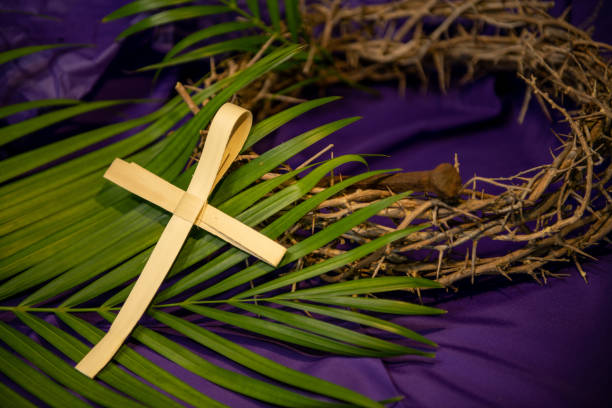
It’s easy to tell that Lent has begun when students walk across campus with ashen crosses on their foreheads.
The religious season of Lent involves a variety of devotions, including alms-giving, fasting, and penitence. Practices vary widely by Christian denomination and church, and some Christians don’t observe Lent at all.
“Lent is one of the best times of the year to grow your connection to Christ,” sophomore Anna Jackson, an Eastern Orthodox Christian, said. “It reminds you of him in a much deeper way than in the normal year because it’s more intentional.”
Orthodox Christians observe Lent through a rigorous fast. It begins with Meat Fare, which is the last week that Orthodox Christians eat meat before Lent starts, and Cheese Fare, which is the last week that Orthodox Christians eat cheese. Orthodox Christians typically fast from meat, dairy (including eggs), oils, and alcohol the two weeks before Lent and the following 40 days between the beginning of Lent and Pasca — the Orthodox word for Easter.
“We practice a very strict fast in order to remember to curb our passions, our bodies, and to remind ourselves to pray because unfortunately, we’re very weary creatures,” Jackson said. “We remember that sort of hunger and deprivation, which helps us to remember to pray and to trust in God’s help and mercy.”
Orthodox Christians also fast during Advent, the Dormition Fast, and various feast days such as the Beheading of John the Baptist.
Orthodox Christians’s Lenten services culminate in an all-night Easter liturgy. Church members read the Psalter through the entire night, and Orthodox catechumens are chrismated or baptized into the Orthodox Church on Easter Sunday.
“I’ve heard Orthodox Christian fasting and Lent as a one-size-fits-all experience, as though that’s a bad thing,” Jackson said. “It’s actually a form of subjecting yourself and giving something up. You have accountability and a standard that’s been set.”
Unlike Orthodox Christians, Catholics fast on Ash Wednesday and Good Friday. Additionally, they fast and abstain from meat on Fridays during Lent.
“We have it very easy compared to the Orthodox,” Catholic and junior Ryan Bagley said. “The requirements for a fast on Ash Wednesday and Good Friday is one full meal and two smaller snacks that when added together are not the size of a full meal.”
Lutherans and Catholics also prioritize the individualized nature of personal fasts, such as avoiding social media throughout Lent.
“Lent is actually an exercise of freedom,”Lutheran and theology professor Jonathan Mumme said. “We give things up because it can help your prayers.”
Catholics Holy Week services include Holy Thursday and Good Friday — the only day of the year when Catholic Mass is not celebrated. Similarly to the Orthodox service, catechumens entering the church will be baptized, confirmed, and take their first Holy Communion at a cande-lit vigil Mass that concludes after midnight on Easter Sunday.
For Mumme, Lent is a reminder of our own mortality.
“There is nothing that we are enjoying today, nothing that we are partaking of, including life itself as we know it, that we can keep forever,” Mumme said. “None of that may possess us. What possesses us is our hope in the resurrection.”
Some Christians don’t practice Lent at all, including many members of the Orthodox Presbyterian Church.
“We don’t follow any church calendar whatsoever,” Presbyterian and junior Lydia Hilton said. “We don’t recognize any church holidays, including Christmas or Easter.”
However, Hilton also has attended various Lenten services, which Lutheran sophomore Maya Toman advocates for.
“Even if you’re not Lutheran or Catholic, go to a midweek Lenten service in the area,” Toman said. “Get a little picture of what it’s like for liturgical churches to practice a church season.”
In Hilton’s view, Lent should not become an opportunity to practice pridefully for the sake of being observed by others.
“There is a scripture passage about not showing off that you’re fasting and the connection with pride,” Hilton said. “However, I think it’s also very important that if you don’t give something up for Lent to not be prideful about that, so like in the reverse, not being prideful either way.”
This is sophomore Ethan Graham’s first year practicing Lent.
“I didn’t really know that Lent was a thing until high school,” Graham said. “Something I’ve always respected about more traditional services is that there is a long preparation for the important things like Easter.”