
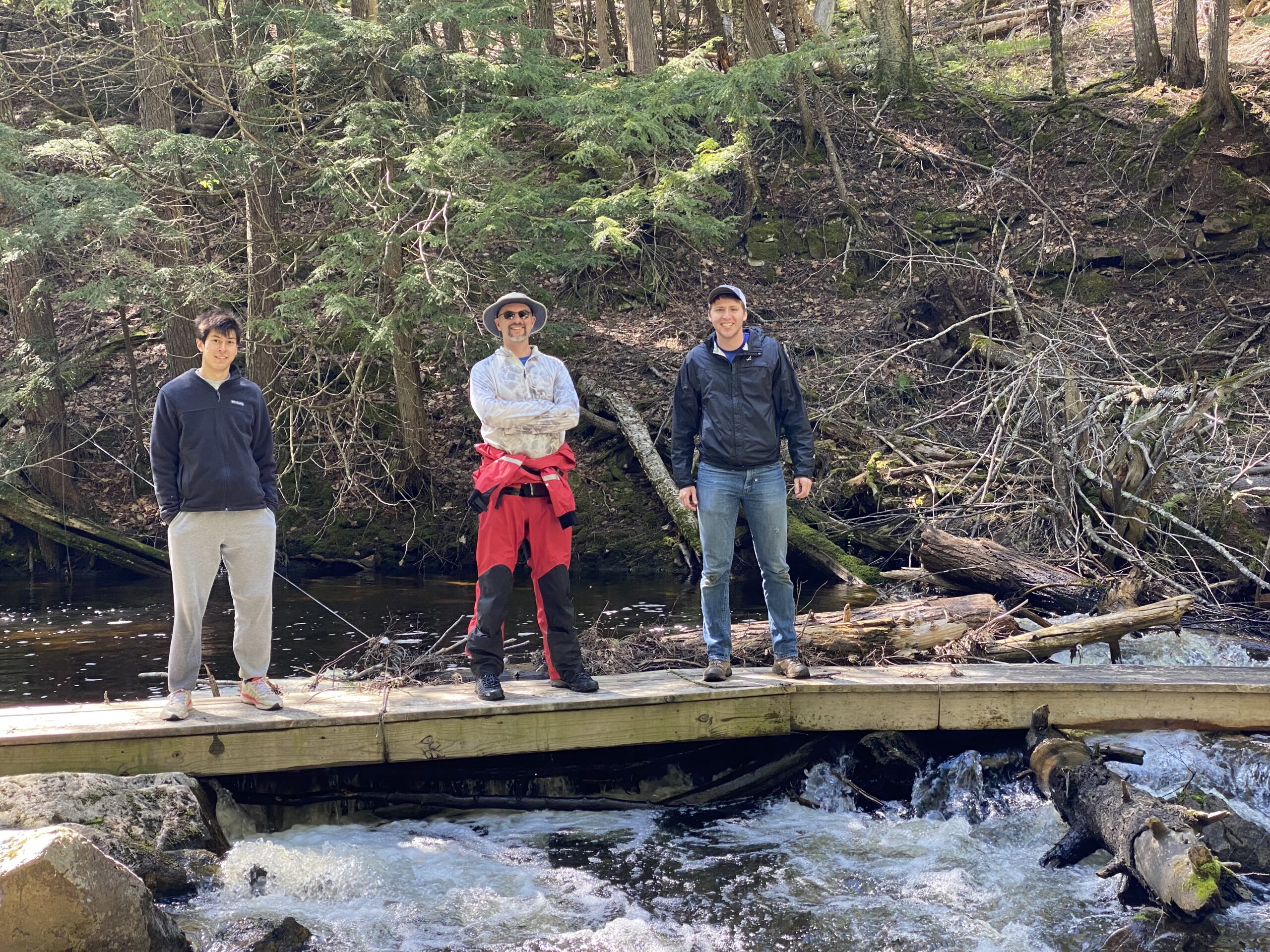
David Houghton and students at a bridge over Mountain Stream in the Huron Mountains. Courtesy | David Houghton
Among biology circles, Hillsdale College is known for its caddisfly collection of over 300,000 specimens and the stream ecology expertise of the G. H. Gordon Biostation, both led by Professor and Chairman of Biology, David C. Houghton.
Houghton has been teaching biology at Hillsdale since 2005, but his interest in the field extends back to his childhood expeditions at the family cabin in northern Minnesota.
“My whole childhood was hunting and fishing and poking around in streams and catching frogs. I didn’t really want to stop doing that,” Houghton said.
Houghton majored in limnology fisheries management at Wisconsin University, but found his passion after taking a class on aquatic insects.
“I thought, these are the coolest things I’ve ever seen,” he said. “I did my own senior thesis project on an exotic invasive crayfish and how its populations affect those of native aquatic insects.”
Students help Houghton with his research projects. Hillsdale pairs students with faculty advisors to aide them in their research, so Houghton also works with students like Jaiden Frantz and Molly Williams on their own projects.
“Jaiden Frantz just got her senior thesis accepted for publication in a professional scientific journal, which is pretty rare for an undergrad,” Houghton said.
Williams is working on a project that Houghton expects will also be published.
“Molly Williams is doing a really complex stream ecology project where she’s looking at the impact of what’s called the riparian corridor,” he said. “She looked at two streams, little first order creeks up in northern Michigan, both of them in agricultural watersheds, and found that that little 100 meter buffer does make a difference.”
When he’s not in the lab or poking around streams, Houghton’s favorite detail about being a professor is seeing his students published.
“The holy grail for me is to try to get students actual scientific credentials,” he said. “Not just jumping through a hoop for their credits, but actually getting something tangible that can never be taken away from them. Once you’re a professionally published scientist as part of the scientific record, you’re actually doing science, not just learning it.”
The biology department is the third most common major at Hillsdale and offers a myriad of classes from freshwater ecology to botany to microbiology. The students continually rank as some of the best in the United States.
“We take a nationwide standardized exam every year, and our majors routinely score in the top 5% in the country,” Houghton said.
But the hallmark isn’t the student publications or standardized test scores— it’s the caddisfly collection.
“For the last 15 years, my students and I have been driving around the Upper Midwest sampling caddisflies. We’ve hit over 800 different streams from Michigan, mostly Michigan, Wisconsin, Indiana,” Houghton said.
The goal of the collection is to determine if the various streams have viable populations of organisms, according to Houghton.
Because it’s the largest caddisfly collection in Michigan, the biology department is raising eyebrows.
“I just got invited to present a seminar at the Illinois Natural History Survey, which is the largest entomology program in the country,” Houghton said. “Because of all these students over the years and all their hard work, we’re amassing an incredible dataset that’s getting people’s attention.”
But Houghton doesn’t believe the book work is the most impactful part of his teaching. Instead, it’s the experience.
“These projects really get the students involved in big science,” he said. “Getting them involved in their own research projects is great, but this plugs them into something even bigger. That’s why I teach at college. I think it’s the coolest thing in the world. They come in as timid teenagers who leave confident grown-ups.”
Houghton’s work has led him to travel all over the country and experience the natural world applications of his work.
“The Huron Mountain Club has some of the most pristine, undisturbed streams anywhere,” he said. “Last year myself, two students, and another worker at the field station were actually sampling from a stream that, as far as I can tell, had never been sampled from before.”
While he was on sabbatical in Alaska, Houghton was paddling on a glacial lake and found a spot where a tiny waterfall had created a patch of perfectly clear water amidst a murky lake.
“I poked around there, and I found all kinds of things, including what I think to be an undescribed species,” Houghton said. “It’s this environment no one’s ever seen before because nobody ever goes out there and looks for it.”
Biology is a promise to Houghton. “The fact that you can still paddle out and find new species of organisms in these unique habitats that nobody ever studies––that’s the kind of stuff I love,” he said. “It’s exploration and finding new things.”
