
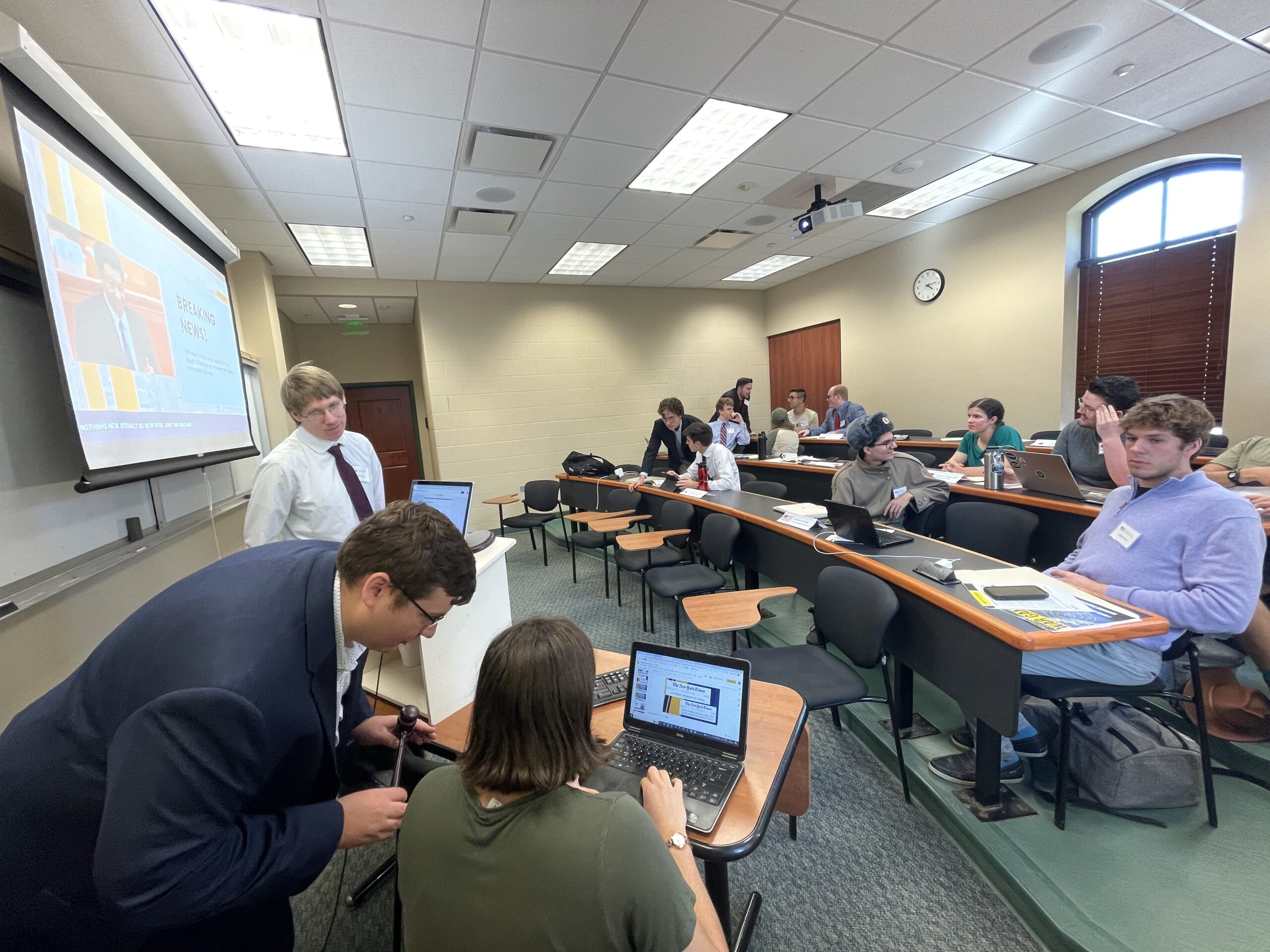
Students work to solve global issues at the Alexander Hamilton Society annual ‘War Games’. Courtesy | Collegian
When his command of a Napoleonic French troop attacked an entire flank of the Prussian army, junior Liam Moffat found himself completely blind-sided.
Moffat was playing Kriegsspiel, a war game that simulates the role of a commander in combat, as part of Hillsdale College’s new war game club, run by juniors Carter McNish and Moffat.
“Political games like Risk are strategy games, but what we play are operational games,” Moffat said. “You play a general or commander and fight other commanders and generals.”
The club runs two different war games: Hex Encounter and Kriegsspiel.
Kriegsspiel was invented in the 1800s by a Prussian general to train commanders for combat. Since then, it has been used by military and naval colleges across the world, according to McNish.
“I’ve seen war games fought on land and sea, and I’ve even seen someone try to recreate what a dogfight would be like on a board,” McNish said. “Admiral Nimitz in World War II said that nothing came as a surprise to him because he already used war games for all possible scenarios.”
Players are unaware of the full map of the game in a Kriegsspiel, and an umpire declares the results of each action to the characters.
“Kriegsspiel is more a simulation of actual combat than a war game,” Moffat said. “The whole point is that it’s a double blind fog of war. As the player, you don’t know where your enemy pieces are unless your pieces can see them, and you don’t know exactly where some of your pieces are, if you can’t see them.”
Dispatches and reports from troops can be delayed because of distance from the commander.
“You have the same kind of knowledge that a real general would have where you can’t see everything and things will take you completely by surprise,” McNish said. “It builds a level of paranoia because you can never see what’s actually behind the fog.”
Kriegsspiel also produces unreliable results that test player’s flexibility.
“One of my friends plays Kriegsspiels and his favorite line is, ‘You can command, not control,’” McNish said. “You can tell someone to do something, but it might not happen in the way you want it to.”
Players also learn the challenges of commanding troops in combat through the game.
“I remember in the Russia-Ukraine conflict, there was a Russian column that did nothing for an hour,” Moffat said. “That was a reallife Kriegsspiel moment. You forget where your units are. You forget that you actually command a unit and can tell it to go somewhere. Units can receive your orders and go in the opposite direction.”
McNish and Moffat began playing Kriegsspiel over the summer and joined the International Kriegsspiel Society. McNish ran a Kriegsspiel over the summer based on the first day of the D-Day invasion.
In Hex Encounters, players see the entire board and move troops across a board made up of hexagons.
“Both the players have perfect knowledge of their own team and of the enemy,” McNish said. “It’s like chess with a bit more nuance.”
Hex Encounters provides information about historical battle practices, different elements on the board, and available weapons, which differ according to the era and terrain of the game’s setting.
“The players are given little tokens representing regiments or divisions depending on the scale of the game,” Moffat said. “Those will have movement speed, damage, value, and defense abilities. Also, if you’re on a hill or in a river or forest, the terrain will affect you.”
McNish started the club upon the recommendation of Edward Gutiérrez, director of the Center for Military History and Grand Strategy.
“The club is a superb addition to Hillsdale’s study and investigation into war and strategy,” Gutiérrez said.
The club plans to host six or seven games a semester and has already played one Kriegsspiel in January. McNish and Moffat hope to collaborate with the Center for Military History and Grand Strategy.
“There is a class right now that Dr. Gutiérrez is teaching on World War II, and I would like to run a war game based on something during World War II this semester,” McNish said. “It would help to bridge the gap between what you read in a book and history.”
McNish believes that war games will allow students to better understand military strategy rather than just political negotiation.
“Russia invaded Ukraine,” McNish said. “Warfare is clearly still on the table. So even if you never plan on going into the military, playing war games helps you get an understanding of what that’s like.”
