
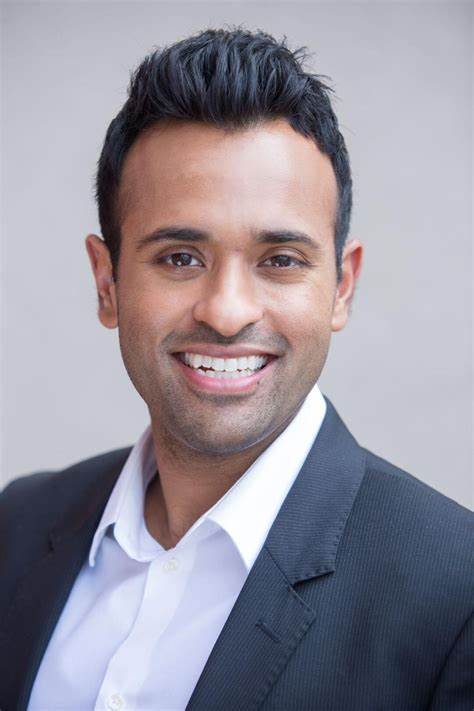
Vivek Ramaswamy visits campus to discuss America’s economic past and future
The government uses private companies as a back door to censor politically disfavored speech, said entrepreneur and political commentator Vivek Ramaswamy in a speech on Tuesday.
“Those on television call it ‘Big Tech censorship,’ but I call it ‘government tech censorship,’” Ramaswamy said.
Hillsdale College’s Kehoe Executive Speaker Series invited Ramaswamy to give a speech titled “The Rebellious Entrepreneur.” Ramaswamy said many corporations have merged with the U.S. government and the Chinese Communist Party, and emphasized China’s role in modern American politics and culture.
“China showed up on the scene and realized they could make U.S. companies critique America relentlessly and do business in China without saying a peep about the actual human rights atrocities there,” Ramaswamy said. “We have undermined America’s greatest geopolitical asset of all—our moral standing on the global stage.”
Ramaswamy explained how the 2008 financial crisis contributed to a shift in culture and politics.
“In the wake of the bailouts, there was a grand, unspoken bargain in this country between big business and what used to be our conception of big government,” Ramaswamy said. “It is the story of this arranged marriage but not one of love. It is more like mutual prostitution. And the net result of that is the birth of this new ESG industrial woke complex.”
Ramaswamy went on to explain what he called the greatest battle of our day.
“It is not between Democrats and Republicans,” Ramaswamy said “It is between the technocratic managerial class and the everyday citizen.”
In a Q&A following the speech, Hillsdale College President Larry Arnn and Ramaswamy discussed the rise of artificial intelligence and its potential consequences.
“It’s not just about governmental control anymore. It’s a culture of technocracy that dissolves the boundaries between moral and technical questions,” Ramaswamy said. “That is one of the threats to the next generation of Americans.”
Ramaswamy concluded that Hillsdale College is one of the institutions that can help people discern the difference between the two questions.
“I genuinely think that there’s a good chance that our best days are still ahead of us,” Ramaswamy said. “Our identity crisis may be just part of the natural course of growing up and going through adolescence. Part of adolescence is losing your understanding of who you are. But I think places like this are going to play a role in remembering who we are.”
Charles Steele, professor and chair of Hillsdale’s economics department, said Ramaswamy hit the target.
“He understands things that are important,” Steele said. “I think that he’s a great speaker. I hope we will see him some more.”
Freshman Katie Crain said Ramaswamy was an engaging and persuasive speaker.
“He knows what he’s doing. He knew the audience he was addressing,” Crain said. “He exhibited a lot of great qualities of a leader and was able to leverage his talents in public speaking in such a positive way. He was very powerful.”
Crain said she hopes Hillsdale continues to cover issues relating to business and corporate America.
“I don’t think Mr. Ramaswamy’s talk could have been more relevant,” Crain said. “It’s my generation’s duty to acknowledge these issues because we are the future.”
