
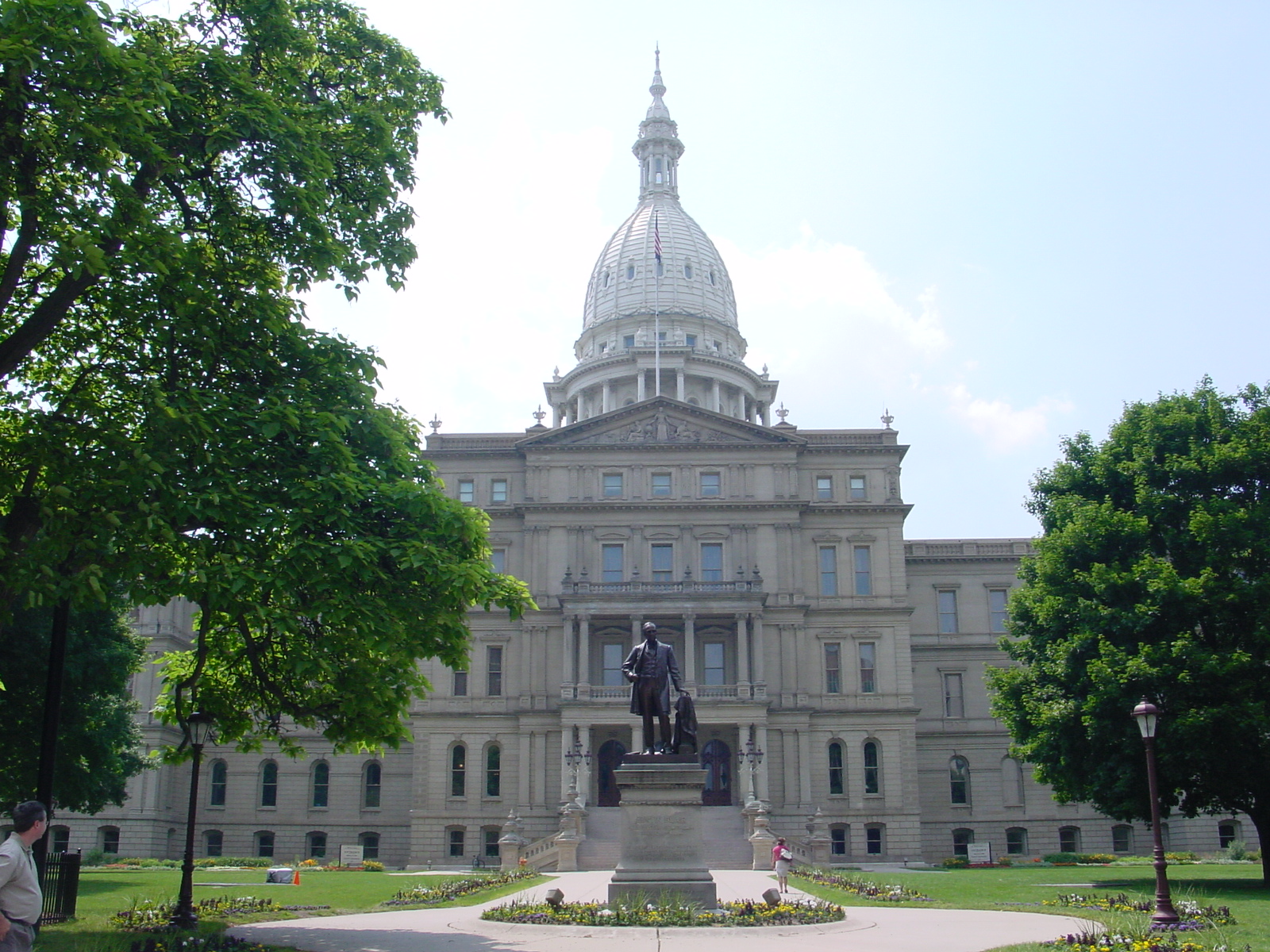
The Michigan Capitol, where Democrats proposed legislation on Jan. 12 to repeal Michigan’s “right-to-work” law. Courtesy | Flickr
Democrats in the Michigan legislature introduced multiple bills Jan. 12 that would repeal the state’s “right-to-work,” which allows employees to work without joining a union.
While supporters of the legislation said it would restore unions’ bargaining power for better working conditions, local leaders are voicing opposition.
Susan Smith, executive director of the Hillsdale County Economic Development Partnership, said she sees no point in repealing “right-to-work” laws.
“You’re limiting people’s freedom of choice,” Smith said. “I don’t think that’s a democratic thing to do. If people wish to join a union, they’re free to do so. If they wish to not be a part of the union, they have that option. As long as they know, I don’t think we need to have any more freedoms taken away from us in Michigan.”
State Sen. Joseph Bellino, R-Monroe, said he thinks the measure will pass his chamber.
“I think they probably have the votes already,” Bellino said.
Michigan has been one of 28 “right-to-work” states in the U.S. since a Republican-controlled legislature passed the law in 2012. Democrats now hold the governor’s mansion and took control of the state Senate and state House chambers following last November’s elections, with a narrow two-vote majority in both.
State Rep. Regina Weiss, D-Oak Park, is sponsoring the legislation. She said she rejects the term “right-to-work” and believes repeal would benefit Michigan workers.
“The phrase ‘right-to-work’ is a lie,” Weiss said, according to MLive. “These laws do nothing but hurt hard-working Michiganders by hamstringing their ability to effectively organize for good benefits and competitive wages.”
Rep. Andrew Fink, R-Hillsdale, pointed to a 2022 study from the Mackinac Center, a right-leaning Michigan think tank. The study found that counties in “right-to-work” states had higher employment levels compared to bordering counties in non-“right-to-work” states.
“Because of our unusual peninsular geography, relatively few communities in Michigan border another right-to-work state, leaving us to bear the brunt of such a policy change,” Fink said.
President of AFL-CIO Ron Bieber said in a press release that “right-to-work” laws harm workers.
“The purpose of so-called ‘right-to-work’ laws is to destroy unions and our ability to improve wages and working conditions for all people,” Bieber said.
Union membership in Michigan has dropped to 13.3% in 2021, down from 16.6% in 2012 when the law was passed, according to the U.S. Bureau of Labor Statistics. If the law is repealed, Michigan would become the first state in almost 60 years to pass and repeal “right-to-work.”
Max Nelsen, director of labor policy at conservative nonprofit Freedom Foundation, said a repeal of “right-to-work” would not help public workers.
“As a matter of fairness and civil rights, no public employee, no worker should be forced to pay a private organization as a condition of keeping their jobs,” Nelsen said. “Without ‘right-to-work’ protections, that’s exactly what happens.”
The Supreme Court ruled in the 2018 case Janus v. AFSCME that under the First Amendment, public workers could not be required to join a union as a condition of employment.
Nelsen said two bills introduced by state Democrats, HB 4004 and SB 0005, would remove “right-to-work” rules for public employees, directly violating this Supreme Court precedent.
“That is just incredible to me,” Nelsen said. “These two bills are in direct defiance to the U.S. Constitution to the First Amendment and would seek to force back into unions tens of thousands of public employees in Michigan. I just don’t see any universe in which those two bills, if passed, hold up in court. I have no idea why Michigan Democrats would waste their time attempting to directly defy the Constitution in this way.”
Weiss did not respond to a request for comment on the constitutionality of HB 4004.
Bellino said the state Senate should be focused on crafting bipartisan policy, and said repealing “right-to-work” laws would make Republicans less likely to cooperate.
“Michigan is flush with cash,” Bellino said. “Michigan has lots of problems with schools and mental health. If we’re going to tackle ‘right-to-work’ first, we’re telling all the other non-union people in Michigan ‘we don’t really care about you.’”
