
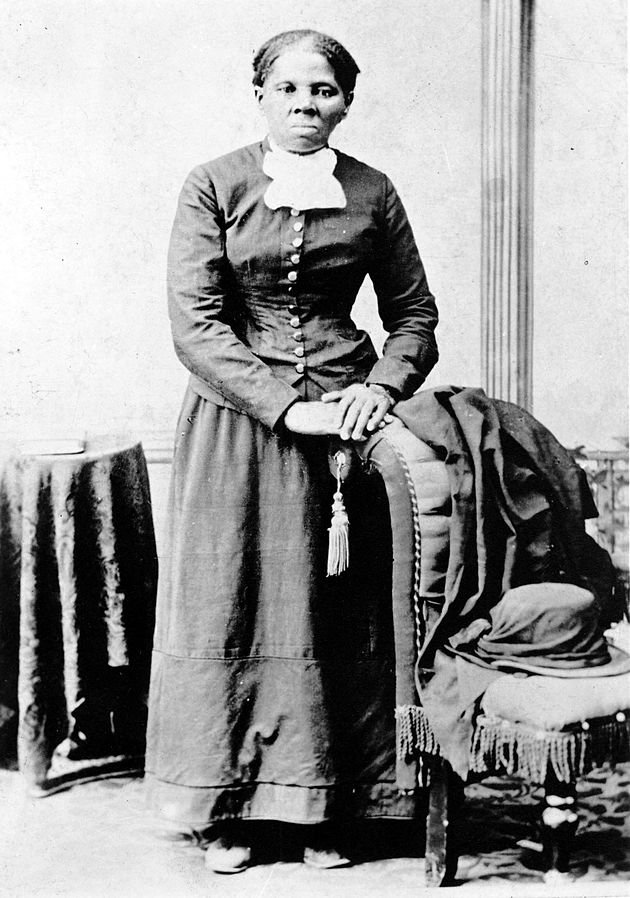
When Harriet Tubman was introduced as a possible replacement for Andrew Jackson on the $20 bill in 2016, Princeton professor of jurisprudence Robert P. George joked about the justice in “a racist populist” favored by Democrats being replaced by “a black, gun-toting, evangelical Christian, Republican woman.” Though her face has yet to displace Jackson’s, Tubman deserves recognition from liberals and conservatives alike. Hillsdale should celebrate her contributions to the Underground Railroad, the Union during the Civil War, and the women’s suffrage movement by adding her to the Liberty Walk.
Born a slave, Tubman knew hardship. At the age of 12, she saw an overseer about to throw a metal weight at a fugitive slave. She stepped in the way and took the hit. The weight broke her skull, leaving her with headaches and narcolepsy for the rest of her life. Yet the injury brought her the unexpected blessing of vivid dreams and visions she believed came from God. Her faith remained steadfast throughout her life, and she often used spiritual folk songs as code when guiding other slaves to freedom.
After the death of her master, Tubman fled her owners’ Maryland plantation. She knew the fatal risks of capture, but she remained undeterred. She escaped via the Underground Railroad to Pennsylvania, where she could live freely. She said, “I had reasoned this out in my mind; there was one of two things I had a right to, liberty, or death; if I could not have one, I would have the other.”
Although she found a job as a housekeeper, Tubman was not satisfied with her own freedom. “My home, after all, was down in Maryland, because my father, my mother, my brothers, and sisters, and friends were there,” she said. “But I was free, and they should be free.” She traveled back into slave territory 13 times, saving most of her family and rescuing more than 70 slaves through the Underground Railroad.
When the Civil War began, Tubman devoted her service to the Union army: first as a cook and a nurse, and later as the head of an espionage and scout network. Most famously, Tubman led the Combahee Ferry Raid, guiding gunboats away from torpedoes and toward strategic points on the Combahee River in South Carolina. When Civil War correspondent James Yerrington reported about the raid, he noted that it was under Tubman’s “inspiration it was originated and conducted.”
The raid succeeded: “Col. Montgomery and his gallant band of 300 hundred black soldiers, under the guidance of a black woman, dashed into the enemies’ country, struck a bold and effective blow, destroying millions of dollars worth of commissary stores, cotton, and lordly dwellings, and striking terror to the heart of rebellion, brought off near 800 slaves and thousands of dollars worth of property, without losing a man or receiving a scratch!”
As a college founded by abolitionists, Hillsdale has recognized the abolition of slavery as an essential step toward liberty for all Americans. Three statues on the Liberty Walk already commemorate the Civil War era: Abraham Lincoln, Frederick Douglass, and an unnamed soldier who stands for the more than 500 Hillsdale students who fought as Union soldiers. A statue of Tubman would recognize her ground-level work as an Underground Railroad conductor and a Civil War scout.
Tubman also fought for a cause not yet recognized on the Liberty Walk: women’s suffrage. She spoke in New York, Boston, and Washington, D.C., using stories of her work in the Civil War and the sacrifices of other brave women to show how women contributed as much to society as men. When asked whether she thought women should be able to vote, she replied, “I suffered enough to believe it.” Though Tubman’s work for the women’s suffrage movement consisted of support rather than leadership, her commitment to women’s suffrage further highlights her dedication to liberty for all people.
Hillsdale has built its commitment to liberty on the understanding that all are born with equal rights, promising an education to “all persons who wish, irrespective of nation, color, or sex.” Harriet Tubman toiled her whole life for the abolition of slavery and the women’s suffrage movement, two causes that furthered equality in America. As a champion of liberty for all, Tubman deserves a statue on Hillsdale’s Liberty Walk.