
China convinced the United States to withdraw military aid and its war fleet from Taiwan in the Alexander Hamilton Society’s annual “War Games” Sept. 17.
The games simulate different foreign policy crises every year. This year’s theme was “Crisis in the Taiwan Strait,” inspired by Nancy Pelosi’s visit to Taiwan in August.
“We chose Taiwan because Taiwan and the Indo-Pacific are representative of the greatest diplomatic challenges that the United States faces,” said Alexander Hamilton Society president and senior Conner Bolanos. “There are at least 10 different ways that this scenario could end.”
This is the first time the Alexander Hamilton Society has done an original simulation centered on military action rather than diplomacy and covert action.
“This year was more militaristic, although there were no assassination plots this year,” senior Stephen Pearson said.
The games began with the movement of military exercises and ballistic tests by China into the East China Sea, threatening Japan.
Approximately 40 students participated in the war games this year.
“Most of the people who come to the War Games aren’t members of the Alexander Hamilton Society,” Bolanos said.
Students participated as members of six teams, representing Japan, the Peoples’ Republic of China, the Republic of China, the Russian Federation, South Korea, and the United States of America. Each country had different conditions and objectives throughout the game. For example, China had to either conquer Taiwan or convince the United States to withdraw from Taiwan, while the United States had to maintain Taiwanese independence and alliances in the Indo Pacific.
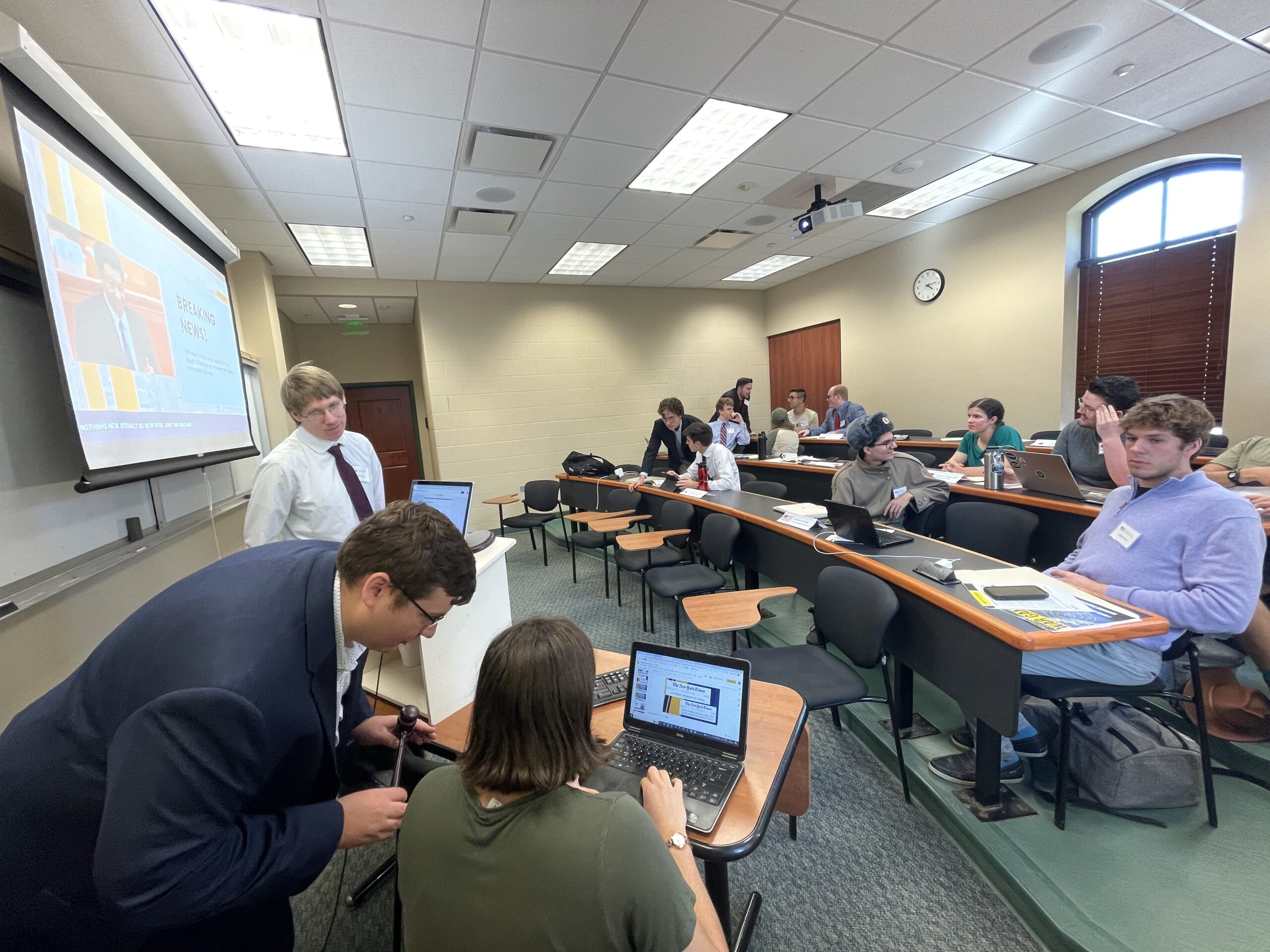
“The small team size of three-to-four people allows students to participate more in the actual game itself,” Bolanos said.
The game’s structure contained two periods, one containing unmoderated discussion time between delegates, and the other with moderated debate and formal speeches and policy announcements.
Pearson won the best delegate for the first committee, and senior Noah Schleusener won the best delegate for the second committee.
Russia and Taiwan won in the first committee, while Russia and China won in the second committee.
“Taiwan is an incredibly complex issue,” said Alexander Hamilton Society vice president and junior Josh Hypes. “A lot of our allies are nowhere near ready for war in Taiwan, and the War Games simulation shows that lack of preparation and the United States’s immense role in the defense of Taiwan.”
Russia’s goal was not related to the Taiwan Strait at all, but to Ukraine.
“Russia successfully convinced the delegates of the United States to aid Russia in the fight against Ukraine,” Pearson said. “From there we were able to unite all the delegates against those of China.”
Some of the negotiations were more diplomatic than others.
“Russia tried to send 1,500 nuclear missiles to North Korea, but that did not work,” Pearson said. “In the end, there was a bloodbath, and the United States and Chinese economies both crashed. The game was wild.”
Within the three hour simulation, three wars, an arrest of Michael Jordan’s daughter, and Black Lives Matter riots leading to the destruction of Minneapolis occurred in the first committee’s simulation.
“It was truly tragic,” Hypes said.
Members of the Alexander Hamilton Society consider the games a success, despite the chaos.
“At the end of the day, people should understand more about where the United States stands on geopolitical issues and what the challenges are in international politics,” Bolanos said.