
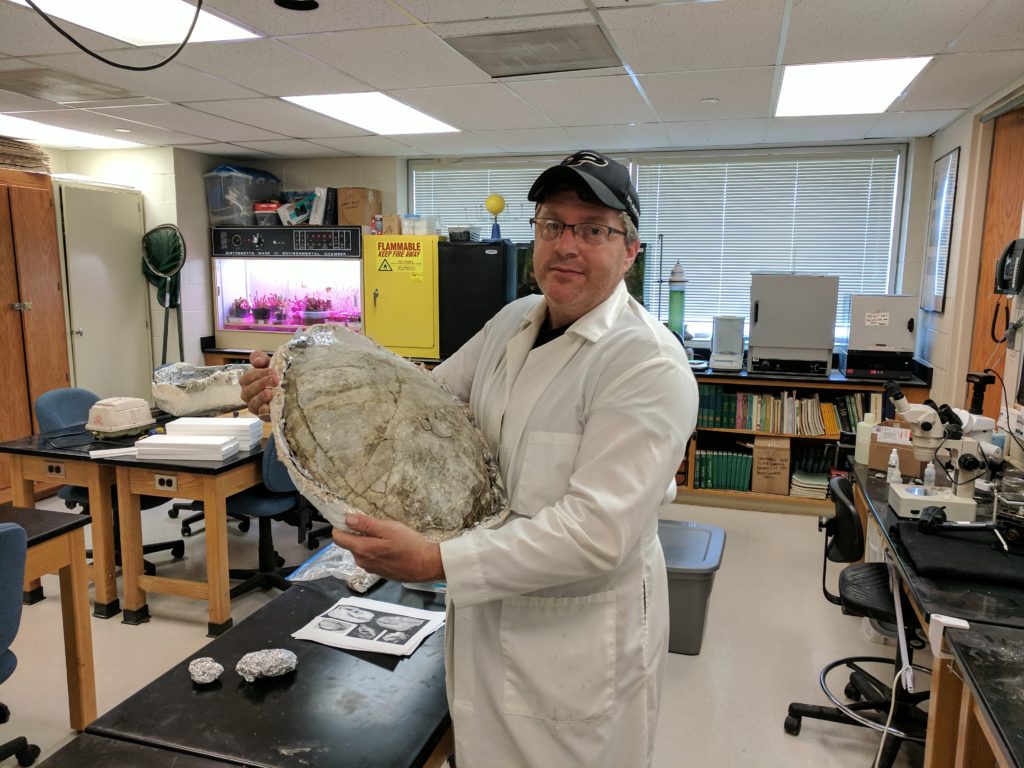
Hundreds of fossils will now call Hillsdale’s natural history museum home, following a donation from paleontologist and geologist, Kevin Wilson.
The D.M. Fisk Museum of Natural History, located on the main floor of Strosacker, received the second installment of the donation last week.
The fossils will include thousands of species from more than 30 different countries. The newest displays include a representation of life after the dinosaurs went extinct, as well as hundreds of fossilized amphibians.
“We use our museum not only as a place for what I call ‘edutainment,’ or educational entertainment, for visitors, but also those thousands of species on display are used for research,” said Professor of Biology Anthony Swinehart, curator of the D.M. Fisk Museum of Natural History.
The donations will give biology students greater opportunities to pursue research without leaving Strosacker.
“I have two senior thesis students right now who are working on fossil specimens in the museum,” Swinehart said.
Among those students is a biology major and senior, Dakota Stamm. Although she plans on pursuing a medical degree, she is studying the museum’s collection of brachiopods, a phylum somewhat similar to a modern clam.
“It’s such a cool museum, and there are cool, expensive, and rare artifacts there,” Stamm said. “It has allowed me to branch into a field I would have otherwise never have thought about.”
In addition to training students to conduct in-depth research, the collection also sources important examples for the classroom.
“There is a whole range of subjects better taught with examples, and science is especially prone to that,” Wilson said. “It’s hard to talk about biology without talking about the history of life, and as soon as you’re talking about that, then you need some fossils.”
Education was one of the many reasons Wilson said he donated his collection to Hillsdale. He said he admired the school’s commitment to tradition and the liberal arts.
After traveling to the college to meet with Swinehart, Wilson said he was convinced Hillsdale was the right place for his donation.
“We just talked things out, and I decided not only was the college the right place, but Tony was the right guy,” Wilson said.
Wilson served as a research associate at the University of Colorado’s museum for four years where he developed a passion for designing exhibits that tell a story.
“I want it to be educational and to tell a story, and so many museums refuse to do that,” Wilson said. “They just throw stuff on the display case or the wall. They give you a name and maybe an age, and that’s the end of it.”
Collecting fossils has been more than a hobby for Wilson, who worked in the oil industry and taught paleontology at Bryn Mawr College for several years before going into the finance industry. During his years as a geologist, Wilson made important contributions to the unifying theory of geology, plate tectonics, Swinehart said.
Sensing Wilson was not his standard donor, Swinehart made a unique offer: Wilson could help design the exhibits.
“He’s been actively involved in the interpretive text and the design of the displays, and he’s been having an absolute ball,” Swinehart said.