
Hillsdale professors agreed that western nations should oppose the Russian invasion of Ukraine, although disagreed about what that response should look like.
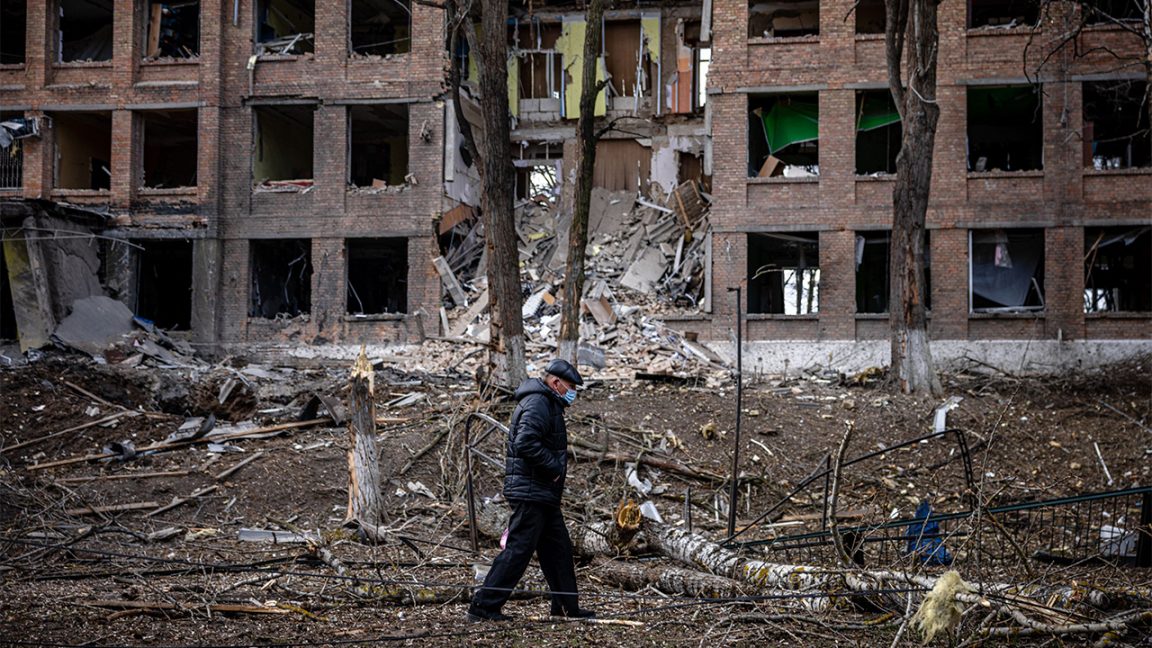
War broke out last Wednesday in Ukraine when Russian troops, stationed at the border for nearly a month, invaded. Western nations have condemned the action and imposed economic sanctions on Russia while promising support for Ukraine.
“Ukraine is a free country, and a dictatorship run by a Soviet secret police officer has invaded. He did so purely because he is set on restoring the Soviet empire and his own power,” said Charles Steele, chairman of economics, business, and accounting.
Russia and Ukraine have had vastly different political and ethnic histories, Kenneth Calvert, professor of history said.
Russia has always had a political system defined by a powerful czar while Russian peasants have been tied to the land and treated as slaves. In contrast, Ukraine has tended to have independent, landowning peasants, Steele said.
Ukraine was part of the Soviet Union and became an independent nation after the fall of the Berlin wall.
Beyond their ethnic and cultural differences, Russia and Ukraine have been in conflict since 2014, when Russia invaded Belarus and annexed parts of Eastern Ukraine, Calvert said.
“The unprovoked Russian invasion of Ukraine in 2014 – Crimea and Donbas – was the actual start of the war. It has been ongoing since then,” Steele said.
Russia has tried to justify the invasion of Ukraine on the grounds that they do not want the country to join the North Atlantic Trade Organization. Instead, the conflict has proven NATO to be as weak as former President Donald Trump claimed it was, Calvert said.
“NATO is great on paper, but not in reality. Putin has no fear of NATO, no fear of the current presidential administration, no fear of the United States,” he said.
Steele believes that the Russian claim that they were concerned over Ukraine joining NATO was merely a pretense.
“The Kremlin’s claim that they were afraid of Ukraine joining NATO is a scam. There was no movement at all for Ukraine to join NATO,” Steele said.
Guttierez, on the other hand, believes that Putin may have been worried about the growth of NATO, and would like to regain an international world order in which Russia is one of two superpowers.
“What Putin is really looking to do, is to gain that bipolarity that the Soviet Union once had when, during the Cold War, it was them versus us,” he said.
Putin is seeking to unite the Slavic peoples under one nation, Guttierez said.
“There’s a long history of Russian leaders trying to eliminate Ukrainian nationality, but Ukrainians are culturally and linguistically and politically distinct,” Steele said. “Ukrainians understand he is willing to exterminate them if that’s what ‘unity’ requires. It is clear that Russians are attacking civilian targets in Ukraine.”
Steele, who taught economics in Kyiv for two and a half years at the Economic Education and Research Consortium, has remained in contact with several of his students. He has also been in contact with a Ukrainian Hillsdale alumnus who is in the country and has been developing an entrepreneurial startup.
Steele expressed pride in his former students for standing up to the Russian regime.
In addition to teaching in Kyiv, Steele also spent a semester teaching in Moscow and has been in contact with one of his former Russian students.
“She says they are horrified and devastated by the war and don’t understand it,” he said.
“The people of Ukraine are putting up an unexpectedly victorious fight against Russia. I really don’t believe that they will be victorious. In the end, the Russian forces are too potent,” Calvert said. “The citizens of Ukraine love freedom and want to enjoy the political and economic blessings that the west has.”
Calvert and Steele agreed that the United States should not become involved in a ground war in Ukraine, although they should provide support.
“America must never involve itself in a major ground war in Eurasia,” Steele said. “I would suggest that the West ought to entirely isolate Russia economically. This would be painful for us but the regimes in both countries would collapse.”
Calvert expressed concern that economic sanctions may not be enough.
“Under the current conditions the United States will do little but yell and scream and then apply economic sanctions – which have never worked anywhere they have been applied,” he said.
Guttierez believes that Russia understands sanctions as acts of war and that the West should respond with hard power. Putin is trying to discover where the West will draw the line.
“Rhetoric is one thing, sanctions are another, but hard, real hard power, is mobilizing troops now, serious troops, shipping them over, taking them from Germany,” he said.
“I hope this is a lesson in humility for the west in particular,” Guttierrez said. “I think a lot of us thought we won the Cold War, but I don’t think we did, actually. I think, through victory, we actually lost a lot of our morality and gained a lot of hubris.”
