
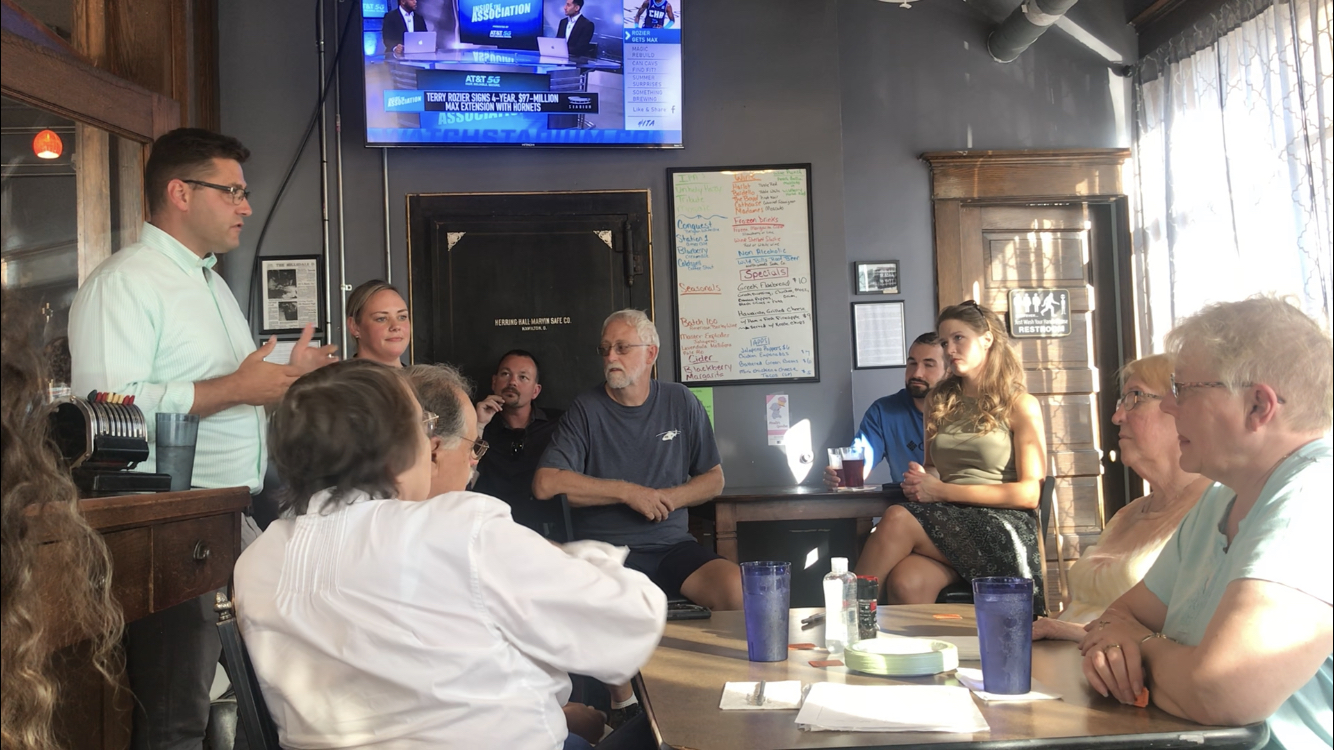
Rep. Andrew Fink spoke about vaccine mandates, power outages, and other topics at a town hall event on Aug. 25 at Hillsdale Brewing Company.
Fink took questions from a crowd of around fifteen constituents on a variety of topics, ranging from local to national issues. A non-profit group, Americans for Prosperity, sponsored the event. The group said this is because they agree with many of Fink’s positions.
“We work with what we call ‘Policy Champions.’ They’re legislators who are philosophically aligned with a lot of our positions, and Representative Fink just happens to be one of those legislators,” said Diana Prichard, community engagement director for Americans for Prosperity in Michigan. “You’ve seen that he’s very thoughtful in his positions, he engages with his colleagues in a respectful way, he’s very genuine in his engagement with his constituents.”
“What do you think about the vaccine mandates?”
“As a general rule, I think that employers, if they really want people vaccinated, should put their energy into explaining why, and not giving people an ultimatum that increases skepticism of the vaccine. If they really think it’s important, they could be doing a better job of explaining it.”
“You’re a veteran. What do you think of the situation in Afghanistan?”
“I think it’s reasonable to say that the time has come to end our engagement there, at least on any significant scale. It is unfortunate that the same government we displaced is coming back in. But mainly, it seems like a lot of avoidable mistakes in the last couple of weeks. I really don’t think it’s too much armchair quarterbacking to say that some of these major muscle movements like closing Bagram Air Force Base and relying on the Kabul airport to withdraw, have not been explained by the administration– by President Biden and his team– at all.”
“What are your thoughts on the economy? Specifically wind turbines, power outages, and Consumers Energy?”
“The wind turbine issue is a matter of great controversy, because a lot of people are skeptical of them as an energy source– I share some of that skepticism. Some people are really offended by looking at them, and some people say, ‘I want to have a wind turbine on my property, and it’s my property.’ So I don’t really think that there’s a really neat, cute thing to say about them except that all of those factors are real, and people really see them in different ways. As far as the power outages go, I do think that one of the explanations for the monopoly system we have now, is that we trade flexibility for reliability. So when a municipality makes a deal with an energy provider and essentially gives them a monopoly in a given area, the expectation is that the power is going to be there. So I do think that it’s always appropriate to hold the energy providers’ feet to the fire, because regardless of whether they’re actually a governmental entity or simply given monopoly powers, holding their feet to the fire is perfectly reasonable.” He continued, “On the economic front, I really just think that we don’t have– either at the state or federal level– an administration that prioritizes innovation, entrepreneurship, and citizen-led recovery. Until we do, we’re going to take longer than we should.”
“What do you think the legislature can do to help the economy?”
“There are ways in which we hope that our budget is going to impact this, including some of the restrictions on how the administration can spend some money. This is not the biggest economic issue, but it’s an easy one to grasp. Our budget drafts require the Secretary of State be open for walk-in services. That’s important to the average citizen, but if you’re a business that has fleets, they’re going through a crisis. Truck fleets, or delivery vehicles, or lawn-mowing companies, everyone who’s got a half-dozen or more vehicles in their fleet are very stressed about the slowness of the Secretary of State. That kind of step, putting some guardrails on spending the money, is probably the most effective thing we can do. We can continue to pass policy bills, but unfortunately, our governor has–without good reason– vetoed a lot of good policies like refunding property taxes or license fees that were paid. That would be helpful to put some money back into the pocket of small business owners who were denied the benefits of the businesses they own according to the government’s decisions in the last 18 months. There’s no reason for the governor to continually veto those things. We’re going to keep making the case, and I hope she sees the light. Hearing from more of her constituents would help.”
“Why is it important to host this type of event with constituents?”
“I can’t do my job as well without talking frequently to as many different constituents as I can. Hearing from all of the people in my district allows me to understand what is important to my district, and how to take what I think is effective policy and then marry it to the priorities of my district. When I go to Lansing, I can have a more informed conversation with my colleagues there, and I can bring information in the same way back to my district once I’ve talked to folks in Lansing, and I understand where my peers are on an issue, or a method of policymaking, or what have you.”
“I can’t say it’s too big of a place to feel like I can’t connect with people on a local, individual level.”
“What is the main message you hope to communicate by meeting with your constituents?”
“It is something that I’ve been emphasizing a lot lately, and I talk to a lot of people who I think are sympathetic to my general policy preferences. It’s good for me to talk to those people, and it’s good for them to contact me and make sure that I am doing what I said I would do when I campaigned for this job. But I also think that if you’re a conservative, you should never forget that you’re the governor’s constituent too. You’re Senator Peters’ constituent, you’re Senator Stebenow’s constituent. You’re Jocelyn Benson’s constituent, and you’re Dana Nessel’s constituent. They should hear from you. They should know that the echo chambers they try to live in every day– that’s the point of me getting out here, to make sure I’m not in an echo chamber, and try to meet more people of all walks of life. They need to be hearing from people of all walks of life too. We should never give up on getting that message across. When the peoples’ voice is made loud enough, then even the most hardened state centralized planner has to hear it in our system.”
