
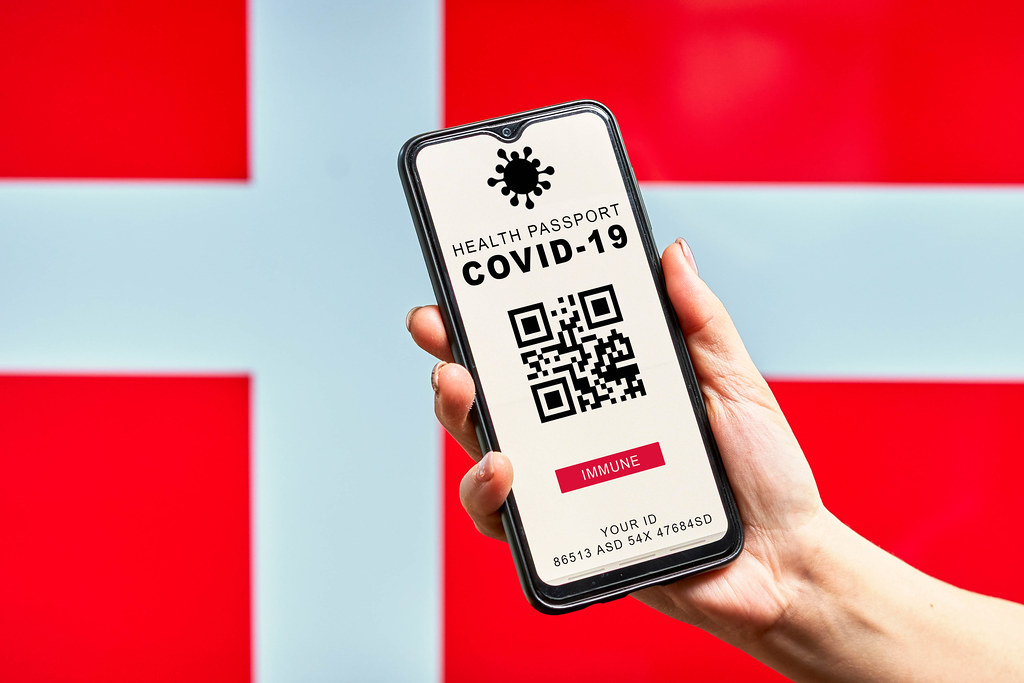
Imagine that you are about to enter a restaurant. As you walk in, the host taps impatiently at an adjacent sign. You fumble with your pocket until you retrieve your phone and scan a barcode. The host moves aside. You make an audible sigh as you walk into the restaurant. You’re relieved.
The highly encoded barcode on your phone was produced by an app and carries one piece of information: your vaccination status.
Vaccine “passports,” while not entirely unprecedented, are being proposed as a method of fighting the spread of COVID-19. Their presence in the national conversation has been growing steadily since December when the Pfizer vaccine was approved.
Countries around the world, such as Denmark and Germany, are already providing federally-backed vaccination passports, leading to the inevitable question: what about the United States?
As the United States vaccination rates approach 25% according to John Hopkins University, businesses and worried consumers have raised the issue of providing a reliable method to prove whether or not a person has been vaccinated. The solution they have come up with is a digital passport of sorts.
The vaccine passport, according to an article published in the Washington Post, would access information about your COVID-19 vaccination status, verify your identity, and provide a barcode showing others you’ve been vaccinated.
As more and more Americans are being vaccinated, the conversation about vaccine passports has exploded. Politically and technologically the idea poses a few problems.
On March 30, 2021, the Biden administration assured Americans that the federal government will not mandate or create vaccine passports, instead, they will be entirely privatized.
“Unlike other parts of the world, the government here is not viewing its role as the place to create a passport, nor a place to hold the data of citizens. We view this as something the private sector is doing and will do,” Andy Slavitt, the acting director for the Centers for Medicare and Medicaid Services, said on March 29 during a COVID-19 White House briefing.
The private sector, however, is failing to offer a viable vaccine passport.
In late March, New York launched an early version of vaccine passports called “The Excelsior Pass.” Theoretically, the app would allow people to return to normal activities by verifying that they have been vaccinated. In reality, it has been a disaster.
Users of the Excelsior app have to have the latest versions of iPhone or Android operating systems; the app doesn’t accept out of state vaccinations; in-state vaccinations require you to obtain a vaccine pass more than 14 days but under 90 days since your last dose; and the pass must be renewed every 30 days. Not only that, but it takes two weeks for the app to recognize your second dose.
Even if all these problems could be solved, the issue of security remains. The Excelsior Pass claims to be operating on a secure database, but their identity verification system is easy to hack.
CommonPass, another company seeking to create a working passport system, insists that it does not store information, according to the same Washington Post article.
Ideally, information would not be stored anywhere, and your phone would simply have a QR code verifying your vaccination and storing that information locally to avoid hackers.
Even if the information is able to be kept private there is still the issue of whether or not requiring a vaccine passport violates the Health Insurance Portability and Accountability Act. According to the U.S. Department of Health and Human Services, no one can demand private health information without the individual’s willing consent.
Even once technological and privacy issues are settled, there are still political questions.
On April 2, Florida Governor Ron DeSantis issued an executive order that blocks private businesses from requiring information such as vaccination or test records, citing freedom and privacy as the basis for his actions.
“It’s completely unacceptable for either the government or the private sector to impose upon you the requirement that you show proof of a vaccine just simply to be able to participate in normal society,” he said during a press conference on March 29.
Texas Governor Greg Abbott did the same on April 6, banning the state government and some private entities from requiring a vaccine passport.
Other governors, such as Kim Reynolds in Iowa, Pete Ricketts in Nebraska, and Bill Lee in Tennessee have stated their opposition to such efforts.
Although the vaccine “passport” may sound like an attractive idea, it poses difficult technological and societal problems that will have to be resolved before it could become a widely accepted key to normality.
