
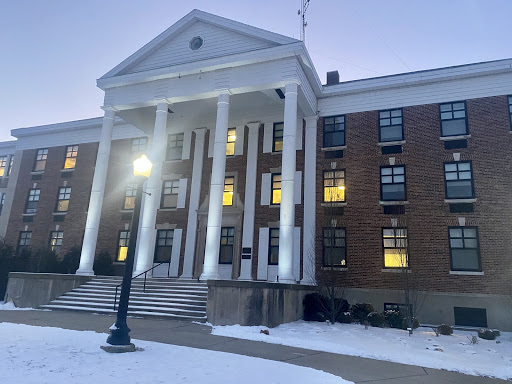
The Hillsdale Hospital has expanded its pain-management capabilities by increasing care providers and a new, renovated space for treatment.
With the expansion and move to the third floor on Feb. 15, the clinic is now called the Center for Excellence in Pain Management and specializes in non-surgical and non-prescription methods of reducing chronic and acute pain. According to Rachel Lott, director of marketing and development at Hillsdale Hospital, the center “has been moved up to the third floor and now has its own dedicated space with multiple rooms for our patients, with multiple places for them to be seen and be treated.”
It’s an expansion of both space and providers, she said.
“The clinic has been very popular with patients in our community, and we even have a lot of patients who come from outside of our community to receive care,” Lott said. “We saw there was a need for more care to be available for pain management, and we needed to expand what we were able to offer, as it was taking people quite a while to be able to get scheduled.”
The hospital brought on J.J. Fontana to serve as a Certified Registered Nurse Anesthetist in addition to Andrew Biegner, who has served as a CRNA at Hillsdale Hospital for over nine years. A CRNA is an advanced practice nurse specialized in administering anesthesia and other forms of pain management. Biegner and Fontana guide patients first through identifying the source of their pain and then create specialized treatment plans.
“The hospital has given us a good portion of the third floor of the hospital, and added not only additional providers in J.J. Fontana but also in adding support people from receptionists to our insurance authorizers and medical assistants to essentially double our team so that we can see more patients and decrease our wait time,” Biegner said.
According to a press release about the changes, “Hillsdale Hospital’s interventional pain management team provides a multi-disciplinary approach to relieve, reduce and manage pain to improve patients’ quality of life. The team first obtains a diagnosis that pinpoints the exact cause of a patient’s pain. After that, the team and the patient discuss interventional treatment options that diminish pain instead of masking it with narcotics or opioids.”
Because of the addiction risk associated with high-powered pain killers, the focus of the pain clinic is to find alternative ways to manage pain.
“The more that we can manage this type of pain, without opioids or narcotics, the less risk there is for folks to have any sort of addiction issues,” Lott said. “We know the opioid crisis is a huge issue in America right now, and here as well. We’re providing an alternative for people so that they don’t have to choose between either living with pain or opioid or narcotic forms of treatment.”
According to Biegner, the CRNAs at the clinic do not prescribe medication, and can assist primary care physicians in helping patients off opioids and narcotics by tackling the root of their pain.
“There are situations where narcotics are appropriate, but there are a lot of patients who have been chronic opioid addicts who need to be assisted,” Biegner said. In providing the treatments that we provide, we can assist our primary care doctors in allowing patients to come off narcotics and increase their activities, get people back to work, and increase their quality of life.”
The treatment available at the clinic depends on the root cause of the pain, but usually involves some kind of injection of steroids or anesthetics to block signals from the nerves responsible for the pain, according to the hospital’s website. They will also be offering a new treatment called “radiofrequency ablation,” which uses radiofrequency energy waves to create heat on specific nerves that temporarily suspends their ability to send signals to the brain.
“We can remove the pain generator with RFA, and the results last anywhere from six months and in some patients up to two years,” Biegner said. “But I’m seeing most patients looking at six to 12 months of significantly improved pain management.”
The goal of these kinds of pain treatments is to help people function normally. Biegner said that they have “small victories and large victories,” meaning sometimes the goal is to help a patient be able to walk to the mailbox or go to the store without pain, and sometimes it’s to take away pain completely.
“We’ve had stories from our pain clinic of patients who have gotten up off the table pain-free for the first time in years at their first appointment,” Lott said. “And that is huge for people. It makes such a difference to not have to live with that kind of pain. It affects your family life, it affects your work life, it affects everything. So for individual patients that can truly be life-changing.”
Biegner said the best part of his job is relieving people from pain that has been lowering their quality of life for years.
“I took care of a patient who had chronic headache pain in the back of her head for 10 years,” he said. “After we did the injections for her, she gets off the table and literally hugs me. So I think that the most gratifying thing for me is when I see we’re making a difference in people’s lives.”
