
Hillsdale Archives
There were 8,000 men on the RMS Queen Mary, and their lives were in danger.
A South American Nazi spy ring was broadcasting the Allied Queen Mary’s location to as many German U-boats as it could reach as they patrolled the north Atlantic. If they caught the ship, they would torpedo and sink it. Listening to the flurry of communication over the radio waves was 1915 Hillsdale alumna Elizebeth Smith Friedman, and she was scribbling down as fast as she could the messages only she could understand.
These Nazi cyphers were smart, but Friedman was smarter. As she decrypted the locations of the submarines, she wired them to naval command, which in turn directed the Queen Mary out of danger. This success shifted power in the Atlantic in favor of the Allies, and allowed the crucial supply lines between North America and Britain to continue throughout the war.
This story and many others about the “mother of cryptology” are recounted in the Jan. 11 episode of the documentary series “American Experience” on PBS. The series documents significant lives and events in American history, and has been on the air since 1988.
In the hands of the seasoned staff at “American Experience,” Friedman’s story comes across clearly and dramatically. She comes alive through a vast number of photographs, especially in the ones taken by her husband, who was an amatuer photographer.
Though she was indispensable to the war effort, Friedman couldn’t have any idea that this dramatic future was in store when she was a student at Hillsdale over 100 years ago. This was partially because the field of cryptology didn’t exist yet, and partially because she had no idea what she wanted to do with her life.
And I’d argue that Hillsdale students can relate.
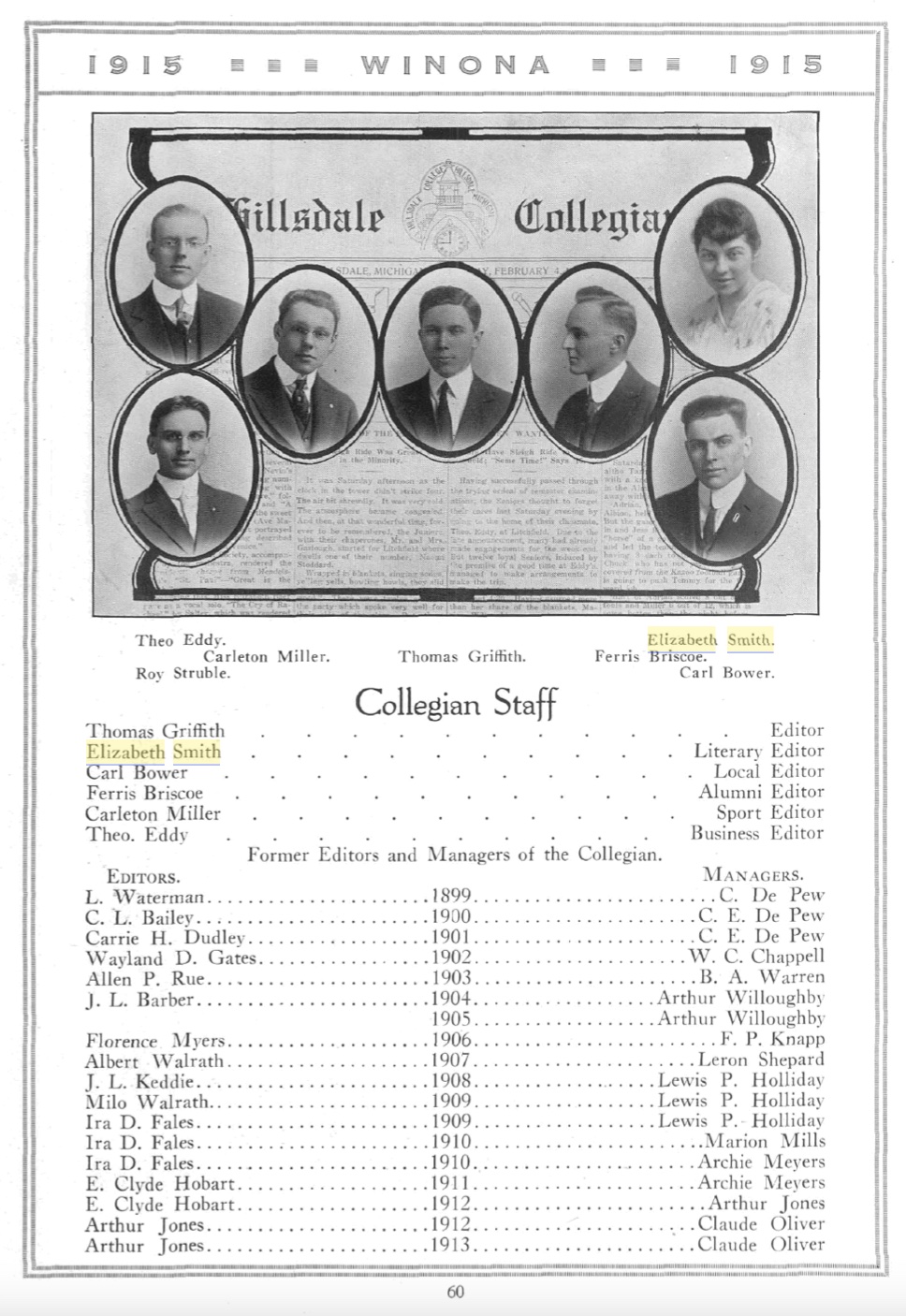
Like so many young people, Friedman was propelled toward education by a fierce but vague burning to do something more with her life. Her large Quaker family didn’t understand this, and her father was against her attending college at all. She went to Hillsdale because it was conveniently close to her family in Indiana, but threw herself into her studies of Greek and English literature, involvement in Pi Beta Phi, and as literary editor of The Collegian.
She wanted to continue her pursuit of the life of the mind beyond Hillsdale, but after graduating in 1915 there were few opportunities for women. She tried being a school principal for a year, but didn’t find it to her liking. Without a plan, she headed to Chicago to look for a job. When her money ran out and she still hadn’t found a job, she faced that prospect that to many recent graduates signifies true defeat: moving back in with her parents.
But Hillsdale gave her a lasting gift that through providence or fortune would change the course of Friedman’s life and, eventually, the tides of wars. While studying English literature, she fell in love with Shakespeare. On her last day in Chicago, she stopped at the library to view a rare First Folio. While looking at the rare book she met George Fabyan, a textile tycoon who collected talented researchers and scientists to work on his pet projects at his private laboratory.
Seeing her interest in Shakespeare, he asked her if she wanted a job studying the plays. He wanted to prove that Francis Bacon was the real author of many works attributed to the Bard, and he believed there were secret codes in the text that would reveal this.
She jumped at the chance and proved to be a natural at finding patterns in numbers and letters. Though she conclusively proved that no such codes existed in Shakespeare, the work primed her perfectly for essentially founding the field of cryptology during the First World War and beyond.
The documentary tells the rest of her incredible life story, but it’s this part between her college years and suddenly finding herself doing indispensable work for American security that interests me most. Soon to be a graduate myself, there’s a lot about the future I don’t know. Friedman shows that there is much to be gained from not having a rigid plan. It’s a lesson that Hillsdale students should hold onto.
Hillsdale is a place with many high achieving people, and high achieving people tend to be planners. Being one of the most important cryptologists ever wasn’t something Friedman could have planned for in 1915 because she was going to pioneer the field. There are many of us on the cusp of graduation who may similarly have drive and ambition, but no where to direct it. But the 21st century is similar to the previous because we too are in a rapidly changing time.
A five year plan may hinder people from taking opportunities that don’t yet exist, and that suit talents they don’t know they have. College is just the beginning, not the end, of refining skills. Everyone should imitate Friedman’s growth mindset — doing so may eventually save lives.
