
Meckley’s Fruit Farm in Cement City village may be one of few businesses doubling its profits during the pandemic.
“We’ve crushed any previous year by over double,” owner Steve Meckley said.
When Meckley’s parents purchased the farm in 1956, their mission was to provide a gathering place for people. Meckley bought the business from them in 2012, and has been staying true to the family motto of “heritage and tradition.”
“We have four generations of customers,” Meckley said. “Great-grandparents are bringing their children and grandchildren and great-grandchildren to the farm.”
The farm added a brewery in August 2019 to allow the business to stay open year-round, Meckley said. Previously, it closed after Christmas and reopened in the spring, but this caused many employees to leave.
“We were losing really terrific people from our staff because they just had no other option, so we decided to put in the brewery,” Meckley said. “And little did we know six months later we would be in the middle of a worldwide pandemic.”
At the onset of COVID-19, Meckley met with his staff and asked for input.
“Unanimously, everybody said ‘You know what, let’s try it. Let’s see how it goes and see what the response from our customers is and let’s just try it,’” Meckley said.
The first two weeks of Gov. Gretchen Whitmer’s stay-at-home order were very difficult, Meckley said. The farm had no online ordering system and had to add staff just to answer the phones. Finding ways to do contactless payment and curbside pickup was also new to the staff.
Employee Marilyn Eicher said because many other stores closed, the farm became very busy.
“I love working with people and answering their questions,” Eicher said. “But talking to people with masks on makes it very difficult to understand sometimes.”
Meckley and his family came together to find solutions. His wife, Adrienne, developed a new website for the farm which allowed people to choose the items they want and pay securely online instead of over the phone. His daughter Lindsay works to reach customers through social media.
“It’s pretty powerful when you can reach into somebody’s home and motivate them through a picture or a short video to get out of the house and drive here,” Meckley said. “We are a destination.”
Lindsay used the online presence to overcome the challenge of supply shortages.
Meckley said he was used to ordering multiple pallets of glass, half-gallon containers for his cider and beer and having them delivered in two weeks. When he was limited to one pallet and given a six-week shipping time, he knew he had to get creative.
Reaching out to customers through social media, they were able to exchange glass containers, properly sanitize, and reuse them.
The national coin shortage also forced the business to adapt. Meckley said he asked his employees to bring in any jars of loose change they had around their house. The farm adjusted their prices to whole dollars, which allowed them to continue accepting cash when other stores went to card-only payments.
Ordinary expenses, such as toilet paper and gloves, sky-rocketed, Meckley said.
“Gloves went from 12 cents a pair to 38 cents a pair. And how many times in a given shift is somebody changing their gloves?” Meckley said. “I spent $2,000 just on gloves.”
Outdoor seating and take-out options have allowed people to social distance, and Meckley said he’s looking into winter seating options.
“In the winter we’ve talked about igloos, we’ve talked about yurts or tents to create a Mongolian basecamp,” Meckley said.
Customers Jo and George Chizmar said they’ve enjoyed going to Meckley’s over the years and have been impressed by how well the farm has handled the pandemic.
“It keeps growing and diversifying,” Jo Chizmar said. “They’re focused on cleanliness and are very family-oriented.”
Meckley said adapting allowed his business to succeed, and he is sad for other owners who were forced to close their businesses this year.
“I think there are people that work their entire lives—and this is what I think a lot of politicians don’t understand and unfortunately some parts of the general public don’t understand—is what it takes to run a business,” Meckley said. “It’s sacrifice and hard work, there’s no substitute for those.”
Meeting mask mandates and additional health protocols was a challenge, but Meckley said he wanted to do everything possible to stay open and make his customers feel welcome.
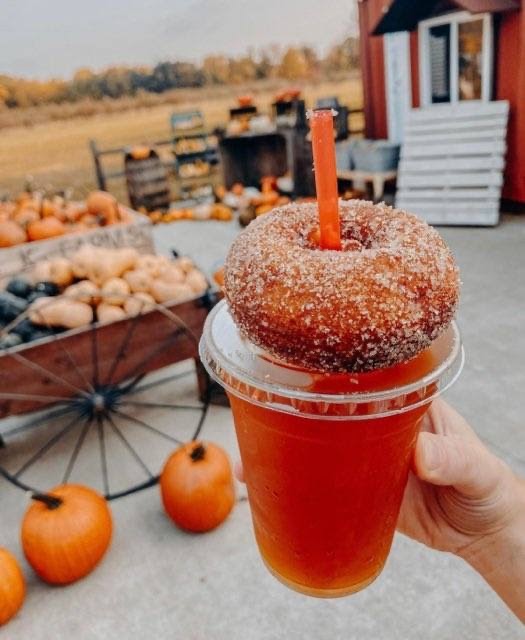
“Customers are looking for something simple to do to make themselves feel normal,” Meckley said. “We’re going to give everybody just a taste. If a doughnut or a cup of coffee makes you feel normal, then no problem. That’s what our whole goal was.”
