
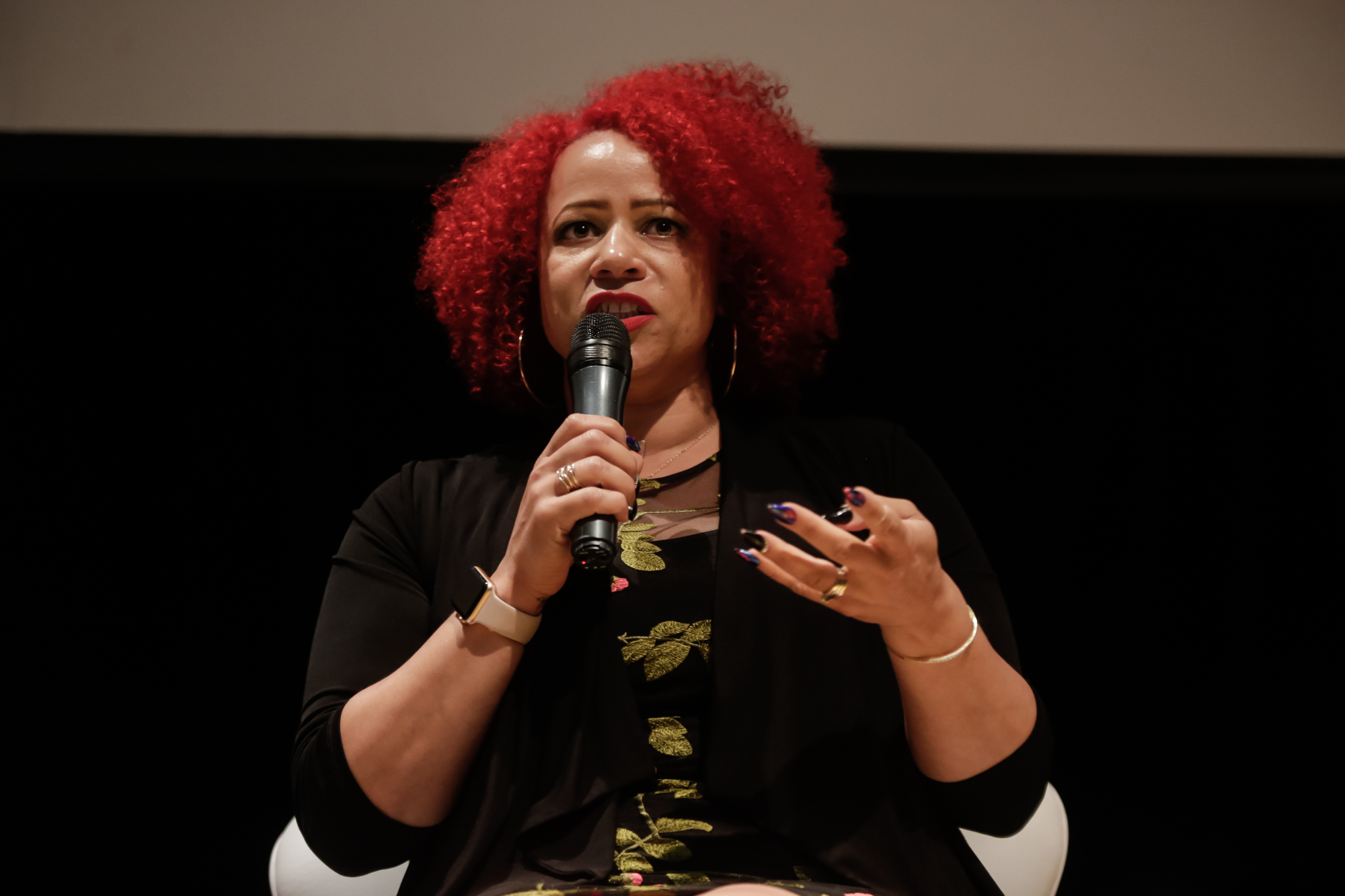
Four Hillsdale professors and 19 other academics signed a letter on Oct. 6 asking the Pulitzer Prize board to revoke the prize it awarded to Nikole Hannah-Jones of the New York Times for the 1619 Project.
Hillsdale College President Larry Arnn, Distinguished Visiting Fellow in History Victor Davis Hanson, and Professors of History Paul Rahe and Paul Moreno all signed the letter. Burton Folsom, distinguished fellow at Hillsdale College and a former history professor, also signed.
The Pulitzer board awarded the 2020 Prize for Commentary to Hannah-Jones for her lead essay in the 1619 Project, titled, “Our democracy’s founding ideals were false when they were written.”
The 1619 project, which seeks to reinterpret the American founding from the perspective of African American slaves, has been condemned by both mainstream and conservative historians for its claim that protecting the institution of slavery was a primary motive for the American Revolution, “a claim for which there is simply no evidence,” the letter’s authors state.
Hanson said the 1619 Project is “factually not the ‘real founding’ of the United States.”
“When reputable historians demonstrably proved that point to Hannah-Jones, she did not offer coherent counter-arguments to support her thesis, but rather she denied that she had ever argued for a 1619 foundational date at all,” Hanson said. “Her platform, the New York Times, without explanation, mysteriously removed a prior explicit reference to the 1619 foundational date as being essential to the project. In other words, Hannah-Jones was awarded the Pulitzer Prize on the basis of arguments that she now not only disowns but claims that she never really made — again demonstrably untrue.”
The letter cites serious factual errors in the 1619 Project as a whole as reasons for Pulitzer to revoke its prestigious award.
“Prominent historians, most of them deeply sympathetic to the Project’s goal of bringing the African American experience more fully into our understanding of the American past, nevertheless felt obliged to point out, in public statements beginning in September 2019, the Project’s serious factual errors, specious generalizations, and forced interpretations,” the letter reads. “Hannah-Jones did not refute these criticisms or answer them in a respectful or meaningful way. Instead, she dismissed them.”
According to Arnn, the New York Times is mistaken about three key elements of America’s founding.
“I think the Times is mistaken, now, in three serious ways,” Arnn said in an email. “Claiming that the real founding of America was the arrival of that ship with slaves on it (they were actually indentured servants, not slaves, but they were captured Africans brought to America likely against their will); in altering the record without admitting it; and, by altering it, making a new argument that is, in my opinion, worse than the original.”
Arnn compared the project to George Orwell’s famous dystopian novel.
“This is very like what happened in the novel ‘1984,’” Arnn said. “History becomes a weapon of despotism.”
Hannah-Jones responded to the letter in a series of tweets on Oct. 6.
“In 1894, the NYT called Ida B. Wells a ‘slanderous and nasty-minded mulattress’ for daring to tell the truth about lynching. 100 years later she earned the Pulitzer Prize. These efforts to discredit my work simply put me in a long tradition of BW who failed to know their places,” she tweeted.
Arnn said the letter came to his attention through Stanley Kurtz, senior fellow at the Ethics and Public Policy Center; Peter Wood, president of the National Association of Scholars, where the letter is currently posted; Roger Kimball, editor and publisher of the New Criterion and a Hillsdale College parent; and Wilfred McClay, author of “Land of Hope,” all of whom also signed the letter.
“I hope the letter will vindicate the proposition from Aristotle: ‘This alone is denied even to God, to make what has been not to have been,’” Arnn said.
