
Nestled deep in the basement of Delp, around a great many corners, far from the prying eyes of overly inquisitive freshman, lies what might be mistaken for a museum of recent American history and culture.
“When you walk in to Dr. Stewart’s office, it’s downstairs in the building, so it’s kind of like entering into a dungeon a little bit. It’s down some steps, around the corner, then when you walk in, you see these big maps, lego sets, and retro signs,” senior Calvin McNellie, who took Stewart for American Heritage, said.
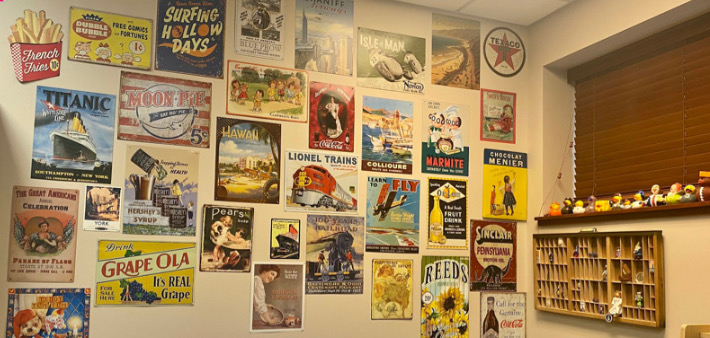
Professor of History Dave Stewart is known for his unique office collectibles. His flock of rubber ducks on the window sill, a vibrant wall of advertising signs hung above his desk, and a growing treasury of medieval weapons make a visit to his office quite memorable. Nevertheless, his office maintains a clean and organized feel with books arranged by height and chronologically by English history, French history, and Spanish history.
“Students notice different things,” Stewart said. “Very few just talk about it in general. Some talk about the signs, others will say something about the sword.”
“Every single time I go, I see something new,” junior Juan Vargas-Hernandez said. “When you walk in, the first thing you see are his rubber ducks right next to his desk. Then, right next to it is this shelf thing that has legos and stuff like that — very interesting.”
Stewart decorated his office with the intention of filling up the walls.
“I wanted one wall to have maps and pictures and stuff,” Stewart said. He placed 10-year collected vintage advertising signs on the opposite wall to add a pop of color and make up for his lack of windows.
“I have always been really fascinated with how ideas play out in real life— at Hillsdale we always talk about the ideas we ought to have — in real life, it’s why and how things are being sold to people.”
Stewart is particularly interested in the story these signs tell about real life. For example, his Hershey Syrup sign conveys a better sense of ideas about health in the 1980s than a formal academic journal.
A student favorite is his growing collection of rubber ducks that sit on the window sill facing the door. Stewart has been hunting ducks for over fifteen years and students continue to give them to him to this day.
“I have a duck collection,” Stewart said. “I guess I have close to 1,000 rubber ducks at home with some weirder ones or ones that sort of connect to some of the classes I teach, like the Queen Elizabeth Duck and the Shakespeare Duck.”
His much-admired collection of medieval weapons was started when the boys of Koon dorm gave him a ball and chain, and has grown since.
“Over the summer I took a bunch of students and we started in Spain — they were all doing Oxford— we did a week in Spain, did a week in the South of France, three or four days in Paris, up the Rhine to Amsterdam, then to Oxford,” Stewart said. “At the end of that trip, all the students knew I had the ball and chain so they got me that sword on the wall as a thank you for leading the trip. Then a few years of later, I took a bunch of students over Christmas to Spain and they decided that the sword looked stupid without a shield, so at the end of the trip they got me shield.”
Stewart’s mother-in-law contributed to the collection with a helmet she found in a gas station in Florida. Now he is proud to say he has protection to go with his weapons.
“My favorite part of his office is his massive helmet,” McNellie said. “It’s got to be at least thirty pounds full size and it looks real. One time I got to try it on. When I had it on, he let me hold the “morning star” which is a ball and chain weapon thing. I felt very cool, but I don’t know how anyone fought in it.”
Vargas-Hernandez found other interesting objects besides the armory.
“The best one is this book he got in Spain that was used to teach children in elementary school. It’s a book from the ’50s when Spain was under dictatorship and it shows how education was, and it’s just very interesting since its a super old book.”
Hillsdale graduate Mariel Stauff ’05, a history and music double major, spent much time in Stewart’s office as a student and has fond memories. His office was on the main floor, enroute from the library to the old cafeteria, so students frequently hung out on his yellow couch or popped their heads in between classes.
“He didn’t have quite the collection of action figures and toys, but he had some of them back in the day. That has been kind of a thing that has grown since I was a student. People see them and now they buy things for him,” Stauff said.
Stauff helped to contribute to his current office by organizing a birthday present. She found an ancient map of Cardona and a battle in the War of Spanish Succession in an antique store in Savannah, Georgia while on family vacation after graduation.
“No one had done anything for his birthday since it was on commencement day. When I saw it, I knew he had been doing some research on that war, and I just emailed a bunch of my friends who had also graduated and said that if we all pitch in a couple of bucks we could buy it for Dr. Stewart.”
