
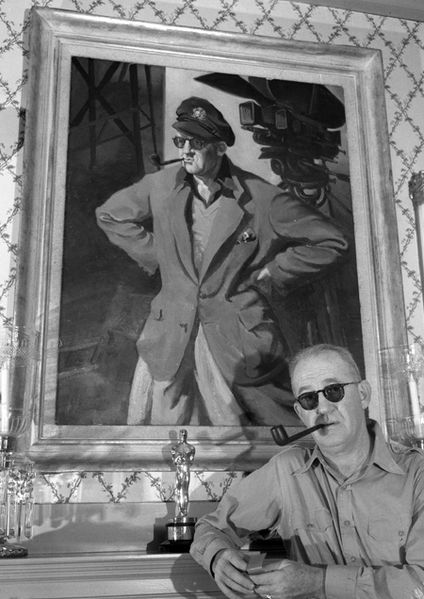
American film historian and writer Joseph McBride believes filmmaker and Oscar-winning director John Ford can be summed up in a line from Walt Whitman’s “Leaves of Grass”: “Do I contradict myself? Very well, then I contradict myself, I am large, I contain multitudes.”
“That’s John Ford,” McBride posits.
Ford and his westerns are the subject of the fourth CCA for the 2019-2020 school year at Hillsdale College. A film CCA, attendees watch one of Ford’s films before each lecture. Classic westerns such as “Stagecoach,” “The Man Who Shot Liberty Valance,” “The Searchers,” and “My Darling Clementine,” were shown on the big screen in Plaster Auditorium Sunday through Wednesday.
McBride, who also wrote a biography on Ford titled “Searching for John Ford,” talked about Ford as a man of contradictions.
“You can’t reconcile his contradictions, they just exist,” McBride said. As an example of this, McBride brought up Ford’s political contradictions. At one point he described himself as a socialist democrat, at other times, a Maine Republican.
American director and film historian Peter Bogdanovich, in his lecture on Ford Monday night said “Ford did not give political statements. He used to say, ‘I’m apolitical,” thereby proving Ford’s complexity.
Ford came from an Irish family in Maine who spoke Gaelic. This experience as an immigrant minority influenced much of his work, as Ford treated minorities sympathetically in his films.
Paul Cantor, an English professor at the University of Virginia who characterized Ford as “America’s Shakespeare” in a lecture on Tuesday, brought attention to how Ford showed both sides of a story in his films.
In “The Searchers,” for example, Ford’s heroes are the white settlers of Texas post-Civil War. Ford shows a settler family massacred by a roaming Comanche tribe. But later on in the film, the U.S. calvary murder and pillage a peaceful Indian village.
This showing of both sides, Cantor asserted, is why Ford is like Shakespeare, for this was a technique Shakespeare utilized in his plays.
Ford’s preoccupations as an artist were family, land, community, and patriotism, themes predominant in his westerns, according to McBride.
“Ford was an idealist who dwelt on the destruction of his ideals,” McBride said. “The history of the Western is the history of the loss of faith in America. Ford always looked back to an imaginary past and its glory.”
Ford’s complexity as a person and his outlook on life bled through to his characters, who were also contradictory, “the noble outlaw,” many times played by John Wayne, being one of them.
Assistant Professor of Spanish Todd Mack who attended the lectures and will appear in a faculty round table for the CCA on Thursday said that students should take advantage of watching Ford’s films on the big screen.
“Every great filmmaker after John Ford is influenced by John Ford, in the United States and abroad,” Mack said. “Even people who think that they’re not influenced by John Ford, are influenced by John Ford. So you’ll have lots of modern people in Hollywood, they’ll say, like Kurosawa, who’s a great Japanese director: ‘Oh, Kurosawa’s films are amazing. He’s the father of the modern action film.’ But you know who Kurosawa’s favorite director was? John Ford. There’s no getting around him. And every great thing that you could say about Spielberg or Orson Welles or Kurosawa, or any of these other—George Lucas was hugely influenced by him. There’s no getting around him. He is a giant.”
Sophomore Alaura Gage said Ford’s westerns are much more sophisticated than she thought they would be.
“It’s taught me a lot more about what it means to be an American, like how Americans have been represented in film,” Gage said. “I’ve always seen caricatures of the West in popular culture, but I’ve never seen it up close and personal. I’ve never seen it firsthand. The characters in the films are trying to reconcile all these ideas of, ‘How does one tame the West and what’s at stake?’ And I think these problems that they’re facing in these films are still problems that we face today, like relations with Native Americans and other minorities and how we treat them—even gender relations are still very complicated in these films, but they’re also complicated today as well. So I think Ford’s westerns can still contribute to an ongoing conversation about what America stands for.”
