
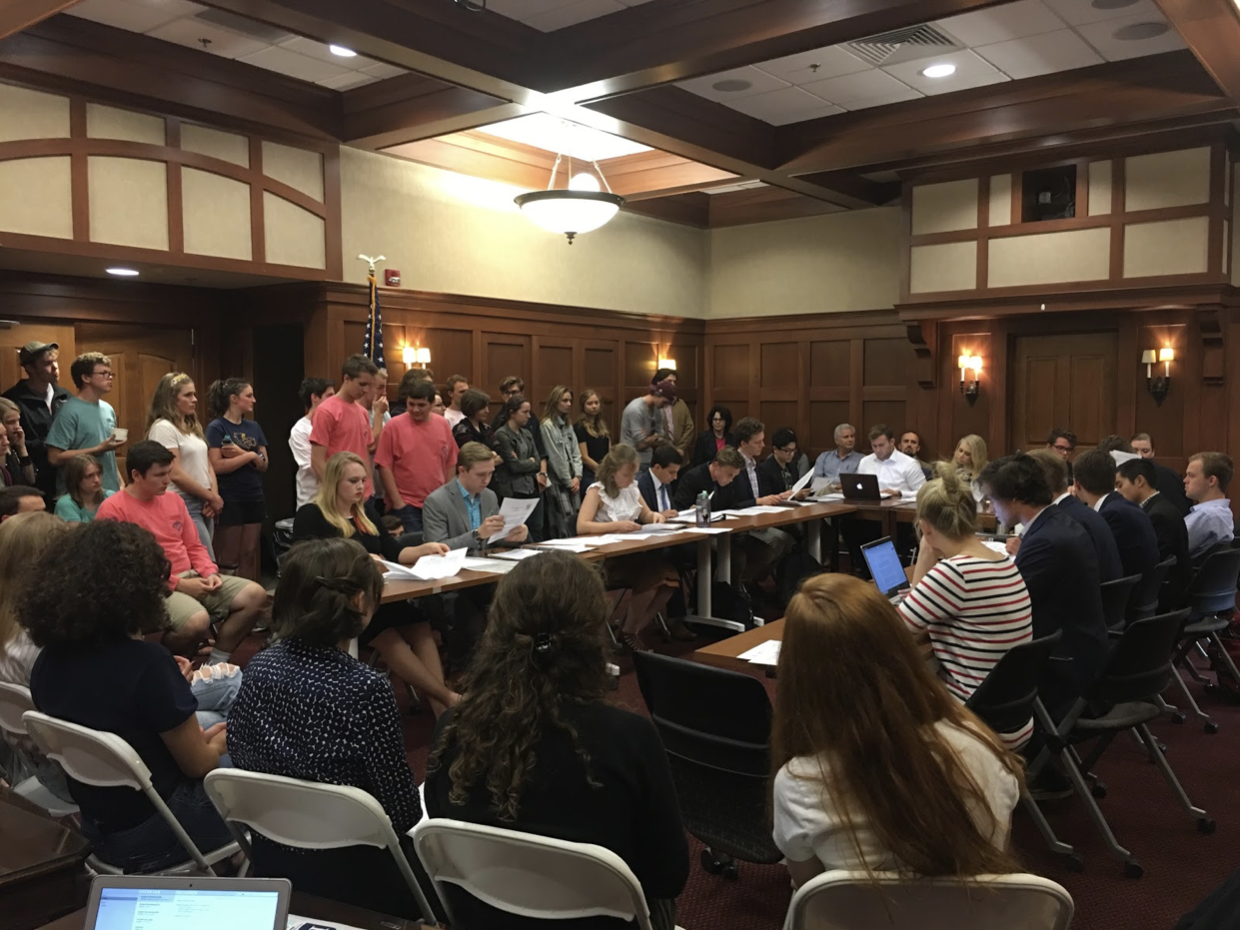
A group of about 70 students and faculty attended the Sept. 26 Student Federation meeting to express their support or opposition to a funding request to reinstate the funds which were cut from the Tower Light budget last spring.
The Student Federation voted 9-4 to uphold the current, reduced Tower Light budget in a contentious meeting that lasted two and a half hours.
The Thursday meeting was the third time since April 2019 that the Tower Light’s budget had come up for a vote, the first being the initial decision to cut $5,500 from the regular allotment of $11,000. With the addition of a $31,000 discretionary surplus the federation discovered in an emergency fund over the summer, the issue was brought up again at the suggestion of Dean of Women Diane Philipp and some members of federation leadership to reinstate the $5,500 in their meeting on Sept. 12. The April budget was upheld 11-2 at that meeting.
The argument revolved mainly around the aesthetic of the publication and whether that was possible on a reduced budget. The federation had previously reduced the budget as the result of a decision to have the Tower Light printed in-house for a quarter of the cost at the expense of glue binding, embossed printing, and sharper images.
Some of the objections at the Sept. 12 meeting were based on the fact that the motion did not proceed through normal committee channels. Typically, a funding request for any of the publications would require meetings with the finance and publications committees, with a vote more likely to succeed based on their recommendations.
Representatives from the Tower Light met with the finance committee on Sept. 22, before the most recent Federation meeting, to formally request that the funds be reinstated. Between the finance meeting and the Sept. 26th federation meeting, an examination of the Tower Light account revealed that there were $2,000 more in discretionary funds than previously thought, which decreased the amount the publication requested to $3,000.
When the Sept. 26 meeting opened with reports from each committee, the finance committee did not recommend that the Tower Light receive the additional money. This was not the final decision, as that would come down to a vote by the whole federation after all discussion had been heard.
The Tower Light saw support early in the form of three letters read aloud during the secretary’s report. One was from a 2010 alumnus and former federation president, another from the Collegian’s Editor-in-Chief Nolan Ryan, and an open letter by Assistant Professor of English Elizabeth Fredericks in solidarity with 13 members of the English and fine arts departments that had been published in the Collegian earlier that day.
After these reports, Mary Kate Boyle, editor-in-chief of the Tower Light, and Maria Servold, faculty adviser to publications, made their case as to why they should receive the funding.
“If you increase our budget, we can print the Tower Light well,” Boyle said. “We’re a school that prides itself on excellence, and our publications should be no exception. If we say we can offer an education equal to or better than any other school in the country, that should be clear through the work we publish.”
Servold reminded the federation that it is required per its constitution to provide funding for all student publications that fall under its purview and noted the apparent lack of respect on campus for the Tower Light.
“You’re required by the college and your own constitution to fund the Tower Light,” Servold said. “Obviously that needs to be done reasonably and responsibly, but everyone involved in the actual making of the Tower Light has created a budget that produces a respectable, beautiful, and professional work. All we ask each year is simply what it costs.”
When Boyle and Servold finished their request, the meeting moved into a period of public comment in which the audience had time to voice their opinions on the matter. The commenting period was limited to a total of 15 minutes, with a maximum of two minutes per comment, and moved in a pro/con alternating format.
The 18 people who spoke during this time included some faculty, students, and Tower Light editors speaking in support of the funding proposal, with emphasis on the need for good aesthetics to match the quality of work within the pages. Some also explained the importance of having an exceptional literary magazine to aid in recruiting students to come to Hillsdale, as the Tower Light’s polished presentation proves that Hillsdale takes the arts seriously. Some students noted this was influential in their decision to attend Hillsdale.
“Aesthetic is not something that is intuitive; it’s something, like conscience, that needs to be cultivated and can be poorly cultivated,” junior Colm Maines said.
Junior Kailey Andrew, who works in the college admissions office, described showing the Tower Light to prospective students.
“We have a lot of prospective students interested in studying English who take literature very seriously,” Andrew said. “Every time I get to show a prospective student the Tower Light, their reaction is always priceless.”
The other half, who spoke against the proposal, stressed that there is a middle ground between financial responsibility and aesthetics, though several of the “con” statements were used to ask questions clarifying the exact financial situation of the Tower Light.
“It’s what’s on the inside that matters,” sophomore Jacob Hooper said. “I expect each and every one of you to be fiscally responsible, and I have a hard time justifying how a printing cost could be so large for such a small publication.”
When public comments finished, discussion moved within the Federation.
Representative Matthew Montgomery opened by voicing support for the reduced budget. Montgomery said that he doesn’t believe that paper quality is the only thing that makes art.
“Art does not require large budgets to flourish and exist so long as a culture that honors art is present, and we have that culture here at Hillsdale College,” Montgomery said.
Vice President Madeline Peltzer countered by pointing out that the federation is required to allocate money and that they are currently working with double their typical budget. Additionally, the average funding request from groups that come before the federation is about $1,500, and what the Tower Light was requesting is equivalent to only two of those.
“Why have we chosen this hill to die on?” Peltzer asked.
Representative Owen Macaulay weighed in on the side of those supporting the current budget by pointing out that Hillsdale’s most far-reaching publication, Imprimis, is printed like a brochure, and yet no one would doubt the quality of its content.
Delta Tau Delta Representative Joel Meng pointed out that the majority of those arguing over the Tower Light’s print quality — including himself as a newly sworn in member of the federation — had never been presented with an example of how the journal would look if printed by the copy center.
When the Chairman of the Publications Committee Braden VanDyke’s turn came to speak, he requested that the time limit of two minutes imposed on other federation members be lifted for him to fully explain the rationale behind the initial decision to cut the Tower Light’s budget. The request was granted by a federation vote.
VanDyke made the same recommendation that the funding request not be approved as he did at the last regular federation meeting. He brought in numerous examples of print products produced in the college’s copy center, including The Forum and the Bon Appetit magazine. VanDyke also described examples of the student-produced literary journals at Harvard, Yale, and the University of Chicago. He pointed out that their journals tend to be simple, and mostly online. He stated that his ultimate goal was to make the Tower Light intrinsically respected again by solving what he believed to be a problem with outreach and campus presence.
After a five-minute recess there was a motion to end the discussion and move to a vote, which was overruled by federation President James Millius. Discussion continued but moved into debate over the proper handling of the federation’s discretionary budget surplus, which Millius halted on the grounds that it was not pertinent to the topic of the Tower Light budget.
What followed was a flurry of debate over the surplus, the Tower Light budget, and Robert’s Rules of Order.
When it came time to vote, Tower Light’s funding request was denied 9-4, with representatives VanDyke, Phil Berntson, and Nick Oxaal abstaining.
The floor was then reopened to general public comment in which both supporters and those in opposition of the budget spoke. Dutton Kearney, associate professor of English defended the large number of faculty present at the meeting.
“I’m disappointed that you are intimidated by our presence,” Kearney said. “College is a partnership. I just came to support the Tower Light. Our point is education and counsel.”
Secretary Victoria Schmidt and Berntson encouraged those in attendance to be civil with those they disagreed with after leaving the meeting.
At the close of the meeting, Millius took a step back from his position as president and chair of the discussion to say, as the most senior member of the board, that he strongly disagreed with the vote due to what he described as the federation’s inconsistent application of fiscal responsibility principles.
Meng had the last word, reiterating that it would be beneficial to actually see the differences in aesthetics at the heart of the debate.
“It’s hard for us new members of the board to really gauge the quality difference because we weren’t here last semester,” Meng said. “It would be helpful to see price quotes from different printers, as well as to hold sample booklets. I just want this to be the best blend of fiscal responsibility and aesthetics for students at Hillsdale to enjoy.”
