
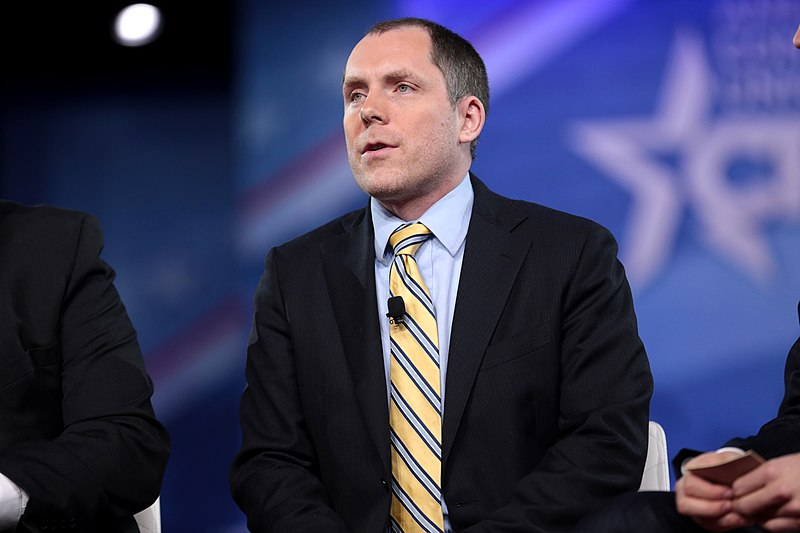
Communities with strong civil institutions provide a safe and healthy environment in which to raise children, said Tim Carney, commentary editor at the Washington Examiner, at a talk last week.
Carney, author of three books, spoke on Thursday, April 4 on his most recent book, “Alienated America.” He described the book as a story about the American Dream, faith, family, and a partial explanation as to why Donald Trump won the 2016 election.
Carney made the argument, based off his own personal research, that in places where there are strong community organizations, there is a sense of purpose. And where both of those are strongest, the American Dream seems most alive to those who live there.
Part of his research included stopping into bars and talking to people about the state of politics. Carney noted that he always avoided roadside bars in the middle of nowhere as they typically had people who, rather than commenting on who they’re voting for, said that politics altogether was “just BS.”
Based off his research, Carney said Trump’s message — that the American Dream was dead — drew certain types of people out. It resonated with that group of people who, before Trump, thought all politicians were frauds.
According to Carney, this is why Donald Trump struggled in areas like Holland, MI, where the community is very connected through different community organizations, namely churches. He said reformed churches specifically defines these Dutch communities.
That message didn’t resonate with connected religious communities, where the sense of purpose was high. The American Dream was alive and well in their eyes.
According to Carney, wealthier people are disproportionately more likely to be involved in other community organizations such as sports teams, musical groups, and golf clubs, and it’s easy not to see the community value these groups provide. This community support creates a sort of safety net. As the nation secularizes, the elite have other outlets to turn to for this net. The lower and middle classes rely more on going to church as it sociologically makes people feel a sense of belonging.
Without the sense of purpose that community allows, the struggles of the working class feel pointless. The necessity of a family or having an essential job are common among elite circles, but not lower and middle class.
During the Q & A following Carney’s lecture, junior Joel Meng asked a question regarding the changing community interactions with the increasing presence of internet communities.
“To what degree has the internet displaced a lot of real communities or physical communities with more virtual communities, and to what extent do you think people can use the internet to actually establish communities that build up?” Meng said.
In response, Carney told a story about the office for Reason Magazine attempting, but eventually failing, to eliminate a physical workplace. People being physically together makes you work better, so the best thing you can do is put people together, he said.
Carney gave a personal anecdote about his daughter, Eve, to show the power of the community. When she started going blue from a respiratory virus, Carney frantically took her to a special children’s hospital in Washington, DC. The doctors were able to get enough oxygen in her lungs and ordered her to stay on this special oxygen machine for a few days. While Eve was recovering in the following days, friends continually brought over food and gifts for the Carneys.
“People would come bring me food in the hospital, bring my wife dark chocolate and I would say ‘Oh that was a guy from The Examiner,’ ‘oh that’s a guy from the American Enterprise Institute,’ ‘that was a couple from our parish,’ ‘that’s a guy from swim club,’ ‘oh that gift card? That came from an organization. I used to serve on their board of directors.’”
In describing these people, Carney pointed out that the wording he used wasn’t just friend — it was always someone connected to him by one of these institutions he belongs to.
“It’s a safety net,” he said. “All of you have experience of either the giving or receiving end if you’re plugged into one of these things.”
Senior Josiah Johnson helped organize a book club for “Alienated America” two weeks prior to Carney’s visit in preparation to discuss his book with him.
Johnson said the book can be directly applicable to the lives of Hillsdale students.
“It’s in a way advice for Hillsdale students,” he said.
He explained that, whether you’re rich or poor, you can have power in these virtues and in the church that can help you thrive. Everyone has access to the church as a source of community and support regardless of their socio-economic status.
