
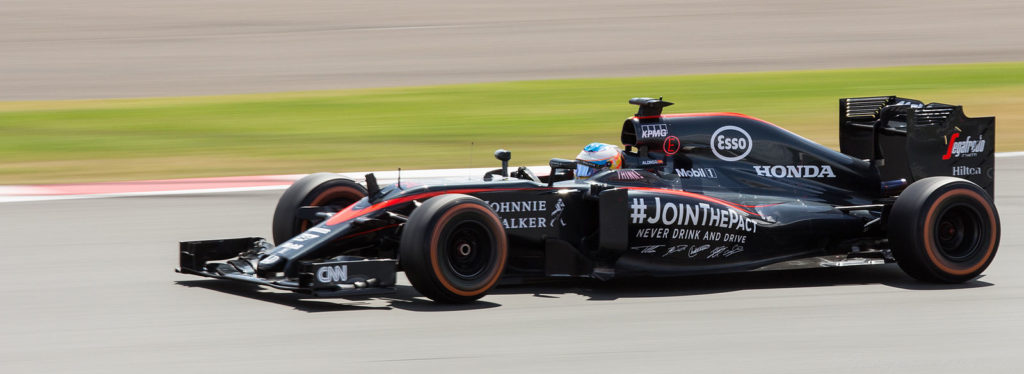
Released a week before the first race of the 2019 Formula 1 season in March, Netflix’s docu-series “F1: Drive to Survive” is an adrenaline-charged piece of escapism.
Formula 1, also known as F1, is the top tier of single-seater, open wheel car racing in the world. Ten teams, with budgets that soar from the tens to the hundreds of millions, put two cars and two drivers on the grid each year for a schedule of 21 races on 10 continents. While a few teams are privately owned, and race under their owners names (Haas, Williams), the majority of F1 teams are owned by manufacturers, automotive and otherwise, including Ferrari, Red Bull, and Mercedes. Most races occur in Europe and in Asia, with the lone American-hosted race, the United States Grand Prix, held in Austin, Texas.
The series hits the astronomic highs and the crushing lows of the 2018 F1 season, from the first race at Australia to the finale in Abu Dhabi. With complete access to pit lanes, drivers, and team principals, Netflix gets full coverage of every team except Mercedes and Ferrari, currently the top two dominating teams in F1. But given the consistency of Mercedes and Ferrari’s podium finishes, the series gives more time to the less certain, more dramatic mid-field fights.
“F1: Drive to Survive” is much less investigative journalism than it is a celebratory documentary of everything that makes this sport magnetic: the oodles of money, the handsome drivers, the constant lethal danger, the sunglasses, the horsepower, the hundreds of miles per hour.
Take the rivalries and testosterone of SEC football and add a zero to the team budgets to make it in the hundreds of millions. You’re approaching the politics, emotion, and money of the F1 production. It makes for good TV.
F1 drivers are conspicuously responsible performers, getting all the credit for a win, but all the responsibility for a crash, racing with millions of dollars breathing down their neck. Lap times define each driver’s value, and the most vicious rivalries are often between teammates, since the only true apples-to-apples comparison is between drivers equipped with the same exact car, which only occurs within a team.
The extremes of racing also generate mundane changes, and this trickle-down effect, along with the absurd amounts of publicity for brands and sponsors, is why F1’s glamour show can go on. Rear view mirrors, disc brakes, and all-wheel-drive first premiered in the F1 racing world.
The Netflix series frequently heightens this tension by using slow motion shots, and slathers the emotional high points with equally tense music. When telling the rags-to-riches story of F1 rookie Esteban Ocon, whose father worked through the night as a mechanic to get his son’s racing career off the ground, violins pitch in when Ocon wins sixth place, illustrating how important it is to him to earn his parents’ approval. Camera footage from within the car is used extensively throughout the show, often paired with the radio from the driver’s cockpit, but the show also delves into the concurrent drama from other drivers’ perspectives.
Wheels bounce; cars fly like frisbees over each other after what seems like the barest bump under a tire. Shockingly, most drivers walk away from an F1 accident. However, the series focuses so much on the crashes, usually first from the on-board cameras, conditioning the audience to think the driver is going nose-over-tail every time they see an on-board camera angle.
One episode features Swiss-French driver Romain Grosjean, driving for the American team Haas, the newest team to the F1 grid.
“If a driver keeps crashing, the biggest thing is he loses his confidence,” Haas team principal Guenther Steiner says of Grosjean’s 2018 season. “On a good day, I think Romain is one of the best out there. But he makes mistakes.”
Grosjean relates how he sought help from a psychologist, unable to shake a string of mistakes. One particularly humiliating slip left the nose of his car stuck in a tire wall in France in qualifying, before the race even began.
When that happens, “you keep your helmet on and your visor down,” Grosjean reflects. “You can be a hero and you can be a zero within five seconds.”
“Drive to Survive” gives cohesion to stories that the average viewer couldn’t piece together by trying to keep pace with a season through normal channels.
You don’t have to like, or to know, open-wheel racing to enjoy this show. You need healthy adrenaline levels, and a high tolerance for shrieking engine noise, because F1 is already a rock-star sport, operating at the extremes of mechanical and human performance.
