
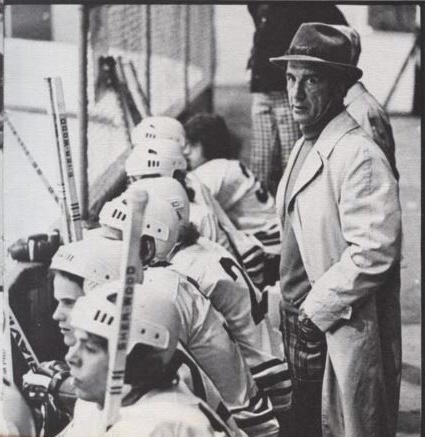
Ted Lindsay’s legendary hockey career with the Detroit Red Wings earned him the nicknames “Terrible Ted” and “Old Scarface.” Despite his fierce reputation, Lindsay built a tradition of respect and integrity within the hockey program at Hillsdale College, where he coached for four years.
Hillsdale College Athletic Director Don Brubacher said Lindsay was held in the highest regard as a player and representative for the Red Wings’ program.
“He was also held in that high regard as head coach here at Hillsdale College,” Brubacher said.
Lindsay died Monday, March 4, at his suburban home in Detroit at age 93.
He is survived by his three children, one stepdaughter, six grandchildren, and three great-grandchildren. Two of his children, Blake Lindsay and Lynn Lindsay LaPaugh, attended Hillsdale College.
His legacy as head coach of the Hillsdale College hockey team from 1974 to 1977 lives on through the lessons he taught his players.
Bob Barss ’77 said he met Lindsay when he was eight years old attending Lindsay and Marty Pavelich’s hockey school in Port Huron, Michigan.
“That’s how I got to know Mr. Lindsay,” Barss said. “And he became extremely close friends with my mother and father.”
When former Hillsdale College hockey coach Jim Drawbridge announced he was leaving, Barss said Blake Lindsay had a solution.
“The team is looking around, and Blake called his dad, and said, ‘Hey, can you come fill in for a couple of weeks while we look for a new coach,’” Barss said.
When Lindsay showed up, Barss said he gave the team a new set of rules.
“Lindsay told us, ‘You represent the school, you represent me, and you represent yourselves. Every game now, I want people to wear a coat and tie to games, and I want everyone to get a haircut,’” Barss said. “Back then everyone wore their hair a little long.”
Barss said the team was hesitant to cut their hair, but Lindsay made his point clear.
“Lindsay goes, ‘You don’t have to cut your hair, only if you want to play for me,’” Barss said. “Then he turned around and walked back out.”
The next day, Barss said everyone came back with a clean haircut.
“Everybody wanted to play for Mr. Lindsay,” Barss said.
Steve Veno ’77 played for Lindsay as a right wing and said Lindsay’s playing style did not come through in his coaching style.
“He was much more of a gentler and kinder person than the reputation he had when he played,” Veno said.
Steve Maggs ’76 played under Lindsay as a center for Hillsdale’s hockey team and was team captain his final two seasons. He said Lindsay always demanded professionalism and respect for one another.
“Integrity was incredibly important to him,” Maggs said.
Maggs added that Lindsay had an incredible work ethic, which earned him four Stanley Cup titles in his 14 seasons with the Red Wings. He was named to the All Star Team 11 times.
Lindsay was inducted into the Hockey Hall of Fame in 1966, but Maggs said Lindsay declined to attend the banquet because it was an all-male event.
“He didn’t attend because women weren’t allowed in the ceremony,” Maggs said. “That just goes to show his character.”
Lindsay played in 1,068 regular season games with the Red Wings and the Chicago Blackhawks. He scored 379 goals, 412 assists, and 851 points, adding 47 goals for 96 points in 133 playoff games.
Maggs said it was a great honor to play under Lindsay.
“We knew that he was a hall-of-famer,” Maggs said. “We all realized that having such a special person take an interest in our team was really something special.”
Craig Connor ’77 played as a left wing for Lindsay at Hillsdale College and said Lindsay was a patient and modest man despite his credentials.
“He was very fair and knew the game,” Connor said. “He was a very tough-minded and determined person.”
Standing just 5 feet and 8 inches, Lindsay wasn’t physically intimidating, but his five older brothers and three older sisters taught him how to play tough.
“He wasn’t a big guy,” Connor said. “But he played with a lot of heart and a lot of grit and determination.”
Both Connor and Maggs said they enjoyed when Lindsay would get the Hillsdale hockey team extra practice at Olympia, the Red Wings’ former arena.
“We would practice there with some of the former Red Wings he had played with,” Connor said. “Sometimes he’d get into games with them, and that was a lot of fun for me and a lot of the other guys.”
Maggs said the games were supposed to be “non-checking,” but Lindsay still played rough at times.
“He was still hitting pretty hard just to make a point to us that we may be younger, but he’s still tough,” Maggs said.
After practicing at Olympia, Maggs said Lindsay always made the team sweep the seats.
“There really wasn’t anything there to sweep,” Maggs said. “We had to pay something for that ice.”
Even when Lindsay was running an automotive business out of the Detroit area, Maggs said he would still drive into Jackson for practices twice a week.
“He still had a full-time job,” Maggs said. “It was a quite a commitment for him, and that always stood out in my mind, just that incredible work ethic. And I think that stuck with a lot of us.”
Maggs said Lindsay always showed up to the Hillsdale alumni games even after the program had ended.
“Ted always participated, or he was there on the bench,” Maggs said. “Even our last one, in September 2016, he was 90. But he was there opening the door for one of the teams.”
Both Connor and Maggs said Lindsay was very committed to the Hillsdale hockey program.
“It was an honor to play for him, and he was a good coach,” Connor said. “I learned quite a bit from him, not only about hockey, but about life.”
Barss said he and Lindsay shared lunch in 1995, and Lindsay discussed his successful efforts to form the NHL Players’ Association in 1967.
“He told me, ‘It was the hardest thing in the world to do because we had to keep this away from the owners. The other thing, that was just as hard, was I had to go talk to all of the key players on other teams, and they all hated me, they all hung up the phone whenever I called them,’” Barss said.
After a celebrated career, Barss said Lindsay considered forming the NHL Players’ Association as being one of the most important things he could have done for the game of hockey.
“I can count the people who have been great mentors in my life on one hand,” Barss said. “And Mr. Lindsay is one of them.”
