
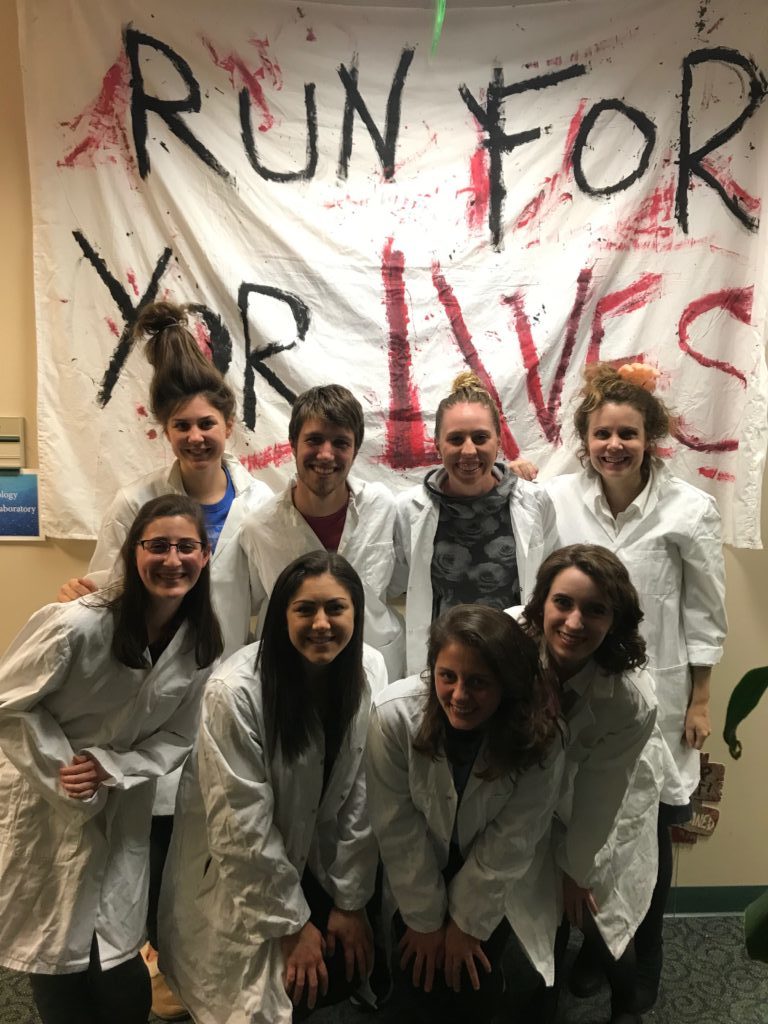
Converting ordinary research tools into spooky thrills, the psychology honorary’s “Haunted Lab” event last week featured attractions from zombie run therapy, to augmented-reality arachnids, to Temple Run travails.
About 50 students attended the Oct. 29 event, according to senior and Psi Chi Social Chair Taylor Bennett. The event was geared toward both psychology students and campus in general to raise awareness about the department’s relatively new laboratory equipment that is available for student research. The lab tools include augmented and virtual reality, exposure therapy, and sensory wristband technology.
The iFeel Alive Labs, one of the new tools introduced last year, involves biofeedback computer programs which are designed to help a person control stress responses through exposure to something that makes him or her feel tense or afraid. To add a Halloween-themed twist for the event, lab assistants had participants play “Temple Run” while wearing a monitor on their finger that detects increased heart rate.
“When you get stressed, the screen will go black,” senior and Psi Chi President Lucile Townley said. “You can only play the game when you’re calm.”
Participants also watched a “Criminal Minds” episode while wearing NeXus-10 biofeedback equipment that detects a change in the participant’s normal resting state.
“Every time there’s a jump scene, you see stress levels spike,” Townley said.
Townley noted one particular student who was using the NeXus-10 technology while talking about her comprehensive exams and saw dramatic graph activity as a result, signaling heightened stress levels.
Another particularly Halloween-themed part of the event were the augmented and virtual reality exhibits. Putting on virtual reality goggles is like jumping inside a video game, Townley explained, where one can look in all directions and see a completely virtual world. Augmented reality, in contrast, only changes one aspect of the participant’s environment. Event organizers used the augmented reality tool to create the illusion of spiders crawling around on an otherwise normal-looking table.
“I hate the augmented reality, because with virtuality reality you can say that it’s not real, but with augmented reality, everything looks real,” Townley said.
The lab also included several tests of dexterity and cognitive abilities, including the ability to trace an image in a mirror or to navigate through a maze while blindfolded.
Townley said the event will probably become an annual activity. She added that the psychology department is fortunate to have the equipment, and she credited Psychology department chairwoman Kari McArthur for her advocacy in improving the department’s research materials.
Psychology students can opt to complete either a practicum or research for their major, and four students, including Bennett and senior psychology major Molly Schutte, are currently completing research projects to fulfill the requirement. Schutte plans to use the Empatica E4 wristband for her project, which involves testing a person’s reaction to an event compared with his or her baseline state. Schutte explained that the wristband is similar to an Apple Watch, in that has two small electrodes on the back touching the wearer’s skin. The watch is able to pick up on bodily functions like heart rate, sweat, temperature, and arousal (a participant’s general reaction to an event). Schutte said the wristband helps the researcher to avoid extraneous anxiety that might skew measurements, as the tool is relatively non-invasive, compared with other equipment.
“We have some other equipment where you have to use tape, or it goes on your finger, or there are patches that go on your back to measure those different things, and it kind of puts you on edge because you’re like, ‘Oh my gosh I feel like I’m Frankenstein,’” Schutte said. “But the wristband is just really simple. You can get a lot of information while focusing on something else.”
Schutte also expressed gratitude for the opportunity to work with the department’s recently-acquired equipment.
“The fact that it’s available for students is huge because then you’re not limited in what you’re interested in studying, and you know you have things that can take you further,” she said. “It’s really impressive.”
