
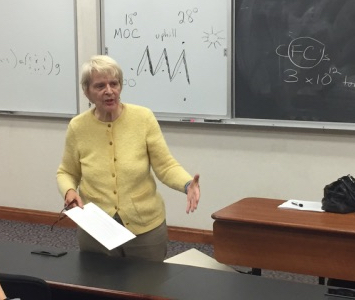
Accomplished planetary scientist Mimi Gerstell, PhD gave a public lecture Oct. 31 titled “Perspectives on Mars.”
Roughly 25 students attended the Astronomy Club talk during which she recounted a few anecdotes from her book “Fish Stories by a Scientific Nobody.”
Gerstell completed her undergraduate degree in mathematics at Harvard University and later earned her doctorate in planetary science from California Institute of Technology. She did not earn her PhD immediately after graduating from Harvard but said she had always intended to pursuit her doctorate.
“At a certain age, I thought, ‘Dear me, I’d always meant to get a PhD,’” Gerstell said. “It was like when you go to the grocery store and forget to grab something.”
Gerstell has since made significant contributions to the scientific community. She has worked among some of the leading experts in the field, conducted groundbreaking research, and written several books.
After receiving a donation solicitation from Hillsdale College, Gerstell reached out to Timothy Dolch, assistant professor of physics, to discuss the prospect of her speaking at the college.
“I read Imprimis, and they were asking for donations to the college,” Gerstell said. “This is what I’m giving. I hope I have enriched Hillsdale.”
Gerstell’s talk centered on her personal experiences dealing with the politics of the scientific community. She said anyone can read about the technicalities of her research in her published work, but she wanted to amuse listeners with her personal anecdotes and offer undergraduate students a glimpse of behind the scenes activity in scientific research.
She recounted one instance in which she learned of unexpected reasons for scientists to promote their work. Despite the fact that she had been unable to accomplish what she had hoped to with a study on the surface layers of Mars and her findings were therefore unremarkable, her boss was adamant that she explain them at a conference.
Gerstell later realized that her boss had two extraneous motivations for encouraging her to present. First, he was hoping that by presenting her data, she would attract attention to the scientist whose work she drew from and cited in her study. Second, her boss was a champion of women in science and wished to give her the opportunity to speak at the conference.
Another of Gerstell’s anecdotes demonstrated the fluctuations of popular scientific thought. She recalled that one paper she co-wrote, which suggested that sulfur dioxide in the atmosphere of Mars could have made possible the presence of running water on the planet’s surface at one time, was widely rejected at the time of its publication.
One scientist refuted Gerstell’s and the others’ claim on the basis that sulfur dioxide would not have been compatible with the planet’s surface level rocks, and their proposal faded into obscurity. Years later, when the prospect of running water on Mars in the planet’s early years gained ground, scientists revisited Gerstell’s team’s paper, and it emerged as a definitive source on the matter.
“Fashions wax and wane in the scientific universe,” she said.
Senior Philip Andrews found out about Gerstell’s lecture through Dolch, and appreciated learning about her experiences with politics of the scientific community.
“I enjoy listening to speakers from outside the school and learning that there are bigger issues out there,” he said. “It’s a great opportunity to take advantage of.”
Dolch, who earned his undergraduate degree at the California Institute of Technology and can relate to Gerstell’s experiences, said that the perspective she offered was invaluable given her exposure to some of the giants in science at Caltech.
“It was quite a treat,” Dolch said.
