
On a recent trip to Hillsdale, Annette Kirk, the wife of famed historian and author Russell Kirk, mentioned what she deemed “a Kirk revival” on campus. She said she saw many students who didn’t know about Kirk are starting to learn about who he was. And they’re becoming excited.
Oct. 19, 2018, marked the 100th anniversary of Russell Kirk’s birth — and in recognition, his family, professors, and students at Hillsdale College warmly remember the legacy of a man who loved Hillsdale College and greatly altered and defined 20th-century conservatism, earning the name “The Father of Modern Conservatism.”
Kirk’s daughter, Cecilia Kirk Nelson, said Kirk was a very kind father, who played with his daughters often and loved to take walks with them, plant trees with them, and tell them stories before bed.
“He wasn’t a hands-on dad, but he was very good with kids,” she said. “He was very kind.”
Nelson went on to describe how her father’s life and his work were intertwined. “One thing I really want people to know is that he was an integrated man,” she said. “Dedication and faithfulness to his family were a part of his philosophy. He was a very consistent man, and it is important that people know that about him.”
Having Kirk as a father, however, altered her youth. “We had lots of people visiting all of the time. There were lots of seminars with students. Many Hillsdale students visited even before the Kirk Center was founded. It’s always just been there, even since I was young.”
As for Mecosta’s various visitors, Nelson says there have been many throughout the years. She remembers one particular Croatian professor who came to Mecosta as a refugee when she was a child. Kirk let him stay at the house and study with him, offering him a place to stay and to raise his family. The professor stayed with them for some time, and his son, Ivan Pongracic, would later go on to teach economics at Hillsdale College.
Pongracic, currently a professor of economics at Hillsdale, remembers the time well. He said that his father had spent most of his life in Croatia (then Yugoslavia) dreaming of moving to the United States, and Pongracic shared that dream. It wasn’t until Pongracic’s father attended a conference at Grove City College that he finally met Kirk. Prior to travelling to Pennsylvania for the conference, Pongracic’s father had discovered Kirk’s books and articles, which made a profound impact on his thinking and person.
Pongracic said that when his father spoke to Kirk, an invitation to stay for a week turned into an offer for Pongracic’s father to study at Mecosta, leading to the family’s move to the United States. Pongracic called it the most profound and impactful moment of his life. And although he wasn’t old enough to appreciate Kirk as well as he wished he would, he says he doesn’t remember ever being intimidated by Kirk.
“He was a funny and somewhat mischievous man, taking any opportunity to come up with a clever joke in response to what someone said, followed by a big smile or a laugh with a twinkle in his eye,” Pongracic said. “Dr. Kirk made it possible for my family to become Americans, and for that he will always have my deepest gratitude. I will always remember him as a supremely kind and generous man. He was one in a million.”
It is because of this lovely and almost mystical character of Kirk that Mecosta, sometimes referred to as “Piety Hill,” is so magical. Alan Cornett, a historian and former assistant to Russell Kirk, said, “Entering Piety Hill has been well described as walking through the wardrobe into Narnia.”
Cornett went on to say, “Russell Kirk was not only America’s foremost expositor of conservatism, he was the very living embodiment of it. For Dr. Kirk, conservatism was not an ideology, but an inclination, a turn of mind and disposition. Piety Hill itself was an organic expression of Dr. Kirk and his vision of what conservatism should be.”
For students who don’t know of Kirk’s legacy, the Dogwood Society, led by senior Kaitlin Makuski and sophomore Isaac Kirshner, is raising awareness of is raising awareness of Kirk on campus. Lecture series, articles, and word-of-mouth has spread news of Kirk around campus like subtle wildfire.
Isaac Kirshner, Vice President of the Dogwood Society, spoke about the recent resurrection.
“The Dogwood Society has been here at Hillsdale for 26 years now, and what we’re seeing now is a reanimation and elevation of the American Studies major that has otherwise been dormant for a while now,” Kirshner said.
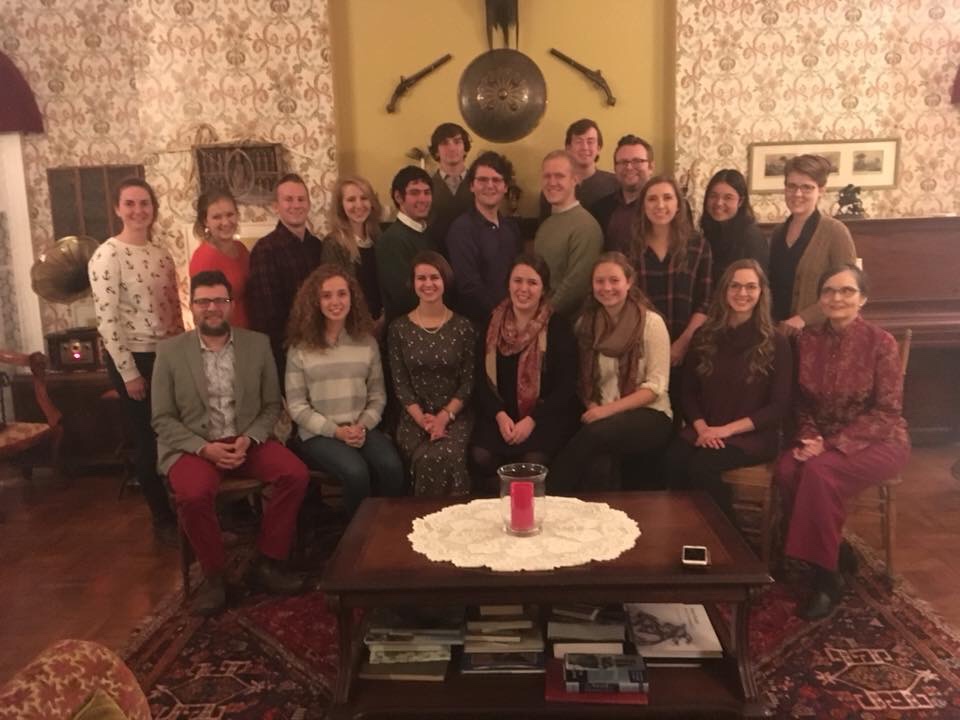
The Collegiate Scholars Program travels to Kirk’s home in Mecosta each fall.
Started by Professor of History Richard Gamble, who is friends with Russell Kirk’s wife, Annette, the Mecosta trip has been an ongoing part of the Collegiate Scholars Program for a long time. Associate Professor of Classics Eric Hutchinson, the director of the program, has continued the tradition in his three years as the director thus far.
“The trip is one of the real perks of being in the program,” Hutchinson said. “I look forward to it every semester. It’s great.”
For four days, students attend a total of six seminars over the course of two days. Although the lectures do not center around Kirk, Hutchinson says that they try to incorporate some of Kirk’s works into the series. The real fun of Kirk in Mecosta, Hutchinson says, is the time the students get to spend with Annette Kirk.
“They get connected with her and get to hear a lot of stories about his work,” Hutchinson said. “They love it.”
Isaac Kirshner, vice president of the Dogwood Society and a student who is traveling to Mecosta, said he loves Piety Hill and the Kirk family.
“The Kirks’ home of Piety Hill is the closest place to Rivendell that I can think of. There, students can spend ample time learning and meditating on the great ideas of the West and their gracious champion, Russell Kirk,” Kirshner said.
Centered around a central theme which governs conversation, the seminars are an hour and a half each and require no paper or exam to follow them. This is something Hutchinson loves and thinks is really important about the program.
“It makes the lectures fun because people are doing the work simply because they want to,” Hutchinson said. “There is nothing else to get out of it other than what it can give you.”
Hutchinson says that the program is about more than just becoming better students. Rather, it is the pursuit of becoming self-educators and gaining knowledge that pushes the individual towards virtue. As Kirk says in the “The Imaginative Conservative,” the purpose of a liberal education should be to cultivate the individual’s intellect and imagination for the sake of the person.
Hutchinson agreed.
“One of the things a good education will do is help the student who has experienced it learn how to learn. That’s what’s really important. If the student can learn how to do that, the world is their oyster.”
As for the lasting impression and continued education that Kirk and his ideas leave on students, Michael Lucchese ‘18 was deeply affected by Kirk as a student. Lucchese said he now attempts to live his life in accordance with Kirk’s principles.
“In this period of late modernity, everyone seems to be living rootless lives,” Lucchese said. “Russell Kirk is important for young people now more than ever because he can teach us how to lay down lasting roots, both in his scholarship and through the example of his life.”
