
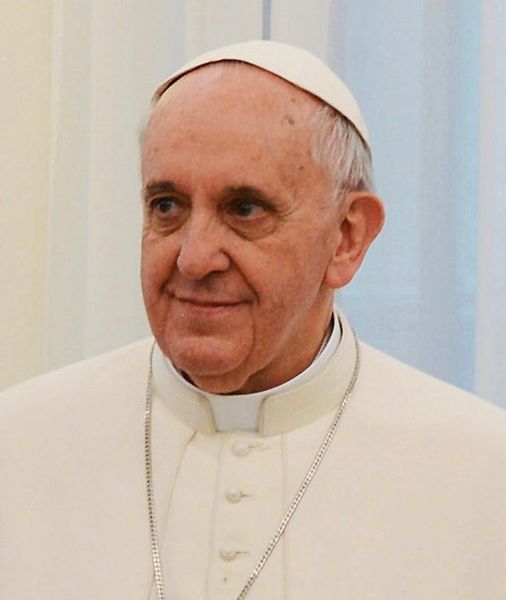
“The more power one has, the more one must be willing to serve,” Pope Francis says early on in “God Is Young,” a book-length interview published in Italian this past March.
The English version of the interview only became available on Oct. 2, in conjunction with the Catholic bishops’ “Synod on Young People.” Francis agreed to the interview in part to explain how he hoped the synod would unfold. Within it, he provides an open and guiding spirit to the topics he believes the synod should cover, the environment and technology in particular. But Francis takes special care to remind leaders in “God Is Young” to think about caring for the weakest in their societies — especially the very young and the very old — in 2018 and beyond.
Francis has preached humility ever since he took office in 2013, and “God Is Young” is no exception. But here, more so than in other parts of his papacy, Francis focuses on spiritual purity as the concept that unites young and old in resisting—and with the help of God, defeating—the abuses committed by those in power.
The pope begins by laying out fifteen spiritual diseases that those in power are most susceptible to contracting, and points out how they hurt both one’s relationship with others and with God. Although he originally wrote them out for members of the Curia, Francis says he believes that they apply just as well to secular leaders.
The first of these diseases Francis calls “spiritual Alzheimer’s,” meaning that it causes one to forget that the path of salvation comes through a “personal romance” with the Lord. Leaders blind to the need for a relationship with God will inevitably fall prey to overpowering desires to possess and control lower goods.
“It happens in particular to those who live hedonistically, to those who are slaves to their passions, their whims, their manias, their phobias, their instincts, at times the lowest and most squalid,” Francis says.
A little further down the list, Francis identifies a disease he calls “existential schizophrenia.” It afflicts those—often administrators—who look after the affairs and welfare of large groups of people but live rotten personal lives, à la Dorian Gray.
“It is the disease of those who lose touch with reality, with actual people, and become simple administrators of bureaucratic matters,” Francis says. “These people create their own parallel world where they set aside everything they sternly teach others and begin to live a hidden and often dissolute life.”
All of the diseases, Francis concludes, stem from the root desire to transform service into power. This perversion turns self-sacrificial love into the love of self-satisfaction—insatiable, and eventually deprives the individual of his ability to serve others. It is the disease that turns the shepherd into predator, and it most often attacks those in public service
This disease, Francis says, is nurtured by an individual’s vanity, making it the hardest to unravel. Drawing on an example from the Desert Fathers, Francis compares vanity’s effect on the soul to an onion: peeling back layer after layer of deceit only reveals another layer of deceit. And even when it’s all gone, the sharp odor remains.
Through this constant enfolding of a society into its leaders’ faults, vanity in a leader can corrupt the whole institution.
“Vanity is a soap bubble,” Francis says. “Being vain is hiding behind a mask.”
But the abuses of the powerful should not deter young people from wanting better leaders, Francis encourages his audience. Corruption is a middle-aged illness, contracted by people who have become jaded by the past failings of the institution they serve.
Francis sees this self-perpetuating problem and warns young people not to fall victim to become complacent.
“Young people must not accept corruption as if it were any other sin, they must never grow used to corruption, because what we let slide by today will reoccur tomorrow, until we adapt to it and become an indispensable cog in its wheel,” he says.
The pope is right: Only those who refuse to accept living with unaddressed atrocities as normal can uproot corruption. And it is good that Francis has extended his advice beyond the Curia—maybe someone will listen.
Nic Rowan is a senior studying history.
