
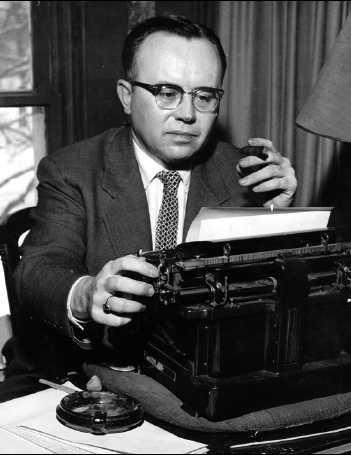
“Every single thing Russell touched became magical,” Annette Kirk said of her husband, the late historian and conservative thinker, Russell Kirk.
In a tribute to Russell Kirk’s long-lasting influence on both conservatism and Hillsdale College, Annette visited Hillsdale and spoke there on Wednesday, along with Alan Cornett, a long-time friend of the Kirks; Professor of History Brad Birzer, who holds the Russell Kirk Department Chair; and prominent author and scholar Gleaves Whitney.
Since his passing, Annette has carried on her husband’s work, becoming a spokesperson for his thoughts and writings and passing them on to the next generation through the Russell Kirk Center.
Even before she met Russell, Annette said she was involved in politics. She was one of the “Goldwater Girls” and followed former President Ronald Reagan’s presidency closely. After marrying Russell, Annette said she “cleared the desk for him so he could do his work.” Cornett said Annette handled the logistics, scheduling lectures at various universities and contacting publishers — all while raising four daughters.
“Annette is just as interesting as her husband,” Birzer said. “Her legacy is equally as strong.”
Annette Kirk said that Russell never expected to become the face of a new kind of conservatism. When he wrote “The Conservative Mind,” he did not expect it to do well because “there wasn’t a conservative presence, let alone a mind.” Regardless, he submitted it to his publisher and noted that the book was his “contribution to the endeavor to conserve the intellectual and spiritual” facets of conservative thought.
“He gave the movement its name, its identity, its genealogy,” Annette said, recalling a New York Times review of the best-selling book.
She said that what made Russell’s movement different than others at the time, was its literary and historical tradition. Unlike the political and economic conservative ideas centered in policy, Russell Kirk was concerned with culture, but not in regards to social questions.
Rather than focusing on political gain, Russell Kirk was concerned with the permanent things. He was often called sentimental, Annette said, but he believed a “world without love is hollow.” This, more than anything, set Russell apart, she said.
“No matter how people felt about conservatives, they all liked Russell,” she said.
Birzer said this dedication to “living what they professed” struck him the most: “His example of living the Christian life will be most remembered.”
Even now, Annette said she wants to “keep Russell above the fray.”
Russell Kirk defined conservatism as a “disposition and a way of being, not an ideology, ” Annette said. This distinguishes him from other conservative thinkers, and Cornett said it will make him more important in the days to come.
“With the rise of Trump, there will be a lot of reevaluation,” Cornett said. “And I think they’ll go back to Kirk.”
Russell Kirk is renowned for his work in fiction, as well as in history and philosophy. His short stories are just as important and influential as “The Conservative Mind,” Birzer said. These works allowed Russell Kirk to “let his imagination loose,” which Birzer said is the “ultimate manifestation of conservatism, outside charity.” Imagination is the expression of the individual human person and storytelling is the only way human beings can truly understand permanent truths, Birzer said.
“Kirk isn’t just a conservative, he’s an imaginative conservative. And that’s different,” Birzer said. “And Kirk would never want anyone to be a Kirkian. There’s no such thing as a Kirkian. There’s only you and who you are as an individual.”
