
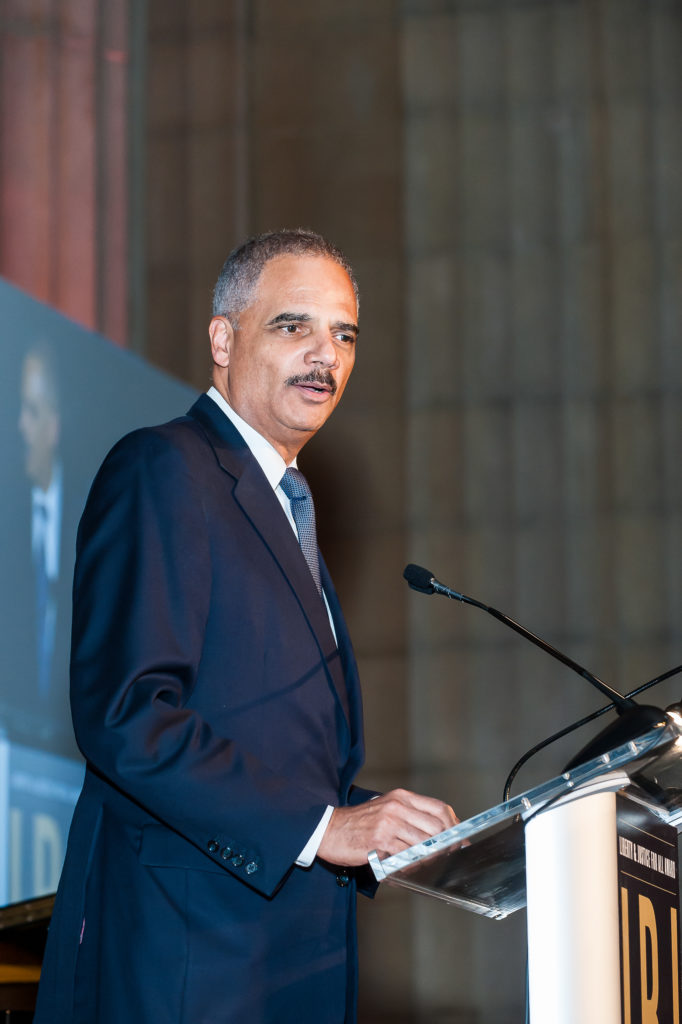
Democrats on a national level are taking an interest in Michigan state politics. “In Michigan, the current electoral system is unfair and is so rigged that politicians can now pick their voters, instead of allowing citizens to choose their representatives,” Eric Holder, former President Barack Obama’s Attorney General, said. Holder’s national Democratic redistricting group, “Voters Not Politicians,” recently announced a $250,000 donation to support the passage of Proposal 2, a Michigan ballot initiative that would take the power of redistricting away from state lawmakers and give it to an independent commission.
Holder claims congressional redistricting practices have become partisan and undemocratic. But their solution is worse: It takes power out of the hands of the people and puts it into the hands of the unelected and unaccountable. Because of this, Michigan voters should reject Proposal 2.
Partisan gerrymandering is wrong because it is undemocratic, the Democrats argue. Why then do they want to get rid of it in an undemocratic way? Elections are the way citizens of a democracy express their opinions. If the independent commission becomes biased, who is going to hold it accountable? The voters will have lost this power.
Proposal 2 gives redistricting power to a 13-member commission of four Democrats, four Republicans, and five Independents, randomly selected from a pool of applicants deemed qualified by Michigan’s secretary of state. The commission would supposedly produce maps that will not give an advantage to either political party.
Initiatives like this have been tried in several other states and the results show that they do not necessarily reduce partisan fighting. Both of Arizona’s commision-drawn political maps, for example, were taken to court, first by Democrats in 2002 and then by Republicans in 2010. There is no normative or easy way to draw congressional district lines, regardless of who is doing the drawing.
It is also difficult to prove whether a map is unduly partisan. In the most recent Supreme Court case on the issue, Benisek v. Lamone, Chief Justice John Roberts said a proposed test, meant to determine if a district had been unfairly gerrymandered, was a “sociological gobbledygook.” The Court unanimously rejected the challenge to both Wisconsin’s and Maryland’s district maps because they said the maps were not so partisan as to infringe upon the people’s constitutional rights of representation. Putting the responsibility of redistricting into the hands of an unelected commission will not change that.
A new working paper by researchers at University of California Los Angeles and Yale University suggests that commission-drawn maps actually made districts less competitive or more partisan than maps drawn by state legislatures. Because of this, the researchers — John Henderson, Brian Hamel, and Aaron Goldzimer — suggest caution in overhauling the political redistricting process. “[Independent commissions may not be as politically-neutral as theorized,” the researchers stated.
Democrats mistakenly believe that an unelected commission will be less biased than elected officials in drawing congressional jurisdiction lines. This kind of faith stems from the old progressive myth that neutral experts are possible. This does not take into account the tendency in human nature to choose sides. People are partisan and political by nature — even independent commissions. Proposal 2 dilutes democracy, the very thing Democrats claim they want to fix. Instead of working within the bounds of normal politics, they are seeking to circumvent the system.
Proposal 2 bypasses the political process and the rule of the people. Democrats that do not like how Michigan state house members redistrict should work to get them out of office in the next election. That is true democracy.
Krystina Schurk is a student at the Van Andel Graduate School of Statesmanship.
